How to Reduce Customer Churn with an AI-Powered Playbook
SynthAI Team
Content Team
To genuinely tackle customer churn, you first need to understand *why* your customers are leaving. This means digging into your product usage data and listening to what they're telling you directly. Only then can you build targeted solutions—like a killer onboarding flow or proactive support—that actually keep them around. This playbook is all about moving past the guesswork and building a data-driven system to boost customer retention.
Finding the Leaks in Your Customer Bucket
Before you can fix a leaky bucket, you have to find the holes. It’s the same with churn. Figuring out why it’s happening is the critical first step. Relying on gut feelings is a recipe for wasted effort. You need a combination of hard numbers and real human insights to get the full picture and turn churn from a dreaded metric into your most valuable signal for improvement.
The most effective way I've found to do this is by blending quantitative and qualitative data. Each one tells half of the story.
* **Quantitative Data (The "What"):** This is all about product usage. Think login frequency, feature adoption rates, and support ticket volume. This data shows you exactly *what* customers are doing—or, more importantly, *not* doing—inside your product.
* **Qualitative Data (The "Why"):** This is where you get the context. It comes from exit surveys, cancellation feedback, support chat transcripts, and even just picking up the phone and talking to churned customers. This uncovers the *why* behind their actions—the frustration, the missing feature, or the unmet promise.
Uncovering Hidden Patterns with Cohort Analysis
Once you have this data, the real work begins. One of the most powerful tools in any retention expert's toolkit is **cohort analysis**. This isn't just about looking at your overall churn rate. It's about grouping customers who signed up around the same time (say, the "January 2024 cohort") and tracking their behavior as a group. This approach helps you spot patterns that are completely invisible when you're just staring at a single, top-level number.
For instance, you might run a cohort analysis and make a game-changing discovery: customers who don't use your "reporting" feature within their first **30** days have a **75% higher churn rate** by day 90. That's a huge insight. It tells you, clear as day, that your reporting feature is a key indicator of long-term value and stickiness.
> Finding these "magic moments"—the key actions that correlate with high retention—is the primary goal of your churn diagnosis. It gives you a specific, high-leverage target for your retention efforts.
You can actually use SynthAI’s Vantage assistant to automate this heavy lifting. After connecting your data sources, you can ask it plain-English questions like, "Show me the churn rate for users who invited a teammate versus those who didn't." Vantage might come back and show you that customers who invite at least one teammate in their first week are **50% more likely to stay**. Just like that, you have another concrete action to drive during onboarding.
From Diagnosis to Actionable Insights
Your diagnostic process shouldn't just end with a list of problems. It needs to produce a set of testable hypotheses. Don't just identify the issue; frame it as an opportunity you can act on.
Here’s a real-world example of how this plays out:
* **Observation:** Our cohort analysis shows users who never integrate with a third-party app churn at twice the average rate.
* **Hypothesis:** If we guide new users to set up at least one integration during onboarding, we can reduce first-month churn.
* **Action:** We'll build a new in-app checklist using SynthAI's Axis assistant. It will highlight the integrations and trigger an email from Lumen with a helpful guide if the user hasn't connected an app within three days.
See how that works? You move from simply measuring churn to actively preventing it. By finding the specific friction points and "aha!" moments in your customer journey, you can stop guessing and start building targeted solutions that directly address the root causes of why customers leave.
To get you started, here’s a quick rundown of the essential metrics to track and how SynthAI’s tools can help you turn that data into action.
Key Churn Metrics and Diagnostic Tools
This table summarizes some of the most important metrics for diagnosing churn and which SynthAI tools are best suited for the job.
| Metric | What It Measures | SynthAI Assistant | Actionable Insight Example |
| :--- | :--- | :--- | :--- |
| **Feature Adoption Rate** | The percentage of users actively using key features. | Vantage | Users who adopt Feature X have a **40%** higher LTV. |
| **Time to First Value (TTFV)** | How long it takes a new user to get their first "win." | Axis & Vantage | Reducing TTFV by one day correlates to a **5%** drop in churn. |
| **Login Frequency** | How often users are logging into your platform. | Vantage | A **30%** drop in logins over 14 days is a strong churn predictor. |
| **NPS/CSAT Scores** | Customer satisfaction and loyalty ratings. | Pax & Lumen | Customers with low CSAT scores churn **3x** more often. |
By keeping a close eye on these metrics, you’re not just tracking numbers—you’re building a deep, empathetic understanding of your customers' experience, which is the foundation of any successful retention strategy.
Building an Unforgettable First Impression
Your best defense against churn isn't a last-ditch save offer; it's a world-class first impression. I’ve seen it happen time and again: companies lose customers before they’ve even had a chance to win them, all because the initial experience is confusing, empty, or just plain overwhelming.
Think of your onboarding process as your secret weapon for cutting down churn from day one. This isn't about firing off a single, generic "welcome" email and crossing your fingers. It’s about creating a carefully designed journey that guides each new user to their first “aha!” moment—that critical point where they truly get why your product is valuable. The faster you can get them there, the more likely they are to stick around.
This diagnostic process is what helps you pinpoint the key actions that signal a successful start for your users.
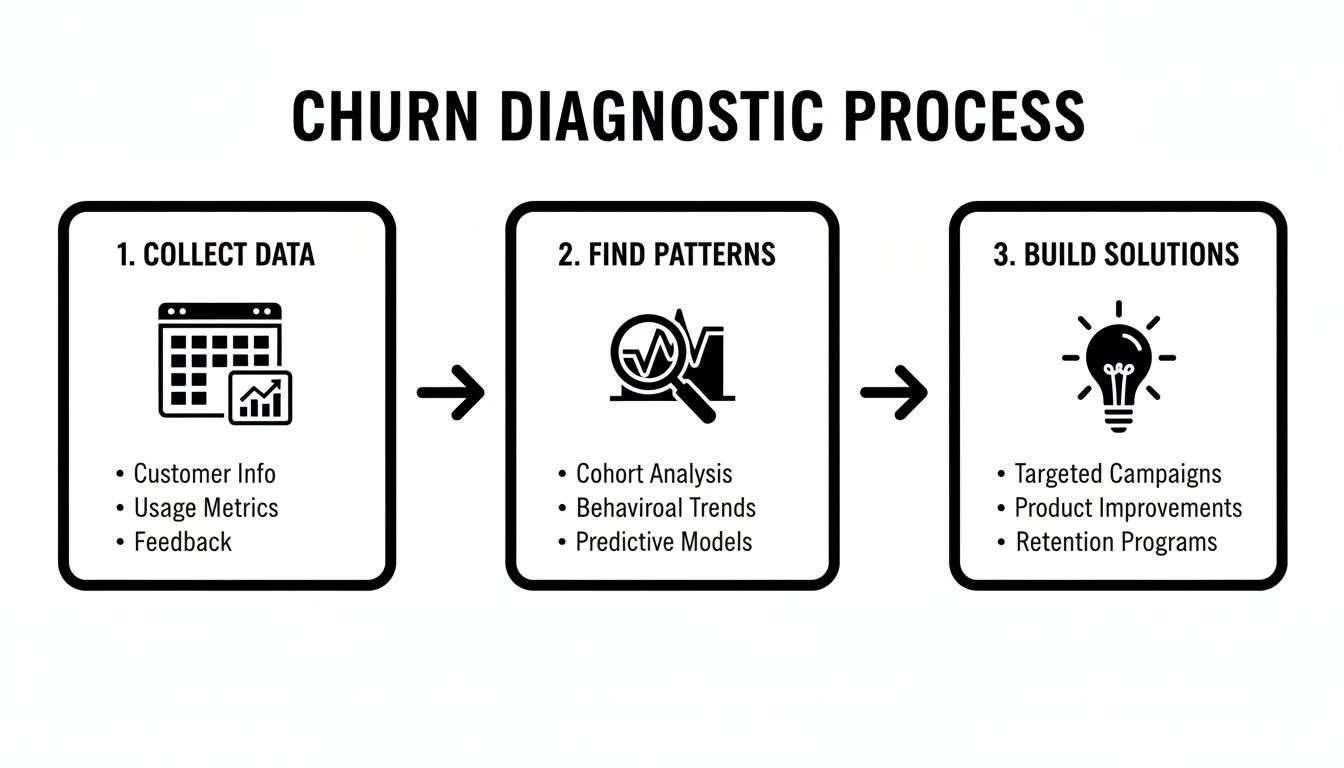
This simple flow—collecting data, finding patterns, and building solutions—is the bedrock for designing an onboarding journey that actively stops churn before it starts by focusing on what actually matters to new users.
Crafting a Multi-Channel Onboarding Workflow
A powerful onboarding experience feels personal and shows up at just the right time, meeting users exactly where they are. Imagine a coordinated, multi-channel workflow powered by an AI team like SynthAI’s assistants. It might look something like this:
* **Immediately After Sign-up:** The Lumen assistant sends a personalized welcome email. It doesn’t just say "thanks"; it highlights the one key action they should take first, based on their sign-up data.
* **First Login:** The Axis assistant triggers an interactive, in-app product tour. This isn't a static video; it's a guided walkthrough that responds to what the user actually does, ensuring they learn by doing.
* **Day 3:** The Pax assistant sends a proactive check-in via email or chat. It asks a simple, direct question: "Have you been able to achieve initial goal yet?" This small touch shows you’re invested in their success.
This kind of coordinated approach ensures no customer falls through the cracks. It replaces disjointed, manual efforts with a seamless, automated system built to create momentum and confidence during those crucial first days.
> The goal of onboarding is to turn a new user's initial curiosity into tangible confidence. Every interaction should build momentum toward their first meaningful win with your product.
The Power of AI-Driven Personalization
The real game-changer in modern onboarding is AI-driven personalization. Instead of a one-size-fits-all journey, AI can dynamically adapt the experience for each user. For instance, if Axis notices a user is struggling with a particular feature, it can trigger Lumen to send a targeted email with a video tutorial on just that topic. This level of personalization makes customers feel seen and supported.
The data absolutely backs this up. Businesses using AI to personalize experiences and anticipate customer needs have seen up to **20% higher retention rates**. What’s more, when companies deploy coordinated, AI-powered communications, they can achieve a **30% improvement** in customer retention. For e-commerce stores, this goes even further, with personalized recommendations accounting for roughly **31% of total revenue** for top brands. It’s a direct link between personal engagement and business growth. You can dive deeper into these findings on the impact of AI on customer retention to see how it applies to your own business.
This approach transforms onboarding from a static checklist into a responsive, intelligent conversation. It’s all about providing the right guidance, at the right moment, through the right channel.
Setting Up Your Automated Onboarding
Creating this automated journey with a platform like SynthAI is surprisingly straightforward. First, you connect your tools—your CRM, email platform, and website. From there, you just need to define the key milestones of your ideal customer journey.
* **Map the "Aha!" Moment:** Start by identifying the core action that delivers that first taste of value. What’s the one thing a user needs to do to *get it*?
* **Define Triggers:** Next, set up rules for what happens when a user signs up, logs in for the first time, or uses a specific feature.
* **Build the Workflow:** Finally, use a coordinator like Nexus to orchestrate the assistants. Tell Lumen what email to send, Axis what tour to show, and Pax when to check in.
By automating this process, you guarantee that every single customer gets the same high-quality, supportive introduction to your brand. This consistency is vital for slashing early-stage churn and building a solid foundation for long-term loyalty.
Spotting At-Risk Customers Before They’re Gone for Good

Here's a hard truth: most customers don't send a farewell email before they cancel. They just... fade away. This quiet disengagement is one of the toughest parts of fighting churn, but it’s also your single biggest opportunity to be proactive. The real trick is learning to spot the subtle warning signs long before they’ve mentally checked out.
Instead of just waiting for the cancellation notice to hit your inbox, you can build an early-warning system. By analyzing behavioral data, you can identify customers whose actions are practically screaming that they're losing interest or running into trouble. This isn't about guesswork; it's about learning to read their digital body language.
Creating a Customer Health Score
A really effective way to quantify this risk is by creating a **customer health score**. This isn’t just another metric. It’s a dynamic score that gives you a real-time pulse on a customer's engagement and overall satisfaction, built from multiple data points.
Think of it as a credit score, but for customer loyalty. A high score means you have a happy, active customer who's likely to stick around. A dropping score is a huge red flag that it's time to step in and help.
You can use an analytics tool like SynthAI’s Vantage assistant to automatically build and watch these scores for you. Vantage plugs right into your product analytics, CRM, and support tools to analyze all the crucial signals happening in the background.
Some of the most telling signals to bake into your health score are:
* **Declining Login Frequency:** This is a classic. A customer who used to pop in daily but now only shows up once a week is drifting away.
* **Reduced Feature Usage:** Are they using fewer of your core features than they were last month? This is a strong sign they aren't getting the full value they’re paying for.
* **A Drop in Support Tickets:** It sounds counterintuitive, but a sudden silence from a user who used to ask for help can be a bad sign. It often means they've just given up and are quietly looking for other options.
* **Unresolved Support Issues:** Nothing screams "I'm frustrated" louder than an open support ticket or a low satisfaction rating on a recent interaction. This is a direct path to churn.
> A customer health score transforms churn prevention from a reactive fire drill into a proactive, data-driven process. It tells you exactly who needs your attention and why, allowing you to focus your efforts where they'll have the most impact.
By combining these signals, Vantage can automatically tag an account as "At-Risk," "Needs Attention," or "Healthy." This gives your team a clear, prioritized list of who to reach out to first.
Launching Automated Rescue Missions
Once a customer is flagged as being at risk, the clock starts ticking. This is where automation becomes your best friend, helping you launch immediate, personalized "rescue missions" that can scale to your entire user base. With a platform like SynthAI, you can orchestrate a multi-channel response without anyone having to lift a finger.
The Nexus coordinator is the brains of this operation. When Vantage flags an at-risk account, Nexus can instantly kick off a pre-defined workflow. For a SaaS user whose engagement has dipped, that workflow might look something like this:
1. **The Trigger:** Vantage detects a **30% drop** in a user's weekly activity and tags them as "at-risk."
2. **The Automated Email:** Nexus immediately tells the Lumen assistant to send a personalized email. This isn't some generic "we miss you" message. Instead, it might be a genuinely helpful guide titled, "3 Underused Features for Teams Like Yours," directly addressing their likely reason for disengaging.
3. **The Internal Alert:** At the same time, Nexus uses the Axis integration to send a Slack notification to the assigned customer success manager. The alert gives them instant context: "Customer X's health score just dropped to 45 due to low feature usage. Lumen sent them a guide. Suggest scheduling a check-in call."
This kind of coordinated response is fast, relevant, and infinitely scalable. It makes sure no at-risk customer slips through the cracks and arms your team with the context they need to have a meaningful conversation.
For an e-commerce brand, a similar workflow could work wonders for re-engaging a one-time buyer who has gone quiet. If they haven't made a second purchase within **60 days**, Nexus could trigger Lumen to send a friendly "we've missed you" email that includes a small, personalized discount on a product related to their original purchase. It's a simple, incredibly effective way to encourage that crucial second sale and start building a loyal customer.
Delivering Support That Makes Customers Stay
Nothing tanks a customer relationship faster than slow, frustrating, or just plain unhelpful support. You can have the best product in the world, but if getting help feels like a chore, customers start asking themselves if it's really worth the hassle. That's a question you never want them to ask.
The truth is, most support teams are stretched thin. They're buried under a mountain of repetitive questions, which means the more complex issues—the ones that really need a human touch—get stuck in a queue. This is where augmenting your team with AI becomes a game-changer. It’s not about replacing your experts; it’s about freeing them up to be brilliant.
Your 24/7 First Responder for Instant Answers
Imagine a team member who’s always online, never gets tired, and has the answer to your most common questions memorized. That’s exactly what an AI assistant like SynthAI's Pax brings to the table. You can plug it directly into your website chat, help center, or even your app to act as a 24/7 first responder.
By training the AI on your knowledge base, product docs, and past support tickets, it learns to deliver instant, accurate answers. The impact is felt immediately.
Think about a typical e-commerce store constantly fielding "where is my order?" (WISMO) questions. With Pax integrated, those queries get handled automatically in seconds.
* **Before Pax:** A customer waits hours—maybe even a full day—for an agent to manually look up their order status. Frustration builds.
* **After Pax:** The customer opens the chat widget, asks the question, and instantly gets a tracking link and delivery estimate. Problem solved.
This simple shift turns a major point of friction into a moment of delight. It also dramatically cuts down your team's workload and shrinks response times from hours to mere seconds.
> The goal here is to resolve customer issues with speed and consistency. When you do that, support stops being a cost center and transforms into a powerful retention engine.
Augmenting Human Experts, Not Replacing Them
The real magic of AI in support is its ability to take over the high-volume, low-complexity tasks. This frees up your human agents to focus on the high-stakes issues where they truly shine—the problems that require empathy, creative problem-solving, and strategic thinking. Those are the conversations you want your best people having.
When an AI assistant like Pax handles the initial triage, it can either resolve the issue on the spot or intelligently escalate it to the right person, passing along all the context. This seamless handoff means the customer never has to repeat themselves, and your agent can get straight to the solution.
The data speaks for itself. AI-enabled customer service teams have been shown to resolve issues **44% faster** and see a **35% increase in the quality and consistency of support**. These aren't just vanity metrics; they lead to real results. Some companies report a **25% jump** in customer satisfaction just by providing quicker, more accurate answers. You can find out more about AI's impact on business efficiency to see the bigger picture.
By building this hybrid model, you create a support experience that is both incredibly efficient and deeply human. Customers get instant help for simple questions and expert guidance for complex ones. It’s this two-pronged approach that builds the kind of loyalty that makes customers stick around for the long haul.
Bringing Lapsed Customers Back from the Brink

It’s tempting to see a churned customer as a closed chapter. A lost cause. But I’ve learned that a churned customer is rarely just a loss—they’re a huge opportunity. They already know your brand, have hands-on experience with your product, and their reason for leaving is pure gold in the form of feedback.
A smart, automated win-back campaign can claw back a surprising amount of that revenue you thought was gone for good. The goal isn't just to spam every lapsed user with a 20% off coupon. It’s about re-engaging them with the *right* message at the *right* time, using their past experience as the very reason to come back. Don’t forget, boosting retention by just **5% can increase profits by anywhere from 25% to 95%**. Winning back an old customer is almost always cheaper than finding a new one.
Segment Your Churned Customers First
Before you write a single email, you have to segment your churned customers. Why? Because a one-size-fits-all approach is a recipe for failure. People leave for all sorts of reasons, so your outreach needs to reflect that.
This is where a tool like SynthAI’s Vantage assistant becomes your best friend. Hook it up to your CRM and billing system, and it can automatically sort churned users into a few critical buckets:
* **High-Value Champions:** These were your power users. They spent good money but left, maybe because of a missing feature or one bad support interaction. They should be your absolute top priority.
* **Price-Sensitive Users:** Did they churn right after a price hike? Or did they always stick to your cheapest plan? A sharp, compelling discount might be all it takes to bring them back into the fold.
* **Feature-Gap Leavers:** Their cancellation feedback or product usage data tells a clear story: your product just didn't do what they needed it to do *at that time*.
* **Involuntary Churners:** This is the low-hanging fruit. Their subscription simply failed to renew because of a credit card issue. They never actually decided to leave you.
> A churned customer isn’t gone forever; they're just waiting for a compelling reason to come back. Your job is to find that reason, package it perfectly, and deliver it at just the right moment.
Once you know *who* left and *why*, you can stop guessing. A high-value champion might get a personal note from a founder, while a price-sensitive user gets that perfectly timed discount.
Automate the Win-Back Journey
With your segments ready, it's time to build automated workflows that do the heavy lifting. Using an AI coordinator like Nexus, you can orchestrate a multi-channel campaign that runs entirely on its own, so no opportunity slips through the cracks.
Let’s walk through a real-world example. Imagine a "Feature-Gap Leaver" who canceled three months ago because you didn't have a specific integration. Well, you just shipped it.
1. **The Trigger:** The moment the new feature goes live, Nexus identifies every customer in that specific segment. This becomes the trigger.
2. **The Personalized Email:** Nexus immediately tells the Lumen assistant to craft and send a personalized email. The subject line could be something like, "That feature you asked for is here." The email body doesn't just announce the feature—it directly connects it to their past problem and includes a special "welcome back" offer.
3. **The Hyper-Targeted Ad:** At the same time, Nexus pings the Aura assistant, which adds this same customer segment to a retargeting audience on Meta and Google. For the next two weeks, those users see ads that show off the new integration, reminding them of the value they were missing.
This multi-touch approach is worlds away from a generic "we miss you" email. It's targeted, timely, and genuinely helpful.
Measure What Matters and Iterate
You can't improve what you don't measure. The final piece of the puzzle is tracking your results to see what’s actually working. The Vantage assistant can pull this all together into a clear dashboard that shows the true impact of your win-back campaigns.
You'll want to keep a close eye on a few key metrics:
* **Win-Back Rate:** Of the churned customers you targeted, what percentage actually came back?
* **Cost Per Reactivation:** How much did it cost in discounts or ad spend to win back each customer?
* **Post-Reactivation LTV:** This is the big one. Are the customers you win back actually sticking around and becoming valuable again, or are they just churning a second time?
By analyzing this data, you can see if your discount for price-sensitive users is truly profitable or if your ads targeting old champions are hitting the mark. This feedback loop allows you to constantly tune your offers, messaging, and timing, turning your win-back program from a hopeful experiment into a predictable revenue machine.
Your Burning Questions on Customer Churn Answered
As you dig into reducing churn, you'll quickly move from theory to real-world questions. This is where the rubber meets the road. Let’s tackle some of the most common ones I hear with direct, no-fluff answers to get you moving with confidence.
What Is a Good Churn Rate?
The honest answer? It depends. There's no magic number that fits every business, as benchmarks swing wildly depending on your industry, model (B2B vs. B2C), and even your company's age. But you absolutely need a target to know if you're winning.
For a little context, here are some general guidelines I've seen:
* **Established B2B SaaS:** An annual churn rate of **5-7%** is often considered top-tier.
* **SaaS Serving SMBs:** Here, a monthly churn of **3-7%** is more typical, as smaller businesses can be more volatile.
* **Subscription E-commerce:** A monthly rate of **3-5%** is a really solid goal to aim for.
> The most important benchmark isn't some industry average; it's your own historical performance. The real goal is to consistently beat *your* last quarter.
SynthAI's Vantage assistant can give you a better feel for this by benchmarking your numbers against anonymized industry data. This gives you a much clearer picture of where you stand and what's actually possible for a company like yours.
How Long Before I Try to Win Back a Churned Customer?
Timing is everything here. Jump in too soon, and you can look desperate. Wait too long, and they’ve moved on and forgotten you. The "right" time really boils down to *why* they left.
For instance, if a customer churned over price, a compelling offer sent within **30-60 days** can work wonders. But if they bailed because of a missing feature? You're better off waiting until you've actually shipped it. That way, your message becomes a powerful "You asked, we listened," not just an empty plea.
We've found a timed sequence, managed by SynthAI's Lumen assistant, is the most effective approach. It might look something like this:
1. **Day 7:** A short, simple survey asking for their honest feedback on why they left.
2. **Day 30:** If the reason was price-related, hit them with a targeted "welcome back" offer.
3. **Day 90:** Send an update showing off the new features and improvements you’ve made since they've been gone.
This automated flow ensures you're re-engaging with purpose, not just shouting into the void.
Can Automation Reduce Churn Without Sounding Robotic?
Absolutely. It’s a common fear, but it's based on an outdated view of automation. Modern tools are built for personalization, not generic email blasts. Grasping this is critical if you want to effectively reduce customer churn.
Tools like SynthAI tap into real customer data—purchase history, product usage, support tickets—to make every touchpoint feel personal. Think about the Pax assistant reaching out to a user by name and referencing a specific ticket they filed last month. Or Lumen sending an email highlighting a feature you *know* they'd love based on their past behavior.
When done right, automation doesn't kill the personal touch. It scales it in a way no human team could ever manage on their own.
What Is the Single Most Effective Tactic to Reduce Churn?
If I had to bet on just one thing, it's **nailing customer onboarding**. While there's no single magic bullet, this is almost always the highest-impact area to fix first.
That initial experience sets the tone for the entire customer lifecycle. A user who "gets it"—who sees the value and achieves a small win in their first few sessions—is dramatically more likely to stick around.
So, focus your energy here first. Map out that ideal "first win" journey and use SynthAI's assistants to automate the guidance, checklists, and proactive check-ins during that critical first week. It pays dividends.
---
Ready to turn churn into your biggest growth opportunity? See how **SynthAI** can help you build and automate your entire retention playbook, from onboarding to win-back campaigns. Start your 7-day free trial today.
Ready to Transform Your Business with AI?
Build your AI team and start automating your marketing today.