How to create engaging social media content: proven tips for better engagement
SynthAI Team
Content Team
Let's be honest: creating social media content that actually connects with people isn't about perfectly polished ads anymore. It's about ditching the corporate-speak and starting real conversations. The secret is to stop selling and start serving—by creating content that genuinely *educates, entertains, or inspires* your audience.
This is how you build a community, not just a follower count.
The New Rules Of Social Media Engagement

The old social media playbook is officially obsolete. Simply blasting out promotional posts and watching your follower numbers tick up just doesn't cut it. Today's users are smart, and they have no time for content that doesn't offer them something valuable right away.
In fact, a lack of personality is now just as bad as boring content. Research shows that **34% of people** are turned off by brands that are either dull or have no discernible personality.
True engagement is now about meaningful interactions that build a loyal community. This takes a real sense of empathy. You have to get inside your audience's head to understand their problems, their goals, and what they actually want to see in their feed.
From Aimless Posting To A Strategic Framework
So, how do you move from random posts to a system that works? It starts with building a strategic framework that combines deep audience knowledge, clear content themes, and smart production workflows. Every single piece of content should have a clear purpose.
A solid strategy is built on a few core pillars that work together to keep your content pipeline full and effective. Here’s a quick overview of what a modern social content strategy looks like.
Core Components of a Modern Social Content Strategy
This table breaks down the essential parts of a successful social media plan. Think of these as the building blocks for creating content that consistently resonates with your audience.
| Component | Objective | Key Action |
| ------------------------- | ----------------------------------------------------------------------------- | --------------------------------------------------------------------------------------------- |
| **Audience Intelligence** | Move beyond demographics to understand what truly motivates your audience. | Conduct surveys, analyze comment sections, and create detailed user personas. |
| **Content Pillars** | Create **3-5 core themes** that connect your expertise with your audience's needs. | Brainstorm topics where your brand's knowledge and your audience's interests overlap. |
| **Platform-Native Formats** | Optimize content for how people behave on each specific platform. | Adapt your core message into different formats (e.g., video for TikTok, text for LinkedIn). |
| **Workflow Automation** | Systematize production to focus more on creativity and strategy. | Use tools like SynthAI to manage calendars and analyze performance. |
By putting these components in place, you create a reliable engine for producing high-quality content instead of constantly scrambling for ideas.
> The goal is to create a social media presence so relevant and helpful that it feels personal to each follower. When you consistently deliver value, you build trust and loyalty that translates directly into business growth.
The Power of Empathy and Authenticity
Ultimately, learning how to create engaging social media content is an exercise in empathy. The brands that win are the ones that listen more than they talk. They jump into conversations, respond to feedback, and aren't afraid to show the real people behind the logo.
This guide is your roadmap to mastering these new rules. We'll walk you through everything, from digging deep into audience research to measuring what truly matters. Get ready to turn your social media from a simple broadcast channel into a thriving community.
Go Beyond Demographics With Audience Intelligence

If you think knowing your audience's age and location is enough, you're leaving a massive amount of engagement on the table. To create content that people actually stop scrolling for, you have to stop guessing and start *knowing* what makes them tick. This means going deeper than basic demographics and getting into **audience intelligence**—the art of understanding the *why* behind their goals, frustrations, and online habits.
Think about a direct-to-consumer coffee brand. Your analytics might say your customers are **25-40** years old. Audience intelligence, on the other hand, tells you they’re stressed young professionals who view their morning cup as a small, mindful ritual to reclaim their day, not just a caffeine jolt. That single insight changes your entire content strategy.
Tap Into Organic Conversations With Social Listening
The single best way to understand your audience is to listen to them when they don't think you're listening. That’s the core of social listening: monitoring keywords, hashtags, and mentions tied to your brand and industry to hear what real people are *actually* saying.
This isn't about vanity metrics or tracking every brand mention. It's about uncovering raw, unfiltered opinions and finding the gaps your brand can fill.
Here’s how to put it into practice:
* **Hunt for Pain Points:** Track phrases like “I wish,” “how do I fix,” and “annoyed with” next to your industry keywords. A skincare brand, for example, could monitor "how to get rid of acne scars" to tap directly into a common frustration.
* **Mine Your Competitors' Comments:** Go read the comments on your competitors' posts. What do their customers love? Even better, what are they complaining about? Every public complaint is a content opportunity for you.
* **Become a Fly on the Wall:** Find the subreddits, Facebook Groups, or niche forums where your ideal customers gather. Don't post—just lurk. Learn their slang, their inside jokes, and the questions that pop up over and over again.
This process gives you a direct line into the customer's mind. It's an endless well of ideas for content that solves real problems, shifting you from creating content *for* them to creating content that feels like it was made *just for them*.
Build Personas That Feel Like Real People
Once you’ve gathered all this rich, qualitative data, it's time to distill it into a few actionable **user personas**. A persona is a semi-fictional profile of your ideal customer, but it needs to be much more than a few bullet points on a PowerPoint slide.
A truly useful persona brings your data to life. Give them a name, a job, a backstory, and—most importantly—a core motivation that drives them.
> A well-crafted user persona transforms your target market from an abstract concept into a relatable individual. Instead of asking, "What should we post today?" your team will start asking, "What would 'Stressed-Out Sarah' find helpful right now?"
Just look at the difference for a fitness app:
| Generic Persona | Detailed Persona ("Ambitious Alex") |
| :--- | :--- |
| Age: 32, Male | Alex is a 32-year-old project manager. |
| Interest: Fitness | He's training for his first marathon but struggles to fit workouts around his demanding **50-hour** work weeks. |
| Goal: Get in shape | His goal is not just to finish the marathon, but to prove he can stick to a challenging personal commitment. |
| **Pain Point:** Lack of time | **Pain Point:** He feels overwhelmed by complex training plans and guilty when he misses a workout. |
| **Social Habit:** Uses Instagram | **Social Habit:** He follows elite runners on Instagram for motivation but feels intimidated by their posts. |
See the difference? “Ambitious Alex” isn’t just a demographic; he’s a person with specific problems. Now you know exactly what to create: content about time-efficient workouts, tips for overcoming guilt, and motivational stories from everyday runners—not just the pros.
This is how you build a real connection. When your audience feels understood, they become more than followers; they become loyal advocates.
Develop Your Core Content Pillars and Formats
Now that you have a solid grasp of who you’re talking to, it’s time to figure out *what* you’re going to talk about. Simply posting at random is a recipe for confusing your audience and burning out your team. The answer is to create **3-5 core content pillars**.
Content pillars are just the main themes your brand will own. They’re found at the sweet spot where your brand’s expertise, your products, and your audience’s real-world interests all meet. Think of them like the main sections of a magazine—every single piece of content you create should fit neatly into one of them.
Building Your Content Pillar Framework
Let's walk through an example. Imagine you run a direct-to-consumer brand selling sustainable, handcrafted home goods. Your audience research told you that your customers are passionate about the environment, they appreciate quality craftsmanship, and they love connecting with the human stories behind the things they buy.
With that in mind, your content pillars could look something like this:
* **Sustainable Living Tips:** This directly taps into your audience's core values. You could create content on reducing household waste or do a deep dive into eco-friendly materials you use.
* **Product Deep Dives:** This is where you show off the quality and care that goes into your products. Think "how it's made" videos or detailed posts breaking down the materials you source.
* **Founder & Artisan Stories:** This pillar is all about building an emotional connection. It’s your chance to humanize the brand with interviews with the makers or behind-the-scenes glimpses into the founder's journey.
* **Customer Spotlights (UGC):** This one is huge for building community. It’s all about celebrating your customers by sharing their photos and stories (with their permission, of course!).
This simple framework makes content planning a breeze. Instead of staring at a blank calendar wondering what to post, your team just has to ask, "Which pillar are we focusing on today?"
> A strong set of content pillars acts as a creative filter. It gives your team the freedom to generate endless ideas while ensuring everything you publish is strategically aligned with your brand’s goals and your audience’s interests.
This approach keeps you from chasing irrelevant trends and gives your feed a consistent rhythm. Over time, followers learn what to expect, and that predictability is what turns them from casual viewers into a loyal community.
Matching Formats to Pillars and Platforms
Once your pillars are set, the real magic happens when you pair them with the right content formats for each social media platform. A brilliant idea in the wrong format will almost always fall flat. The goal is to make your content feel native to the platform, not like an ad that was shoehorned in.
Let’s stick with our sustainable home goods brand. Here’s how they could map their pillars to specific formats that actually work:
| Content Pillar | Best Platform(s) | Winning Content Format(s) |
| :--- | :--- | :--- |
| **Sustainable Living Tips** | Instagram, Pinterest, Blog | **Instagram Carousels** for step-by-step guides, and **Pinterest Idea Pins** for visual tutorials. |
| **Product Deep Dives** | TikTok, Instagram Reels, YouTube | **Short-form videos** showing the product in action or highlighting a unique feature. |
| **Founder & Artisan Stories** | LinkedIn, Instagram Stories | **LinkedIn articles** for in-depth narratives and **"ask me anything" (AMA) sessions** on Instagram Stories. |
| **Customer Spotlights (UGC)** | Instagram Feed, Facebook | **Image posts and carousels** featuring high-quality customer photos, always with credit and gratitude. |
See how the format is tailored to what users expect on each platform? A long, thoughtful story about the founder's vision is perfect for LinkedIn, but it would be a disaster as a fast-paced TikTok. A quick "how-to" video, on the other hand, is exactly what thrives on TikTok and Reels.
This is especially true for platforms like TikTok, which heavily reward native content. In 2025, TikTok’s engagement rate soared to an incredible **3.70%**, a **49%** increase from the previous year, cementing its status as the king of social interaction. Brands that lean into the platform by using trending sounds, working with creators, and embracing features like Duets often see their content get pushed to huge audiences well beyond their follower list. If you want to dive deeper into these kinds of numbers, you can check out a complete social media benchmarks report.
Nail Your Opening Hook and Closing CTA
You’ve got about **three seconds**. That’s the brutally short window you have to stop someone from scrolling past your content. In a feed that never ends, your first line—the **hook**—is everything. It doesn't matter how brilliant your video or insightful your carousel is; if the hook is weak, it’s invisible.
A great hook is a pattern-interrupt. It snaps a passive scroller to attention by sparking curiosity, hitting a pain point, or making a bold claim they just *have* to see you back up. Getting this right is one of the most fundamental skills for creating social media content that actually works.
Why a Good Hook Works Like Magic
The best hooks tap straight into human psychology. They create an "open loop"—a question or a cliffhanger that our brains are wired to want to close. Or, they trigger a quick emotional jolt, whether it’s surprise, validation, or even a healthy dose of "No way, that can't be right."
Think about the opening scene of a blockbuster movie. It doesn't waste time with boring exposition. It throws you directly into the action or presents a mystery you're instantly invested in solving. That's exactly what your content needs to do.
Here are a few tried-and-true hook formulas you can start playing with today:
* **The Shocking Stat:** "Did you know that **82% of all internet traffic** is now video? Here's how to make sure yours doesn't just add to the noise..."
* **The "You're Doing It Wrong" Reality Check:** "If you’re still using these three hashtags on Instagram, you're killing your reach. Here’s why."
* **The Vulnerable Confession:** "I completely wasted the first year in my business making this one expensive mistake..."
* **The Provocative Question:** "Is 'hustle culture' finally dead? Let's get into it."
> A great hook isn't just clickbait; it’s a promise of value. It instantly tells your audience what problem you’re solving or what secret you’re about to reveal, making it a no-brainer for them to stick around.
To really dial in your hooks, you need to match the formula to your goal for the post. Are you trying to educate, entertain, or drive a specific action?
Here’s a quick breakdown of which hooks work best for different objectives.
Hook Formula Comparison for Different Content Goals
| Hook Type | Example | Best For | Platform |
| :--- | :--- | :--- | :--- |
| **Problem/Solution** | "Can't get your Reels past 1,000 views? Try this editing trick." | Educating the audience and establishing authority. Excellent for tutorials and tips. | Instagram, TikTok |
| **Surprising Fact** | "Your phone's camera has a pro feature you've probably never used." | Grabbing immediate attention and creating a "wow" moment that encourages shares. | All platforms |
| **Bold Statement** | "Email marketing is more powerful than social media in 2024. Here's the proof." | Sparking debate and conversation, driving high comment volume. | LinkedIn, X (Twitter) |
| **Story Starter** | "The day I got fired was the best day of my life..." | Building a personal connection and fostering brand loyalty through relatability. | Instagram, Facebook |
Experimenting with these different hooks will quickly show you what resonates most with your specific audience. Pay attention to what gets people talking and what makes them save or share your content.
Tell Them What to Do Next with a Clear CTA
Okay, so you’ve snagged their attention with a killer hook and delivered some real value. Your job isn't done yet. In fact, the biggest mistake I see people make is ending their fantastic content with… nothing. You need to guide them to the next step with a clear **call-to-action (CTA)**.
Leaving the next step to chance is a recipe for low engagement. But a CTA doesn't always have to be a hard sell. The key is to match the intensity of your "ask" with the context of the post and how familiar the audience is with your brand.
The Difference Between Soft and Hard CTAs
Not every post is the right place to ask for a sale. A healthy content strategy uses a mix of "soft" and "hard" CTAs to build a relationship first.
A **soft CTA** is a low-commitment ask designed to spark conversation and build community. It’s perfect for your daily educational or entertaining posts.
* **Example:** "Which of these tips was your favorite? Let me know in the comments!"
A **hard CTA**, on the other hand, is a direct request that moves someone further down your sales funnel. This is for when you’re aiming for a conversion.
* **Example:** "Ready to finally automate your content calendar? Start your free trial of SynthAI at the link in our bio."
Think of soft CTAs as making small deposits in your "trust bank." You’re building a habit of interaction without asking for too much.
Save your hard CTAs for when you've delivered massive value and are speaking to followers who have shown they’re interested. After a post sharing a huge client win using your service, a hard CTA to "Book a Demo" feels natural and earned.
By mastering both the opening hook and the closing CTA, you create a perfect loop: you grab attention, deliver on your promise, and then guide your audience toward a meaningful action.
Scale Your Content Workflow With AI Automation
The content treadmill is real. For most brands, trying to keep up with the demand for fresh, high-quality social media content is the single biggest drain on time and resources. The answer isn't just to work harder; it's to build a smarter, more efficient content engine. This is where AI automation stops being a buzzword and becomes your most valuable player.
Think beyond simple post scheduling. Modern AI tools, like our own **SynthAI**, function more like an extension of your team. Imagine giving an AI assistant a simple brief in plain English—"we're launching a new eco-friendly product next month"—and getting back a complete social calendar. We're talking platform-specific copy, video concepts, and even suggestions for relevant, trending hashtags.
This completely changes the game. Your team shifts from being stuck in the weeds of manual production to focusing on the bigger picture: strategy, creative direction, and community engagement. You guide the strategy; the AI handles the heavy lifting.
Amplify Creativity, Don't Replace It
Let's be clear: the goal of AI in content creation isn't to replace human ingenuity. It's to be a force multiplier for it. One of the best ways I’ve seen this work is by intelligently repurposing high-effort content.
Take a single piece of content you've poured hours into, like a one-hour webinar. Manually slicing and dicing that into social media assets can take a full day, or even more. An AI-powered workflow can get it done in minutes.
* **Short-Form Video Scripts:** AI can listen to the entire webinar, pinpoint the most compelling soundbites, and script them out for short, punchy TikToks or Reels.
* **Quote Graphics:** It instantly pulls out the most powerful statements and formats them into shareable quote cards for Instagram or LinkedIn.
* **Carousels and Threads:** The webinar's main discussion points can be expanded into detailed educational carousels or insightful threads for X (formerly Twitter).
* **Blog Post Drafts:** The entire transcript can be summarized and structured into a solid first draft for a follow-up blog post, often with SEO keyword ideas included.
This is how you get the absolute most value out of every creative effort. Your brand stays top-of-mind across all your channels without your team hitting a wall.
> AI automation isn’t about taking the human out of the equation. It's about clearing the decks of repetitive, soul-crushing tasks so your team can focus their brainpower on what really moves the needle—strategy, creativity, and building a genuine community.
The Simple Anatomy of Great Content
At its core, every piece of successful social media content follows a simple but powerful structure. This is true whether it's a 15-second video or a 10-part carousel.
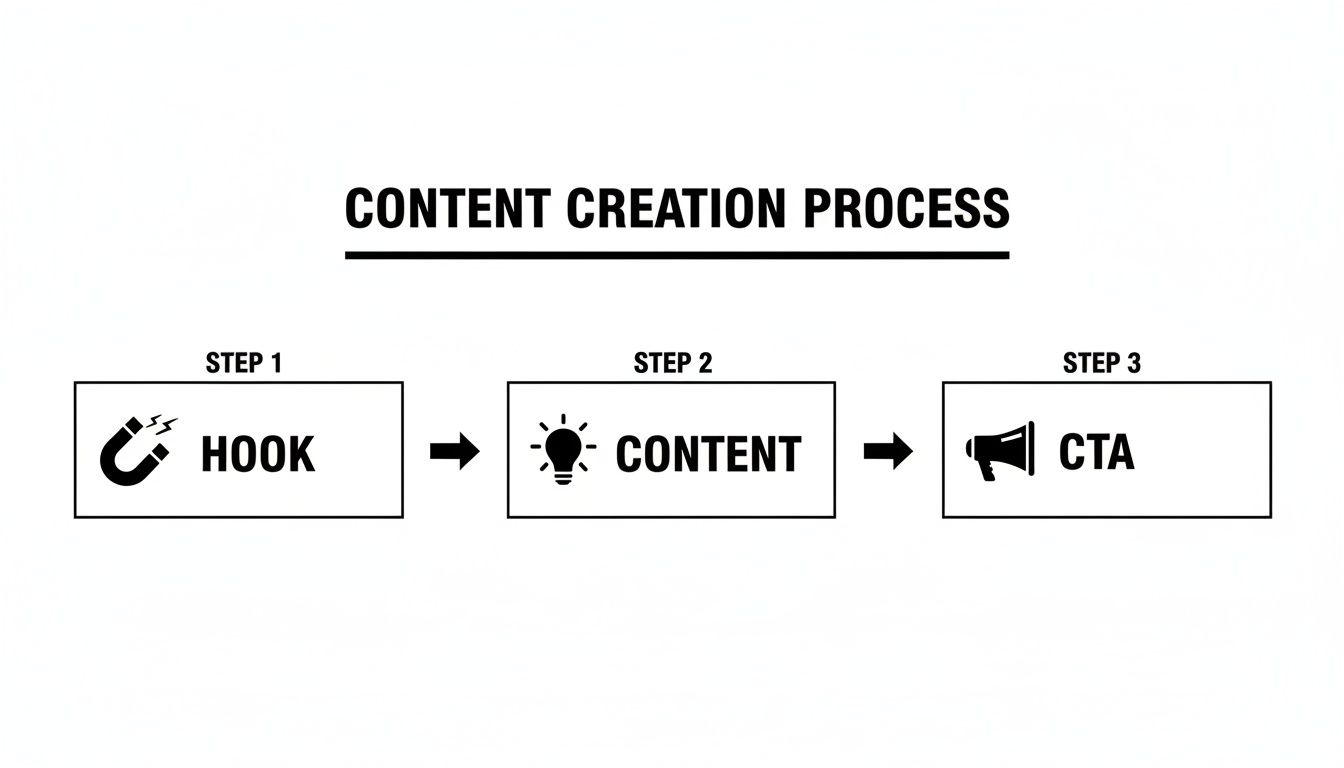
The journey from a strong **hook**, to valuable **content**, to a clear **call-to-action (CTA)** is fundamental. AI tools are uniquely good at helping you nail each of these stages, and do it at scale.
How AI Enhances Each Part of Your Workflow
Let's get practical. Here’s how an AI assistant, like the ones inside the SynthAI platform, can sharpen each part of that creative process. It's no wonder **88% of marketers** already use AI for things like content ideation and uncovering audience insights.
#### The Hook
AI can analyze thousands of top-performing posts in your industry to identify hook formulas that are proven to stop the scroll. It can generate dozens of different opening lines for you to test, so you can quickly learn what grabs your specific audience's attention.
#### The Content
Working from the content pillars you've already defined, an AI can draft post copy, outline video scripts, or even generate entire visual concepts. For instance, you could tell SynthAI’s Echo assistant, "Create an Instagram carousel about the benefits of sustainable packaging," and it will produce a multi-slide post complete with suggested text and design ideas.
#### The Call-to-Action
Even your CTAs can be fine-tuned with AI. By analyzing your past performance data, it can predict whether a soft CTA (like "What do you think?") or a hard CTA (like "Shop the collection") is more likely to work for a particular post on a specific platform. This data-driven approach takes the guesswork out of your strategy, helping you build a more effective content machine over time.
Measure What Matters And Optimize For Growth
You can create the most beautiful, engaging social media content in the world, but if you can’t prove it’s actually doing anything for the business, it’s just a creative exercise. We’ve all been tempted by those flashy follower counts and post likes—they feel good, but they’re often just **vanity metrics**.
Real growth happens when you start tracking the numbers that tie your social media efforts directly to business goals. We need to answer the tough questions: Is our content actually driving people to the website? Are we getting qualified leads from this? Is social contributing to the bottom line? These are the **sanity metrics** that will justify your budget and prove your worth.
Focus On Metrics That Show Real Impact
To get the full story, you have to look beyond the surface. Instead of getting hung up on total likes, it’s time to prioritize the data that shows how people are *really* interacting with your brand.
Here are the metrics I always push teams to focus on:
* **Engagement Rate Per Reach:** This one is gold. It calculates the percentage of unique people who saw your post and actually took an action (liked, commented, shared). It tells you how compelling your content is, regardless of the algorithm's mood swings.
* **Click-Through Rate (CTR):** This is your direct line from social media to your website or landing page. A high CTR shows that your content and call-to-action are perfectly aligned and successfully compelling your audience to take that next step.
* **Content-Assisted Conversions:** This is a bit more advanced, but it's a game-changer. It tracks how many customers saw or engaged with a piece of your content on social at *any point* before they eventually converted. It proves that social is a critical stop on the customer journey, even if it wasn't the last click.
Once you shift your focus to these numbers, you stop guessing and start making truly data-informed decisions. You’re no longer just throwing content at the wall; you’re building a strategy based on what you know moves the needle.
Use Analytics Tools to Connect The Dots
Trying to track all of this manually across different platforms is a recipe for a headache. This is exactly where a solid analytics tool comes into play. Platforms like SynthAI’s **Vantage** are built to pull everything into a single dashboard, giving you a clear view of performance from that first impression all the way to revenue.
For example, a dashboard like this one from Vantage lets you see the financial impact of your social media activity at a glance.
The real magic here is seeing not just which posts got a lot of likes, but which ones actually drove sales. With this kind of clarity, you can immediately spot your most valuable content pillars and formats and double down on them.
> Moving from vanity metrics to sanity metrics is the single most important shift you can make in your content strategy. It turns social media from a cost center into a predictable, revenue-driving engine for your business.
Conduct Monthly Audits For Continuous Improvement
Your data is only as good as the action you take on it. The final piece of this puzzle is setting up a simple, repeatable process to review your performance and fine-tune your approach. A monthly content audit is perfect for this.
At the end of every month, sit down and look at your top- and bottom-performing posts. Don't just look at the numbers; ask *why*.
1. Which themes and content pillars sparked the highest **engagement rate per reach**?
2. What formats—videos, carousels, single images—generated the best **click-through rates**?
3. Were there any outliers? A post that completely flopped or another that went unexpectedly viral? Dig in and figure out what happened.
This consistent feedback loop is the key to sustainable growth on social media. It allows you to systematically do more of what works and ditch what doesn't. This is how you stop chasing fleeting trends and start building a content machine that delivers real, measurable results month after month.
Your Top Social Media Questions, Answered
Let's be real—running social media brings up a lot of questions. I’ve seen them all over the years. Below, I’ve tackled some of the most common hurdles that managers and creators face, with practical advice you can use right away.
How Often Should I Post?
Ah, the million-dollar question! Everyone wants a magic number, but the honest answer is: it depends entirely on the platform and your audience.
For fast-moving channels like TikTok and X (formerly Twitter), where the feed is a constant stream, posting **1-3 times daily** can keep you relevant. On platforms like Instagram and Facebook, the focus shifts to polish and impact, so a goal of **3-5 high-quality posts per week** is a great starting point.
> The golden rule is **consistency over quantity**. I'd much rather see a brand post three incredible, value-packed pieces of content a week than seven mediocre ones that nobody engages with. Don't burn out your team (or your audience) just to hit an arbitrary number.
What's the Best Way to Handle Negative Comments?
That gut-sinking feeling when a negative comment pops up? We've all been there. The key is to see it not as an attack, but as an opportunity. Your first instinct might be to hide or delete it, but don't—unless it's spam or hateful speech. Leaving it up and responding shows you’re transparent.
Always try to respond publicly first. Acknowledge their point, show some empathy, and offer a path to a solution. For anything that requires personal information or a longer back-and-forth, a simple, "I'm so sorry to hear this. I'm sending you a DM right now so we can get this sorted out for you," works wonders. You'd be surprised how often a well-handled complaint can turn an unhappy customer into one of your biggest fans.
How Can I Create Great Content on a Tiny Budget?
Let's clear this up: great content is about creativity and connection, not a Hollywood-level budget. Your smartphone is probably the only camera you need. Use it to capture the real, human side of your brand—think behind-the-scenes tours, quick "how-to" videos, or a day-in-the-life of a team member. Authenticity always wins.
Here are a few ways to create amazing content for next to nothing:
* **Embrace User-Generated Content (UGC):** Encourage your followers to share photos and videos featuring your product. When you reshare their posts (always with credit!), you're getting powerful, free social proof that feels genuine because it *is*.
* **Go for Low-Effort, High-Impact Formats:** You don't always need a polished video. Simple polls, thought-provoking questions, and "Ask Me Anything" (AMA) sessions in your Stories are fantastic for sparking conversation and getting to know your audience.
---
While these tips will get you far, building a system that truly scales takes time and resources. **SynthAI** can help. It assembles a team of AI assistants to manage your social calendar, write compelling copy, and analyze what's working, freeing you up to focus on the big picture. Start your free trial of SynthAI today.
Ready to Transform Your Business with AI?
Build your AI team and start automating your marketing today.