Ai Sales Assistants: Boost Productivity with ai sales assistants
SynthAI Team
Content Team
What if you could clone your best salesperson? Imagine they worked **24/7**, never got tired, handled thousands of leads with perfect consistency, and never once complained about administrative work. That, in a nutshell, is the power of an **AI sales assistant**. It’s the digital superpower your team needs to stop drowning in repetitive tasks and start focusing on what they were hired to do: sell.
Your Sales Team's New Digital Superpower
It’s best to think of an **AI sales assistant** not as another piece of software, but as a hyper-efficient digital team member. These are sophisticated systems built to take over the most draining, time-consuming parts of the sales cycle. The goal is to free up your human reps so they can pour their expertise into building relationships and closing complex deals.
The biggest bottleneck for most sales teams isn't a lack of skill—it's a chronic lack of time. It's a well-known pain point that sales reps can spend up to **75%** of their day buried in non-selling activities. We're talking about endless manual data entry, trying to score leads, scheduling meeting after meeting, and sending countless follow-up emails. AI completely flips this script.
The Impact of Intelligent Automation
This isn't just about shaving off a few minutes. It's about rewriting the entire productivity formula for your sales organization. The proof is in the numbers: the global market for AI sales assistant software is expected to skyrocket from **US$ 3.2 billion** in 2026 to an incredible **US$ 14.2 billion** by 2033. That’s driven by a blistering **23.7%** compound annual growth rate.
This explosive growth is happening for a reason. Businesses are seeing real, tangible results. On average, teams see a **25%** productivity boost and a **25-35%** increase in sales-qualified leads. You can dig deeper into the rapid expansion of the AI sales software market to see the trend for yourself.
When you bring on an AI assistant, you’re not just getting a new tool. You're investing in a system that pays you back with compounding returns over time.
> An AI sales assistant is a tireless qualifier, a perfect scheduler, and a flawless data entry clerk, all rolled into one. It makes sure every lead gets attention, every follow-up happens on time, and every CRM record is perfectly clean. It builds the foundation for serious growth.
Let's look at how this shift from manual to automated work plays out in the real world.
Manual Sales Tasks vs AI Automation
The table below gives a snapshot of how AI assistants take over the grunt work, freeing up your team for high-value conversations.
| Manual Task | AI Sales Assistant Solution |
| :--- | :--- |
| Guessing which leads are hot | Automatically scores and prioritizes leads based on behavior and data. |
| Endless data entry in the CRM | Logs all calls, emails, and interactions and updates contact records instantly. |
| The back-and-forth of scheduling meetings | Finds the best time, sends the invite, and handles confirmations and reminders. |
| Crafting generic follow-up emails | Nurtures leads with personalized, timely follow-ups at scale. |
| Letting leads fall through the cracks | Ensures every single lead is engaged and nothing is missed. |
By offloading these tasks, you're not just making your current team more efficient. You're building a scalable engine for growth—one that can handle a flood of new leads without needing to hire an army of new reps.
How AI Sales Assistants Work Behind the Scenes

To really get why **AI sales assistants** are so effective, it helps to peek under the hood. While the technology sounds complex, the basic ideas are surprisingly intuitive when you think about them in terms of human roles. These assistants are powered by a combination of key technologies, mainly **Natural Language Processing (NLP)** and **Machine Learning (ML)**, all tied together with **workflow automation**.
These three pillars work in concert to create a system that doesn't just follow a script. It actually understands, learns, and adapts, becoming a more valuable part of your team over time. Let's break down what each piece of the puzzle does.
Natural Language Processing: The Universal Translator
Imagine you have a hyper-efficient team member who is fluent in every language and dialect. They can instantly read an email, a chat message, or a social media comment and grasp exactly what the customer wants, no matter how they word it. That's the essence of Natural Language Processing.
NLP is what gives an **AI sales assistant** the ability to comprehend human language. It’s the engine that analyzes all that incoming text and speech to pull out key information and figure out the customer's intent.
* **Understanding Customer Inquiries:** When a lead emails, "I'm interested in your pro plan but need to know if it connects with Salesforce," NLP instantly identifies the product of interest ("pro plan") and the specific question ("connects with Salesforce").
* **Sentiment Analysis:** NLP can also read the room. Is the customer happy, frustrated, or just curious? This helps the assistant flag urgent issues for a human or tailor its own response to fit the mood.
* **Data Extraction:** The technology automatically pulls important details like names, companies, and contact info from unstructured text, getting it ready to be logged neatly in your CRM.
Without NLP, an AI assistant is just a fancy script. With it, the assistant becomes a true conversational partner that understands the nuances of how people actually communicate.
> Think of NLP as the ears and mouth of your AI assistant. It listens to what your customers are saying across every channel and then formulates intelligent, context-aware responses.
But understanding is just the first step. The real magic happens when the assistant can think and predict.
Machine Learning: The Digital Sales Manager
Now, picture a seasoned sales manager who has analyzed every single deal your company has ever won or lost. They have an almost psychic ability to look at a new lead and predict, with startling accuracy, whether they'll become a customer. This is the role Machine Learning plays.
ML algorithms are built to sift through massive amounts of your historical data—every email, call log, deal outcome, and customer interaction—to spot patterns that a human could never hope to see.
This predictive intelligence is what makes an AI assistant "smart." Instead of treating every lead the same, it makes data-driven decisions that make your sales process far more efficient and effective. For example, it uses ML to:
1. **Score and Prioritize Leads:** ML models assign a score to each new lead based on how closely they resemble your best customers. This ensures your team is always focused on the hottest prospects first.
2. **Predict Customer Churn:** By analyzing usage data and communication history, the assistant can flag at-risk accounts, giving your team a heads-up to step in before it's too late.
3. **Optimize Follow-Up Cadence:** Machine Learning helps figure out the perfect time and channel to contact a lead for the highest chance of getting a response, moving you beyond generic, one-size-fits-all email sequences.
This constant learning loop means the AI sales assistant gets smarter with every interaction it processes. It’s always refining its predictions and improving its performance, delivering value that compounds over time. When you combine NLP's understanding with ML's intelligence, you get an assistant that can both understand *and* act, creating a powerful automated experience that feels seamless.
Unlocking Growth With Real-World AI Use Cases
It’s one thing to understand the technology, but seeing how **AI sales assistants** actually drive business results is where it all clicks. These aren't just abstract concepts; they are practical, hard-working engines for growth that get their hands dirty across the entire sales funnel.
Let's walk through some real, tangible examples of how they work at each stage. From that very first website visit all the way to closing the deal, an AI assistant can build a smart, seamless journey for your customers. The result isn't just a more efficient sales process—it's a real jump in lead quality, conversion rates, and, ultimately, revenue.
Top of Funnel: Engagement And Qualification
The top of the funnel (ToFu) is all about grabbing attention and figuring out who’s genuinely interested. This is where an AI sales assistant shines, acting as a tireless front-line responder who makes sure no potential customer is ever left hanging.
Picture an e-commerce store that sells high-end audio equipment. A visitor lands on a product page late on a Saturday night with a very specific question about speaker compatibility. Instead of hitting a dead end until Monday morning, an AI-powered chat assistant engages them right away.
* **Instant Answers:** The assistant immediately pulls the right answer from its product knowledge base, resolving the compatibility question on the spot.
* **Intelligent Qualification:** It then goes a step further, asking, "Are you setting this up for a home theater or a professional studio?" This simple question helps qualify the visitor as a potentially high-value lead.
* **Lead Capture:** The assistant offers to send over a detailed setup guide in exchange for their email, smoothly capturing a new lead for the sales team.
In just a few moments, that single interaction turned a simple question into a qualified prospect. Your team comes in on Monday morning to find a warm lead, complete with all the context they need to have a meaningful conversation. This proactive engagement is huge, especially when you consider that visitors who interact with AI chat show **8% higher engagement** on retail sites.
> An AI assistant at the top of the funnel acts like the perfect concierge. It greets every visitor 24/7, answers their initial questions with expert knowledge, and gently guides the most promising prospects toward the next step.
This is how you consistently fill your pipeline with well-qualified leads, not just a high volume of anonymous website traffic.
Mid-Funnel: Nurturing And Education
Once a lead is in your system, the middle of the funnel (MoFu) is all about building trust and educating them. For most sales teams, this is a major bottleneck—personalized follow-up at scale is incredibly time-consuming. An **AI sales assistant** can automate this entire nurturing process.
Think about a B2B SaaS company with a 14-day free trial. The moment a new user signs up, an AI assistant like Ascent from **SynthAI** can take the wheel. It doesn't just blast out a generic "welcome" email; it designs a personalized journey for them.
1. **Behavior-Triggered Emails:** If the user starts exploring the "integrations" feature, the assistant can automatically send them an email with a case study about a similar company that got great results using that exact feature.
2. **Usage-Based Nurturing:** Let's say the user's activity drops off after a few days. The assistant can send a friendly check-in, offering a short video tutorial on a key feature they haven't tried yet.
3. **Identifying Purchase Intent:** When the user repeatedly visits the pricing page, the assistant recognizes this as a strong buying signal. It can instantly alert a human sales rep in Slack, telling them it's time to reach out directly.
This kind of smart, automated nurturing keeps leads warm and engaged. It delivers exactly the right information at the right time, guiding them toward a purchase without your team having to lift a finger.
Bottom of Funnel: Closing And Administration
When you get to the bottom of the funnel (BoFu), speed and efficiency are everything. Here, an AI assistant takes on all the final logistical hurdles, freeing up your salespeople to do what they do best: close the deal.
Let's go back to our SaaS company. The human rep just got an alert about that hot lead. Now, the AI assistant transitions into a support role.
* **Intelligent Scheduling:** The rep can just tell the assistant, "Book a demo with this lead for next week." The AI checks both calendars, finds a time that works for everyone, and sends out the meeting invite with all the necessary info.
* **Flawless CRM Updates:** After the demo, the assistant automatically logs the call in the CRM, updates the deal stage, and even transcribes the call notes. No more manual data entry.
* **Automated Follow-Up:** Based on how the demo went, the assistant can trigger the next step, whether that's sending a formal proposal or scheduling a follow-up call in a week.
This completely removes the administrative drag from the closing process. Your sales team can move from one high-value conversation to the next, knowing all the background tasks are being handled perfectly. It's a coordinated system that creates a smooth path from first click to final close, making a direct impact on your bottom line.
Putting Your First AI Sales Assistant to Work
Bringing an AI sales assistant on board might seem like a huge technical lift, but that’s a common misconception. Modern platforms are built to be surprisingly user-friendly. Forget about needing a team of developers; think of it more like walking a new hire through their first week—connecting them to the right tools and explaining what you need them to do.
This guide breaks down the whole process into five straightforward steps. If you follow this roadmap, you can get a powerful system up and running that starts making a difference from day one.
Step 1: Pinpoint Your Goal
Before you even look at a single piece of software, you need to decide what you’re trying to fix. This is the most important step. A vague goal like "sell more" won't cut it. You need to get specific with measurable targets that an AI can actually work toward.
Start by asking yourself: where is the biggest bottleneck in our sales process right now?
* Are leads going cold because we can’t respond fast enough?
* Is our sales team wasting time on leads that will never buy?
* Is manual data entry bogging everyone down?
Once you’ve identified the core problem, attach a number to it. For instance:
* "Let’s get our lead response time under 5 minutes."
* "We need to boost our sales-qualified leads (SQLs) by **20%** this quarter."
* "Let’s automate **90%** of CRM updates to give each rep back 10 hours a week."
These clear, concrete goals give your AI a mission. They also give you a yardstick to measure its success down the road.
Step 2: Choose the Right Tool for the Job
Now that you know what you want to achieve, you can start looking at different **AI sales assistants**. This space is getting crowded, so it’s key to look past the flashy features and focus on how a tool will actually fit into your daily operations.
Here’s what to look for:
* **Integrations:** Does it play nice with the tools you already rely on, like HubSpot, Shopify, Gmail, and Slack? The whole point is to bring your data together, not create yet another island.
* **Scalability:** Will it grow with you? You want a platform that can handle simple tasks today and more complex, multi-step workflows tomorrow. Cloud-based tools are usually a good bet here.
* **Ease of Use:** How intuitive is it? The best platforms let you build and tweak automations using plain English, so your sales or marketing teams can run the show without needing constant help from IT.
The market data backs this up. AI sales assistants are fundamentally changing how teams work, with companies reporting an average **25%** boost in rep efficiency and seeing **25-35%** more qualified leads. North America is at the forefront with a **43.9%** market share, thanks to mature tech ecosystems and deep AI integration from CRM leaders. You can learn more about AI sales assistant market trends to see how they're impacting revenue.
Step 3: Connect Your Data Sources
An AI assistant is only as smart as the information you give it. The next step is to plug in your business apps. Don’t worry, modern platforms like **SynthAI** have made this incredibly simple—it’s usually just a few clicks to authenticate your accounts.
You’ll want to connect things like:
* **Your CRM** (like HubSpot) to pull lead data and track deal stages.
* **Your Email and Calendar** (like Gmail or Outlook) to manage conversations and book meetings.
* **Your E-commerce Platform** (like Shopify) to access customer purchase history.
Doing this creates a single, unified view of each customer. It's this complete picture that allows the AI to understand the full context behind every interaction and deliver automations that feel truly personal and effective.
> Connecting your tools is like giving your new digital team member a security badge, a company directory, and access to all the relevant project files. Without this access, it can’t do its job effectively.
Step 4: Build Your First Workflow
This is where the magic happens—you finally get to tell your AI assistant what to do. My advice? Start small. Pick one of the goals you defined in the first step and build a simple workflow to tackle it. Lead qualification or meeting scheduling are almost always great places to start.
For example, you could set up a workflow that does the following:
1. **It starts** the moment a new lead fills out your "Contact Us" form.
2. **It analyzes** the submission to score the lead based on things like company size and job title.
3. **It sends** high-scoring leads straight to a sales rep’s calendar to book a demo.
4. **It adds** lower-scoring leads to a nurturing email sequence for later.
By starting with a single, high-impact task, you’ll get comfortable with the system quickly and see a tangible return right away.
Step 5: Monitor, Tweak, and Improve
Finally, remember that this isn't a "set it and forget it" project. Once your first workflow is live, you need to keep an eye on it. Use the platform’s built-in analytics to see if you’re hitting the goals you set. Are more meetings getting booked? Is your lead quality improving?
Use what you learn to make small adjustments. You might decide to tweak the lead scoring rules or rewrite the follow-up email copy for better engagement. This continuous cycle of monitoring, analyzing, and optimizing is what turns your **AI sales assistant** from a simple tool into an invaluable member of your team—one that gets smarter and more effective over time.
Meet SynthAI: Your Coordinated AI Business Team
While a single **AI sales assistant** can certainly make your team more efficient, it often ends up working on its own. This creates a classic problem: your sales AI isn’t talking to your marketing AI, and neither knows what the other is doing. The result is a choppy, disconnected experience for your customers.
To get real results, you need more than just automation. You need coordination.
That’s where the idea of an AI *team* comes in. Instead of juggling a dozen different software tools and paying expensive freelancers, imagine having a single, unified platform where specialized AI assistants work together, completely in sync.
Get to Know Your New Digital Business Team
With SynthAI, you aren’t just buying another piece of software; you're onboarding a fully coordinated business team. We’ve even given them personas to make it easier to understand their roles. Think of them as dedicated experts, each with a specific job, all managed by a master coordinator.
Getting your AI team set up is straightforward. This simple, three-step process is all it takes to get started.
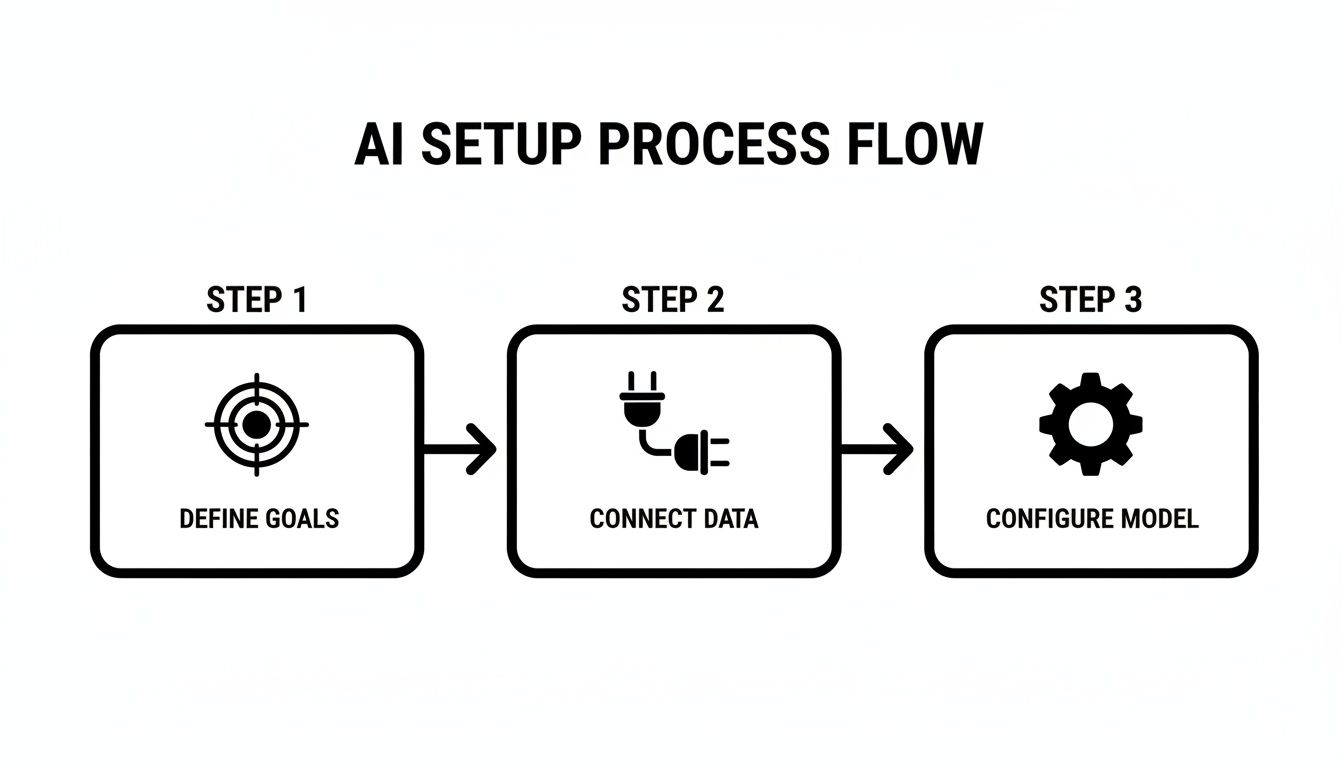
This flow—Define Goals, Connect Data, and Configure Model—is the blueprint for building a smart, coordinated AI system that is wired directly into your business goals.
Each assistant in the SynthAI ecosystem has a clear job:
* **Ascent:** Your dedicated sales and CRM specialist, laser-focused on qualifying leads and managing your sales pipeline.
* **Nexus:** The master coordinator that connects all the dots, ensuring every action taken by the team is intelligent and synchronized.
These two work hand-in-hand, creating a powerful duo that handles the entire lead-to-close process.
How a Coordinated Team Solves Real-World Problems
The real magic happens when these assistants work together. This collaborative approach breaks down the data silos that frustrate most businesses, creating a smooth, automated workflow from the very first touchpoint to the final sale.
Let's walk through a quick example. Ascent, your AI sales assistant, spots a hot lead on your website who has just checked out your pricing page for the third time. Instead of just logging the activity and moving on, Nexus springs into action to coordinate the next steps.
1. Ascent instantly flags the lead as "high-intent" right inside your CRM.
2. Nexus immediately instructs Lumen (our email specialist) to send a perfectly timed follow-up with a relevant case study and a link to book a demo.
3. At the same time, Nexus pings a human sales rep in Slack, giving them the full rundown on the lead's activity so they can jump in.
This whole sequence unfolds in seconds. No more missed opportunities. It's a level of speed and coordination that's practically impossible to replicate with a messy stack of disconnected tools.
The table below shows just how different this integrated approach is from the fragmented status quo.
SynthAI's AI Team vs. Fragmented Tools
| Challenge | Fragmented Tool Approach | SynthAI's Coordinated Team Solution |
| :--- | :--- | :--- |
| **Data Silos** | Data is trapped in separate apps (CRM, email tool, social platform), leading to blind spots and missed context. | A unified data hub where Ascent and Nexus share a single source of truth for all customer interactions. |
| **Manual Handoffs** | A sales rep has to manually check one system, then log into another to take action, creating delays. | Nexus fully automates the handoff between lead activity and sales outreach, ensuring instant follow-up. |
| **High Costs** | Multiple software subscriptions and freelance fees for specialized tasks add up quickly. | One predictable subscription replaces the need for several tools and external contractors. |
| **Inconsistent Experience** | The lead receives one message from marketing and a completely different one from sales, causing confusion. | Nexus ensures all communication is consistent and based on the lead's complete history with your brand. |
As you can see, a coordinated team doesn't just patch problems—it fundamentally changes how work gets done.
> The core benefit is simple: A coordinated AI team replaces fragmented software and manual work with a single, reliable system. It ensures that your marketing, sales, and support efforts are all working in perfect harmony, 24/7.
This integrated model doesn't just make your team more effective; it also delivers a clear and direct return on your investment. You slash software subscription costs, reduce your reliance on freelancers for routine work, and build a scalable engine for growth. The result is a far more efficient business that can deliver better experiences for your customers and achieve up to **4x efficiency gains** in less than 90 days.
How to Measure the ROI of Your AI Sales Assistant
Putting money into an **AI sales assistant** is a strategic business decision, not just a tech upgrade. And like any good investment, you need to be able to measure its return. To really prove its worth, you have to look past surface-level numbers and dig into the key performance indicators (KPIs) that actually affect your revenue.
A well-designed AI platform should make this straightforward. For instance, SynthAI includes a built-in analytics assistant called Vantage, which provides a live dashboard to track these metrics automatically. It takes the guesswork out of measuring ROI.
Key Metrics to Track
To get the full picture, you’ll want to look at metrics that cover both efficiency and direct revenue. A great place to start is with these five essential KPIs:
* **Lead Response Time:** How fast does your AI engage a new lead? Speed is everything in sales. A quick response can massively boost your conversion odds, and an AI is ready to reply instantly, day or night.
* **Lead Qualification Rate:** What percentage of leads does the assistant flag as "sales-qualified"? This KPI tells you how good the AI is at finding the real gems for your sales team to focus on.
* **Meetings Booked:** This one is simple but powerful. How many demos or sales calls is your AI actually scheduling? It’s a direct measure of how effectively it's filling your pipeline.
* **Sales Cycle Length:** How long does it take for a lead to go from initial contact to a closed deal? An AI can shrink this timeline by automating all the tedious follow-ups and admin work that slow things down.
* **Customer Acquisition Cost (CAC):** Your AI assistant should drive down your CAC. It can do the work of several software tools or even handle tasks previously given to junior staff, which cuts down your total sales and marketing expenses.
Keeping an eye on these specific data points gives you a clear, day-to-day understanding of how your AI sales assistant is performing.
Your 90-Day ROI Assessment Framework
The real impact of your investment will start to show after a couple of months. A **90-day** window is perfect for connecting the AI’s daily activities to tangible business growth.
> The goal is to shift the question from, "Is the AI working?" to "How much more revenue are we generating *because* of the AI?" A 90-day period gives you enough data to spot meaningful trends in efficiency, cost, and growth.
Here’s a simple framework to run your own assessment:
1. **Measure Efficiency Gains:** First, look at time. Compare how many hours your sales team spent on administrative tasks before and after bringing the AI on board. Tally up the hours saved on things like data entry, scheduling, and lead scoring. This is valuable time your reps can now dedicate to what they do best: selling.
2. **Calculate Cost Savings:** Next, look at your expenses. Add up the monthly subscription costs for any software tools your AI assistant has replaced. If it also helped you cut back on freelance or part-time support, factor those savings in, too.
3. **Attribute Revenue Growth:** Finally, connect the AI to the bottom line. Analyze the deals that came from AI-qualified leads. Compare the conversion rates and average deal sizes for leads the AI touched versus those it didn't. This is how you draw a direct line from the AI’s work to your company's revenue.
Your Top Questions About AI Sales Assistants, Answered
As you can see, AI sales assistants are a serious asset for any growing business. But it's completely normal to have a few questions before diving in. We get it.
Here, we'll tackle the most common questions we hear from business owners and sales leaders who are exploring this technology for the first time. Let's get them answered.
Will an AI Sales Assistant Replace My Human Sales Team?
Not at all. The real magic happens when AI *augments* your human team, not when it tries to replace them. An AI assistant is built to take over the high-volume, repetitive tasks that drain your salespeople's time and energy—things like initial lead qualification, appointment scheduling, and endless data entry.
By handing off that grunt work, you free up your best reps to zero in on the high-value activities that actually drive revenue. We're talking about building solid customer relationships, navigating complex negotiations, and closing the kind of nuanced deals that require a human touch.
> Think of it this way: an AI sales assistant is a force multiplier. It handles the administrative noise so your top performers can focus all their energy on what they do best—selling.
How Difficult Is It to Set Up and Integrate an AI Assistant?
You can forget about needing a dedicated developer or getting lost in a technical swamp. Modern platforms like **SynthAI** are designed to be surprisingly simple and intuitive, letting you get started in minutes, not weeks.
The whole process is usually just a few straightforward steps:
* **Connect Your Tools:** You’ll link your existing software—like your CRM, email, and e-commerce platform—using simple, one-click integrations.
* **Define Your Goals:** Just tell the AI what you want it to accomplish. You can use plain English, almost like briefing a new team member.
* **Activate Your Plays:** Launch pre-built workflows for common sales tasks or easily customize your own with a drag-and-drop style editor.
The goal is to get you up and running fast, so you can see a return on your investment almost immediately.
Is My Customer and Business Data Secure?
Absolutely. Data security isn't just a feature; it's the foundation of any trustworthy AI platform. Protecting your sensitive business and customer information is non-negotiable.
This is why you should always look for solutions that are **SOC 2 compliant**. SOC 2 is a rigorous, independent auditing standard that verifies a service provider manages your data with the highest level of security and privacy. When you're choosing a partner, make sure they are transparent about their security protocols and can show you their compliance certifications.
What Is the Typical Cost and ROI of an AI Sales Assistant?
Pricing models can vary, but today’s best platforms offer flexible plans that grow with your business. This makes **AI sales assistants** a viable option for everyone from solo entrepreneurs to large enterprise teams.
As for the return? Most businesses see a significant ROI within the first **90 days**. It typically comes from two key areas:
1. **Cost Savings:** You can stop paying for a mishmash of single-purpose software tools and reduce your reliance on freelancers for repetitive admin work.
2. **Revenue Growth:** The AI directly impacts your bottom line by boosting efficiency, improving lead conversion rates, and shortening your sales cycle.
It’s common for businesses to report up to **4x efficiency gains**, along with a clear increase in both qualified leads and closed deals. It’s an investment that tends to pay for itself—and then some—very quickly.
---
Ready to see what a coordinated AI team can do for your business? With **SynthAI**, you can replace a dozen scattered tools and expensive freelancers with a single, intelligent platform that works around the clock to grow your revenue. Start your free trial of SynthAI today.
Ready to Transform Your Business with AI?
Build your AI team and start automating your marketing today.