The Modern Guide to a Virtual Assistant for Sales
SynthAI Team
Content Team
Think of your top salesperson. Now, imagine them having an elite support crew that handles all the background work—researching leads, updating the CRM, and scheduling calls—so they can focus entirely on what they do best: selling.
That's the essence of a **virtual assistant for sales**. It isn't just another software tool or a temp; it's a dedicated partner designed to take over the repetitive, time-consuming tasks that bog down even the most efficient sales teams.
By handing off this administrative load, your reps get to spend their valuable time actually engaging prospects, building relationships, and closing deals. It’s a smart move more and more businesses are making, especially once they realize the high cost of paying a skilled salesperson to get buried in spreadsheets and manual data entry.

The market growth reflects this shift. The global virtual assistant market exploded from **$1.64 billion** in 2015 to over **$12.1 billion** by 2020. Even more telling, it's projected to hit a staggering **$44.25 billion** by 2027. This incredible growth is a direct response to the sales world's demand for greater efficiency and scale, a trend you can explore further with these insightful virtual assistant statistics.
What Is a Virtual Assistant for Sales?
At its core, a virtual assistant (VA) for sales is a specialized resource—either a real person working remotely or a sophisticated AI—that handles the administrative side of selling. Their entire purpose is to give your core sales team more leverage and more time back in their day.
> The core idea is simple: let your closers sell. By delegating the repetitive, non-revenue-generating tasks, you multiply the effectiveness of your most skilled team members without multiplying your headcount.
This frees up your A-players from the grind of low-value activities, allowing them to focus on high-impact conversations.
So, what does that look like in practice? It involves a whole range of tasks that keep the sales pipeline moving and ensure no lead gets forgotten. These often include:
* **Lead Enrichment:** Digging up and adding key details to new leads, like their job title, company size, or direct phone number.
* **CRM Hygiene:** Keeping your CRM clean and up-to-date by logging every interaction, note, and deal stage change. This creates a reliable source of truth for the whole team.
* **Initial Outreach:** Kicking off the conversation by sending personalized first-touch emails or LinkedIn requests to warm up leads before a salesperson steps in.
* **Scheduling & Coordination:** Taking on the frustrating back-and-forth of scheduling discovery calls and demos, managing calendars so your reps can just show up and sell.
Ultimately, a sales VA builds the operational backbone that lets your sales engine run faster and smoother, which translates directly to a healthier bottom line.
Choosing Your Sales Assistant Type
Picking a virtual assistant for your sales team isn't a one-size-fits-all deal. The right choice hinges entirely on your sales process, how your team is structured, and what you're trying to achieve. Think of it like picking a vehicle: you wouldn't buy a sports car to haul lumber or use a giant freight truck for your daily commute.
In the same way, the "best" assistant is simply the one that fits the job. Let's break down the three main models—Human, AI, and Hybrid—so you can find the perfect engine to power your sales machine.
The Human Touch Specialist
First up is the **human virtual assistant**. This is a real person, a remote professional who dedicates their time to supporting your sales efforts. Their superpower is something technology is still trying to authentically replicate: emotional intelligence and the art of nuanced conversation.
Human VAs truly shine in high-touch sales environments where building personal rapport is everything. They can read between the lines in a conversation, pick up on subtle social cues, and tailor their approach to a prospect's unique personality.
This makes them perfect for tasks that need a delicate, personal touch, such as:
* **Handling VIP Leads:** Engaging with high-value prospects who expect a white-glove experience from the very first hello.
* **Complex Discovery Calls:** Digging deeper than a script allows to uncover the real pain points and motivations driving a potential customer.
* **Building Strategic Relationships:** Nurturing long-term partnerships that are built on trust and genuine human connection.
A great human VA acts as a true extension of your team, bringing intuition and adaptability that can warm up a lukewarm lead and turn them into a loyal advocate for your brand.
The AI Efficiency Engine
Next, we have the **AI virtual assistant**—a software-driven solution built for speed, scale, and relentless precision. Platforms like SynthAI’s **Ascent** fall into this category, offering 24/7 execution and data-crunching power that no person could ever hope to match.
An AI-powered virtual assistant for sales is your secret weapon for handling high-volume, repetitive tasks that would otherwise bog down your team. It can analyze thousands of data points in a flash, run outreach campaigns around the clock, and maintain perfect consistency without ever getting tired or making a careless mistake.
> An AI sales assistant is like having an infinitely scalable team of SDRs that works tirelessly to sift, sort, and score your leads, ensuring your human salespeople only ever talk to the most qualified prospects.
Look to an AI assistant for workflows that demand automation and scale:
* **Mass Lead Qualification:** Instantly scoring thousands of inbound leads from a webinar or content download against your ideal customer profile.
* **Automated Outreach:** Sending thousands of personalized, yet templatized, first-touch emails to initiate contact at a massive scale.
* **CRM Data Management:** Automatically logging every call, email, and touchpoint, keeping your data pristine without any mind-numbing manual entry.
This space is growing fast. The overall virtual assistant market, which hit **$8.2 billion** in 2024, is projected to climb at an **11.4% CAGR** through 2030, with specialized sales roles leading the charge. In fields like e-commerce, these assistants slash administrative work—which can eat up **30-40%** of a sales rep's day—and drive **20-25%** higher conversion rates simply by enabling faster lead responses. You can explore more on how VAs are redefining business scalability and see why this trend is picking up so much steam.
The Hybrid Powerhouse
Finally, there's the **hybrid model**, which gives you the best of both worlds. It strategically blends the raw efficiency of AI with the critical oversight and intuition of a human. This approach creates a powerful partnership where technology does the heavy lifting, and people provide the final, high-value touch.
Picture this: an AI virtual assistant for sales works through the night, analyzing 1,000 new sign-ups. It scores them, enriches their contact data, and by the time your team logs on, it has a neat list of the top 50 most qualified leads. A human VA then takes that list and crafts deeply personalized outreach for those high-priority prospects, turning a cold process into a warm, inviting introduction.
This model lets you scale your efforts without losing that essential human element. The AI handles the volume, and your human experts can focus their skills where they matter most—on building relationships and closing deals. For most businesses aiming for rapid growth without sacrificing quality, this integrated approach is the most effective way forward.
What a Sales VA Actually *Does*: 6 High-Impact Workflows
So we've covered the 'what' and the 'who'. Now for the fun part: the 'how'. A virtual assistant for sales isn't just another tool in the background; it's an active part of your team, capable of taking over entire workflows that are critical to closing deals.
Think of your sales pipeline like an assembly line. Every stage needs specific actions to move a lead forward. A sales VA is the smart automation that keeps this line moving 24/7, eliminating bottlenecks and making sure no one falls through the cracks.
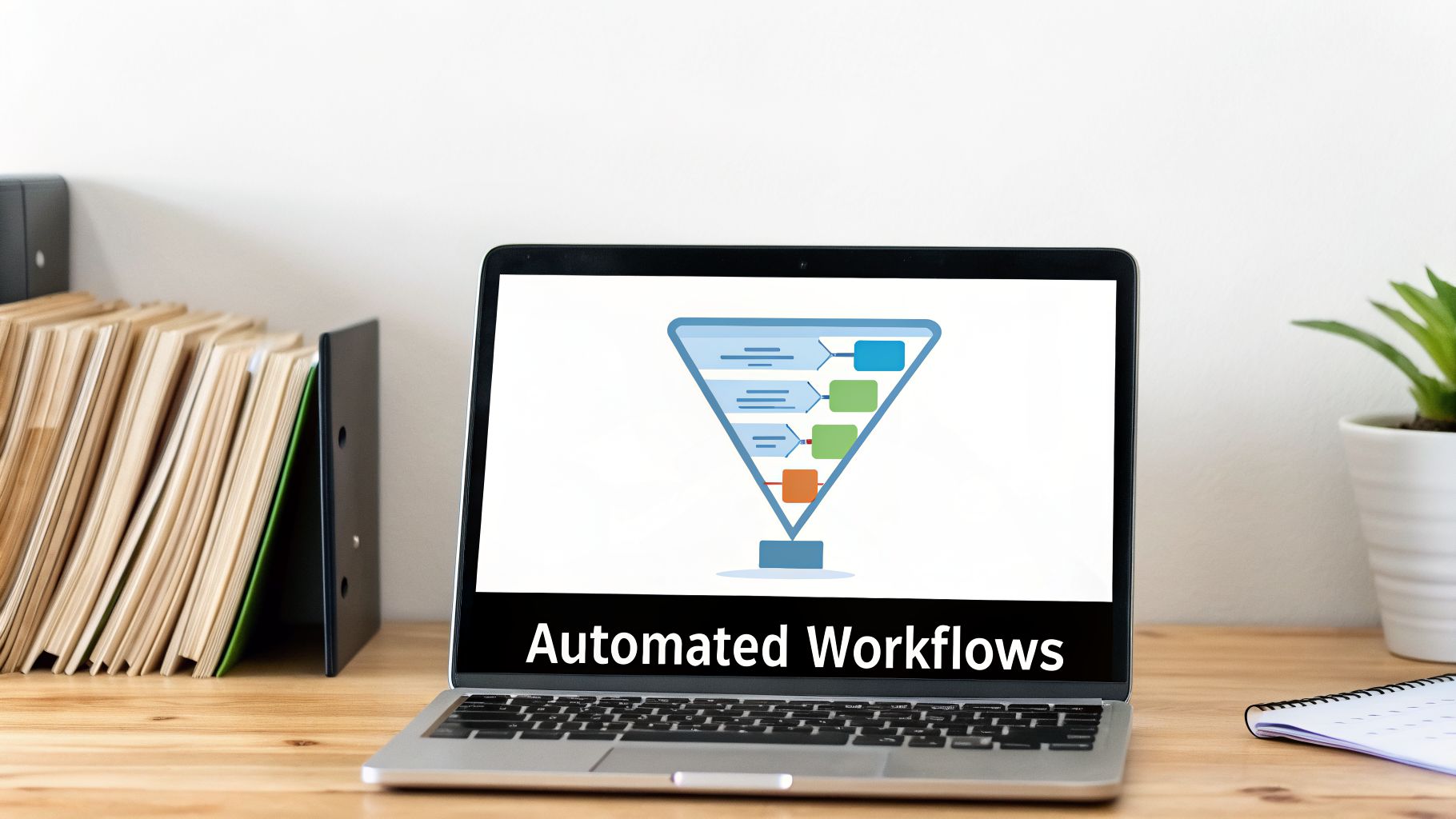
Let's break down the exact, revenue-generating tasks a sales VA can own, turning manual grunt work into a serious competitive edge.
1. Automated Lead Qualification and Enrichment
Your sales team’s most precious resource is their time. Having them chase down unqualified leads is like using your star quarterback to punt the ball—it’s just a massive waste of talent. A sales VA acts as your front-line screener, making sure your reps only talk to people who are actually likely to buy.
Here’s what that looks like in practice:
* **Instant Sorting:** A new lead comes in from a web form or event. The VA immediately checks it against your ideal customer profile (ICP).
* **Data Enrichment:** It then automatically fills in the blanks by finding key details like company size, industry, job title, and location, giving your reps the full story.
* **Lead Scoring:** Using all this data, the VA assigns a score, instantly flagging the hottest leads for your team to jump on.
This is a game-changer. Instead of your team guessing which of the **500** webinar attendees to call first, the VA hands them a prioritized list of the **30** best-fit prospects, complete with all the context they need to have a great conversation.
2. Intelligent Outreach and First Touch
That first interaction with a lead can make or break a deal. A generic, mass email blast is the fastest way to get ignored. A sales VA, on the other hand, can execute smart, personalized outreach at scale, grabbing attention and starting real conversations.
And we're not just talking about inserting a `First Name` token. This is about sending the *right* message to the *right* person.
> A virtual assistant for sales can automate personalized outreach sequences that feel genuinely human. It can reference a lead’s specific industry or a recent company milestone, creating an opening that is relevant and shows you’ve done your homework.
This is how you cut through the inbox clutter. For a SaaS company, an AI VA like **Ascent** could send a tailored email to every new trial user from the manufacturing sector, pointing them to a case study they'll actually care about. That one automated action can massively boost demo requests.
3. Seamless CRM Automation and Data Hygiene
Let's be honest: salespeople hate manual data entry. And a CRM is only as useful as the data inside it. With reps spending so much of their day on admin tasks, it's no surprise that bad data costs businesses millions every year.
A sales VA solves this by becoming your CRM's best friend. It automatically:
* Logs every email, call, and meeting.
* Updates contact records when it finds new info.
* Moves deals to the next stage based on specific triggers.
* Creates follow-up tasks so nothing gets missed.
The result? Your CRM becomes a single source of truth you can actually trust. Your reps get to focus on selling, knowing all the tedious record-keeping is handled for them. And leadership gets accurate data for forecasting and reporting.
4. Effortless Meeting Scheduling and Follow-Ups
The endless "What time works for you?" email chain is a productivity black hole. A sales VA completely eliminates this back-and-forth, making it incredibly simple for qualified leads to get on your team's calendar.
By connecting directly to your reps' calendars, the VA can offer up available times, send confirmations, fire off reminders, and even handle rescheduling requests. It’s not just a time-saver; it creates a smooth, professional experience for your potential customers.
But it doesn't stop there. The VA also runs your follow-up game on autopilot. If a hot lead goes quiet after a demo, the VA can trigger a pre-planned sequence of gentle nudges to re-engage them. No opportunity goes cold just because someone forgot to follow up.
How to Measure the ROI of Your Sales Assistant
So, you're thinking about bringing on a virtual assistant for sales. It's a smart move, but it's not just about adding another tool to your stack—it's a financial decision. And like any good investment, you need to know if it's actually paying off. Measuring the return on investment (ROI) is how you prove your new assistant isn't just an expense, but a genuine revenue-driver for your business.
How do you calculate it? At its core, the formula is simple: (Net Profit Gained / Cost of Investment). But the real work isn't in the math; it's in knowing exactly *what* to measure.
To get the full picture, you have to track two kinds of benefits: the "hard" ROI and the "soft" ROI. Hard benefits are the direct, dollars-and-cents metrics you can pull from a sales report. Soft benefits are the less obvious, but equally powerful, advantages that improve how your team operates and grows over the long haul.
Tracking the Hard ROI Numbers
Hard ROI is where you’ll see the immediate financial results. These are the numbers that draw a straight line from your virtual sales assistant to your bottom line. To see the impact, start tracking these key performance indicators (KPIs) before your assistant starts, and then keep a close eye on them afterward.
* **Increased Sales Velocity:** How much faster are deals closing now? By taking over follow-ups and scheduling, a VA can easily trim days or even weeks off your sales cycle.
* **Higher Number of Meetings Booked:** When a VA handles the tedious outreach and calendar management, your reps’ schedules fill up with qualified meetings. Bumping each rep from 5 to 8 demos per week is a massive, tangible win.
* **Lower Cost-Per-Lead:** Your sales team should be talking to people who are ready to buy, not just kicking tires. A sales VA does the pre-qualification work, which means you spend less time and money chasing down dead-end leads.
* **More Time for Selling:** This one is huge. Calculate the hours your VA frees up from mind-numbing admin tasks. If a rep gets **10 hours** back each week and you value their time at $50/hour, that’s **$500** in productive time recovered—*per week, per rep*.
This kind of efficiency boost is why small and mid-sized businesses, which make up **44.4%** of the virtual assistant market, are adopting this technology so quickly. For instance, Shopify store owners using an AI specialist like SynthAI's Ascent often see these numbers come to life, achieving up to 4x efficiency gains in just 90 days as it takes over their sales pipeline. You can learn more about the global demand for VAs and see how they are becoming essential for growth.
Don't Ignore the Soft Benefits
Soft benefits might not show up on a spreadsheet, but they are just as important for long-term success. Think of them as the operational and cultural upgrades that build a stronger, more resilient sales machine.
> The biggest soft benefit? You give your best salespeople their time and energy back. They get to focus on what they actually love doing: building relationships and closing deals. That morale boost is one of the most powerful, yet overlooked, drivers of performance.
Think about these game-changing advantages:
* **Improved Team Morale:** Let's be honest, nobody enjoys data entry. By automating the soul-crushing admin work, you cut down on burnout and make the job more rewarding. A happy sales team is a productive sales team.
* **Enhanced Customer Experience:** Leads get fast, consistent, and professional responses from the very first touchpoint. That initial good impression builds trust and sets a positive tone for the entire sales conversation.
* **Better Strategic Decisions:** A good sales VA ensures your CRM data is clean and up-to-date. This means sales leaders can finally make accurate forecasts and smart decisions based on reliable data, not just gut feelings.
When you put the hard numbers and the soft benefits together, the case for a **virtual assistant for sales** becomes crystal clear. It’s an investment that pays for itself not just with more revenue, but by creating a more efficient, motivated, and data-driven sales organization.
Your 7-Step Implementation Checklist
Bringing a virtual assistant for sales into your workflow is a game-changer, but success doesn't just happen. You need a clear plan. This isn't just about plugging in a new tool; it's about thoughtfully integrating it into your sales machine to get real, measurable results.
Think of it like getting a new race car engine. You wouldn't just drop it in and hit the track. You'd need to tune it, connect it to the existing systems, and test it to make sure it runs perfectly. Let's walk through how to do that for your sales VA.
Step 1: Define What Winning Looks Like
Before you do anything else, get specific about your goals. "Improve sales" is not a goal; it's a wish. You need to define success with clear, measurable objectives that leave no room for guesswork.
What does a win actually look like in 90 days?
* Increase qualified demos booked by **20%**.
* Cut the sales team's time spent on admin by **10 hours** per week.
* Get lead response times under **5 minutes** for all inbound requests.
Setting these benchmarks gives you a finish line. You'll know exactly what you're aiming for and how to measure the impact of your new assistant.
Step 2: Audit Your Current Sales Process
Now, it's time for an honest look at your sales process. Where are the cracks? Where do things slow down or fall apart? This is about finding the bottlenecks.
Is your CRM a ghost town of old, irrelevant contacts? Are hot leads going cold because your team can't follow up fast enough? Are your top closers getting bogged down in the endless back-and-forth of scheduling meetings?
> Pinpointing these friction points is everything. It shows you exactly where a virtual sales assistant can make the biggest and most immediate impact, ensuring a fast return on your investment.
This audit gives you a blueprint for your assistant’s most critical tasks.
Step 3: Choose the Right VA Model
As we've covered, not all assistants are created equal. Your choice between a human, AI, or hybrid model should flow directly from your goals and process audit.
If you need to scale high-volume, top-of-funnel outreach, an AI assistant like **SynthAI's Ascent** is built for that. But if you need someone to manage complex, high-touch relationships with a handful of VIP clients, a human VA might be the answer. Many businesses find that a hybrid approach gives them the best of both worlds.
This decision directly connects your investment to the benefits you're aiming for.
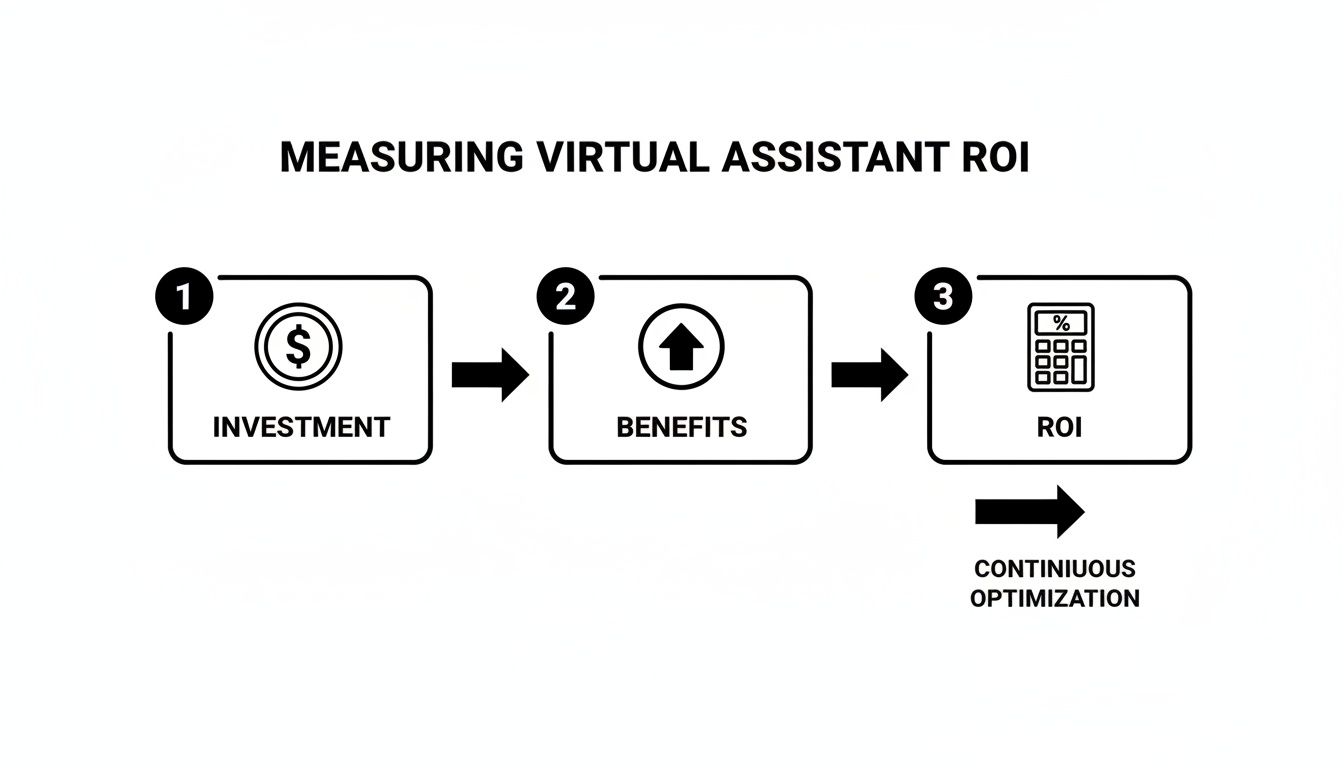
Tracking your investment against tangible gains—like increased efficiency and more meetings booked—is how you'll prove the value and calculate your ROI.
Step 4: Prepare Your Tech Stack
Your virtual assistant is only as good as the tools it can connect with. Before you launch, make sure your core platforms—like your CRM, email marketing software, and calendars—are ready to integrate. Modern AI platforms like **SynthAI** often make this incredibly easy, letting you plug in your whole tech stack in minutes.
A smooth integration is what allows your VA to automatically log activities in the CRM or book meetings directly on your team's calendars without anyone lifting a finger.
Step 5: Create Clear Standard Operating Procedures (SOPs)
This step is non-negotiable. You have to document the exact workflows you want your assistant to own. These SOPs are detailed, step-by-step guides that eliminate any confusion.
For example, an SOP for lead qualification should spell out:
1. Where to find new leads (e.g., inbound web forms, specific list).
2. What data points to enrich (e.g., company size, job title).
3. The exact criteria for scoring a lead as "hot."
4. What happens next (e.g., assign to a rep in the CRM, add to an outreach sequence).
Great SOPs are the foundation of consistency and quality.
VA Implementation vs. Traditional Hiring
To put this into perspective, let's compare the process of launching a sales VA with the traditional route of hiring a full-time Sales Development Representative (SDR). You'll quickly see why so many teams are opting for the faster, more agile VA approach.
| Stage | Virtual Assistant (AI-Powered) | Traditional SDR Hire |
| :--- | :--- | :--- |
| **Sourcing** | 1-2 days to select a platform/model. | 2-4 weeks to post jobs and screen resumes. |
| **Onboarding** | 1-3 days to integrate tools and define SOPs. | 2-4 weeks of formal training and shadowing. |
| **Ramp-Up** | Fully operational in under a week. | 2-3 months to reach full productivity. |
| **Cost** | Fixed monthly subscription; no overhead. | Full salary, benefits, commissions, and overhead. |
| **Scalability** | Scale up or down instantly. | Slow, costly process to hire or downsize. |
As the table shows, a virtual assistant provides a level of speed and flexibility that's simply impossible to match with traditional hiring, getting you to a positive ROI much faster.
Step 6: Launch a Pilot Project
Don't try to boil the ocean. Start small with a focused pilot project.
Pick one or two of the biggest pain points you found in your audit—like lead enrichment or initial outreach—and have the VA take over that task for a single salesperson or a small, dedicated team. This controlled test lets you work out the kinks, refine your SOPs, and get some early wins on the board without disrupting your entire sales operation.
Step 7: Measure, Refine, and Scale
Once your pilot is live, keep a close eye on the metrics. Circle back to the goals you set in Step 1. Are you booking more demos? Is admin time actually going down?
Use this real-world data to tweak and improve your workflows. Once you've proven the model works in your pilot, you can confidently roll it out across the rest of the sales organization. This is how you multiply your results and build a truly efficient, modern sales engine.
Building a Coordinated Sales Team with SynthAI
A single virtual assistant for sales can give your efficiency a serious boost, but what happens when your needs get more complex? Your sales process isn't an island; it's deeply connected to marketing, content, and analytics. This is where a lone assistant starts to hit a wall, leaving you to patch together different tools and manage clunky workflows.
The logical next step is to go beyond a single helper and build a fully coordinated, automated business team. This is the whole idea behind SynthAI. Instead of just giving you a sales assistant, it provides a whole crew of specialized AI assistants that work together perfectly under one central guide. Think of it as upgrading from a single crew member to an entire, synchronized pit crew for your business.
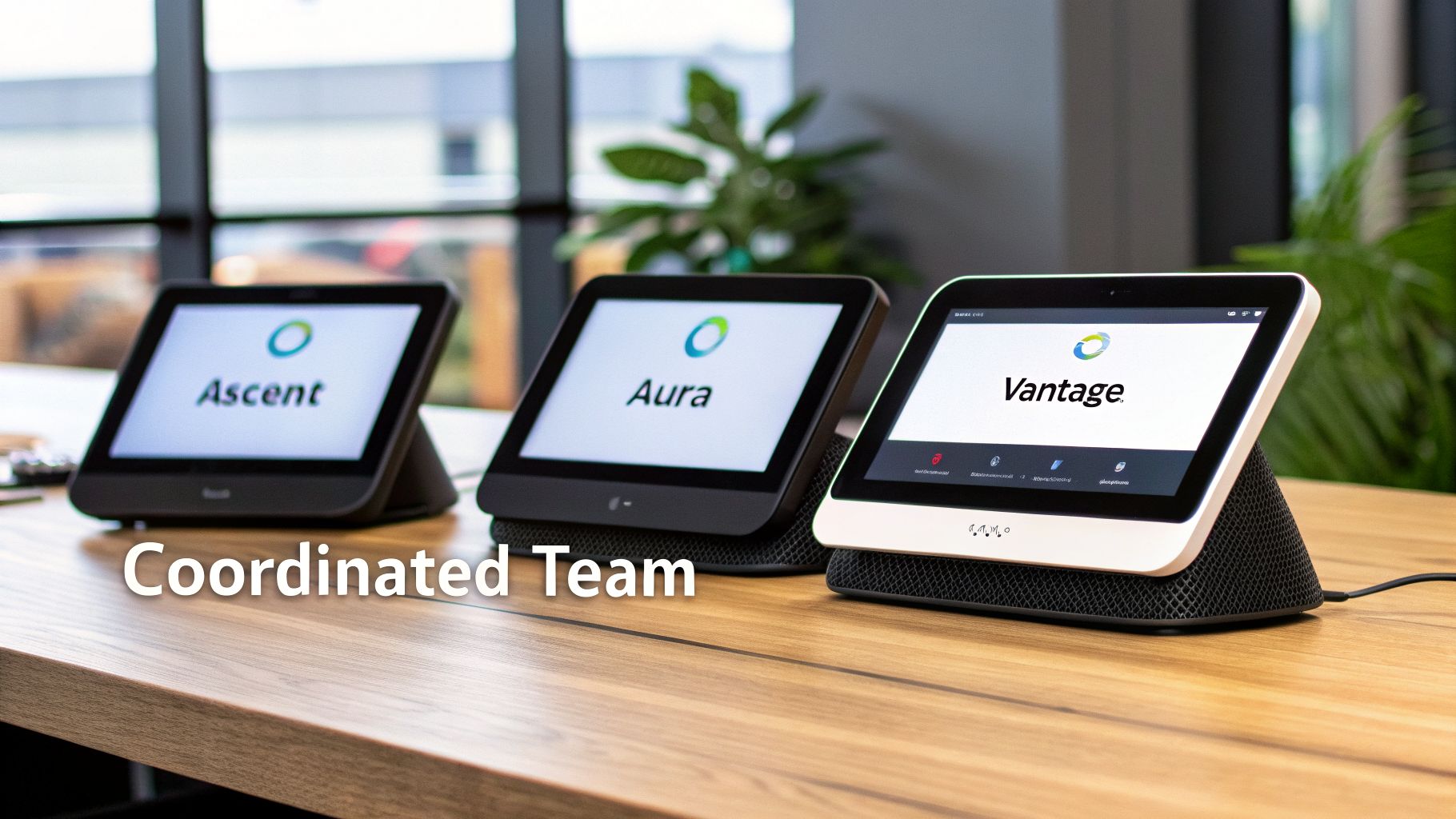
Meet Your New Automated Team
At the core of this system is **Ascent**, SynthAI’s specialist **virtual assistant for sales**. Ascent is purpose-built to manage your CRM, qualify leads, and keep your sales pipeline moving. But Ascent isn’t a solo act. It works hand-in-hand with its teammates to create a powerful, end-to-end growth engine.
Here’s a look at how this coordinated system plays out in the real world:
* **Aura (SEO & Ads):** This assistant handles your digital marketing, pulling in new leads from places like Google and Meta.
* **Ascent (Sales & CRM):** The moment Aura captures a lead, it’s instantly handed off to Ascent. Ascent then gets to work qualifying the lead, enriching its data, and nurturing it right inside your CRM.
* **Lumen (Email):** When the time is right for outreach, Ascent designs the campaign and hands it off to Lumen, who then executes the personalized email sequences.
* **Vantage (Analytics):** All the while, Vantage is tracking every single metric—from ad spend to close rates—giving you a complete, real-time picture of your funnel’s performance.
This tight-knit workflow creates a powerful, self-optimizing system that runs **24/7** without needing you to constantly look over its shoulder.
More Than a VA—an Operating System
This "business team" approach completely changes how you think about scaling your operations. Instead of trying to tape together separate tools for ads, email, and sales, you get a single, unified platform where specialized assistants collaborate toward one shared goal: growth.
> It's the difference between hiring individual freelancers who need constant management and having a fully integrated department that runs on its own. The system automates the handoffs and communication that would normally eat up hours of your day.
This entire model is built on a foundation of **enterprise-grade security**, including SOC 2 compliance, so you can be confident that your company and customer data is always secure. By connecting the tools you already use—like your CRM, ad accounts, and email—you empower this AI team to run complex strategies for you, automatically.
What you end up with isn't just another **virtual assistant for sales**. It's a fundamentally new way to build and scale your sales and marketing operations, replacing fragmented tasks with a consistent, automated engine designed for growth.
Got Questions? Let's Talk Specifics.
It's one thing to understand the concept of a virtual sales assistant, but it's another to see how it fits into your actual budget and workflow. We get it. Here are some of the most common questions we hear from teams considering making the leap.
What's the Real Cost of a Virtual Sales Assistant?
This is usually the first question, and the answer depends on the route you take. The good news is, it's almost always a smarter financial move than hiring a full-time employee.
A human virtual assistant, for instance, typically bills by the hour, with rates anywhere from **$15 to over $50 per hour**. This really hinges on their location, experience, and the complexity of the work.
On the other hand, AI platforms and agencies often use a subscription model. You pay a set monthly fee for a certain number of tasks or hours, which makes budgeting a breeze. An AI-powered platform like **SynthAI** takes a more flexible approach with a credit-based system. This lets you ramp up during your busy season and scale back when things are quiet, all without getting stuck in a rigid contract.
Will This Thing Actually Work with My CRM?
Absolutely—and if it doesn't, you should run the other way. A virtual assistant that can’t communicate with your existing tools just creates more data silos and manual work, which defeats the whole purpose.
> Think of your virtual assistant as the central nervous system for your sales tools. Its real power isn't just in what it does, but in its ability to connect, read, and write data across your entire tech stack.
The best virtual assistants are built from the ground up to integrate seamlessly. Whether your team lives in **HubSpot**, **Salesforce**, or another CRM, a capable VA will plug right in. It can log activities, update contact details, and advance deals in your pipeline automatically. This also applies to e-commerce platforms like **Shopify**, where it can monitor customer actions to kick off timely sales sequences.
Isn't My Business Too Small for Something Like This?
We hear this a lot, and it’s one of the biggest misconceptions out there. In reality, startups and small businesses often see the *biggest* impact from a sales VA. When your team is lean, every single minute is precious.
Founders and early hires simply can't afford to get stuck in the weeds of administrative tasks. A sales VA gives you the firepower to go toe-to-toe with bigger competitors without the hefty salary and overhead of a full-time sales development rep (SDR).
By automating lead qualification, outreach, and scheduling, you free up your team to do what they do best: talk to high-value prospects and close deals. It’s a true force multiplier that lets you grow smarter, not just bigger, making it a perfect fit for ambitious small businesses.
---
Ready to see how an AI team can handle your sales and marketing operations for you? **SynthAI** brings together specialized assistants like Ascent (for sales and CRM) to automate your entire funnel, from generating leads to closing them. Start your free 7-day trial and build your AI team today.
Ready to Transform Your Business with AI?
Build your AI team and start automating your marketing today.