Boost Your Ops with ai workflow automation tools
SynthAI Team
Content Team
Imagine your business humming along, with crucial work getting done perfectly, 24/7, even while you sleep. This isn't science fiction anymore. It's what **AI workflow automation tools** make possible, acting as a smart, tireless director for your daily operations.
What Are AI Workflow Automation Tools

You're probably familiar with standard automation. Think of a simple tool like Zapier that adds a new customer from a Stripe purchase to a Mailchimp email list. It's incredibly useful, but it’s like a conveyor belt—it does one specific, pre-programmed job repeatedly. It just follows a rigid set of rules.
AI workflow automation is a whole different ballgame. It’s less like a conveyor belt and more like a seasoned project manager overseeing an entire department. Instead of just following a script, this AI "manager" understands the big-picture objective, whether it's "launch a new product" or "slash customer churn."
This central AI then intelligently delegates work to a team of specialized AI agents to hit that objective. One agent might be tasked with drafting social media posts, another could analyze advertising performance, and a third might handle incoming support tickets. They all communicate, sharing data and adjusting their strategies based on what’s happening in real time.
> At their core, AI workflow automation tools are systems that use artificial intelligence to coordinate multiple, interconnected tasks across various applications to achieve a complex business objective. They move beyond simple "if this, then that" rules to enable dynamic, goal-oriented execution.
From Doing Tasks to Achieving Goals
The real game-changer here is the move from simply *doing tasks* to actually *achieving outcomes*. A traditional system is told to send a promotional email every Friday morning. An AI workflow, on the other hand, is given a goal: **increase customer engagement by 15%**.
It then figures out the best way to do that. It decides *when* to send the email, what the subject line should be, and which customer segments to target, all by analyzing data and learning from every interaction.
This goal-first approach delivers some serious benefits:
* **Intelligence:** These systems don’t just follow orders; they analyze data, learn from results, and get smarter over time. They can spot which ad creative is resonating and automatically shift more budget its way.
* **Coordination:** A central AI brain makes sure all the different pieces are working together. The marketing AI knows what the sales AI is doing, which means customers get a smooth, consistent experience.
* **Adaptability:** When something unexpected happens—like a sudden spike in negative feedback or an unusual customer question—the system can think on its feet and adjust its plan instead of just breaking down.
To see the difference clearly, let's compare the two approaches side-by-side.
Manual Effort vs Intelligent Automation: A Side-by-Side Look
The table below highlights the fundamental differences between leaning on manual processes and adopting AI-driven workflows.
| Aspect | Manual Workflow | AI Automated Workflow |
| :--- | :--- | :--- |
| **Speed & Scale** | Slow, limited by human capacity and work hours. | 24/7 operation, capable of executing thousands of tasks simultaneously. |
| **Accuracy** | Prone to human error, inconsistencies, and fatigue. | Highly consistent and precise, with error rates near zero. |
| **Decision-Making** | Based on gut feelings, past experience, or limited data. | Data-driven, using real-time analysis to make optimal choices. |
| **Adaptability** | Rigid. Responding to change is slow and requires retraining. | Dynamic. Learns and adapts to new information automatically. |
| **Strategic Focus** | Team gets bogged down in repetitive, low-value tasks. | Team is freed up to focus on strategy, creativity, and growth. |
The takeaway is clear: while manual effort gets the job done eventually, intelligent automation gets it done faster, smarter, and more reliably, freeing up your team for the work that truly matters.
This evolution from basic, task-based automation to intelligent, goal-driven orchestration is why these tools are becoming so critical. They provide the strategic horsepower your business needs to not just compete, but to pull ahead of the pack.
How AI Automation Unlocks New Levels of Growth
Bringing **AI workflow automation tools** into your business isn’t just about getting things done faster. It’s a fundamental shift in how your company operates, competes, and grows. This is about more than simple task-checking; it’s about unlocking three powerful forces: radical efficiency, built-in intelligence, and effortless scalability.
These systems go far beyond the old, rule-based automations you might be used to. They empower your team to hit goals that once seemed impossible, no matter the size of your staff. Let's break down what this actually looks like in practice.
Drive Radical Efficiency by Reclaiming Your Team's Time
Every single business is plagued by them—those repetitive, soul-crushing tasks that eat up the clock and kill creativity. Think about the hours spent manually pulling data for weekly reports, processing vendor invoices, or just keeping the CRM updated. It's necessary work, but it's low-value "busywork" that pulls your team away from the strategic thinking that actually moves the needle.
AI workflow automation is like hiring a digital workforce that takes over these manual chores completely. For instance, a marketing manager might spend half of Monday morning compiling performance stats from Google Ads and Meta. An AI workflow can pull that data, organize it into a clean report, and drop it in the team's Slack channel before anyone's even had their first coffee.
The ripple effect of this is huge:
* **Frees Up Human Capital:** It liberates your most valuable asset—your people's brainpower—to tackle complex problems, build customer relationships, and innovate.
* **Reduces Burnout:** It’s no surprise that **90% of knowledge workers** report being happier in their jobs when automation handles the monotonous stuff.
* **Minimizes Human Error:** Machines don't get tired or distracted. Automated systems execute tasks with near-perfect accuracy, wiping out costly mistakes from manual data entry.
Gain a Competitive Edge with Built-In Intelligence
The best **AI workflow automation tools** don't just follow a script; they think, learn, and adapt on the fly. Old-school automation needed you to map out every single "if-then" scenario. Modern AI is different. You give it a goal, and it uses data to figure out the smartest way to get there.
> This is the difference between a simple calculator and a financial analyst. The calculator just follows your command. The analyst gives you insights and recommends a course of action based on what the market is doing *right now*.
Let's say an e-commerce brand is running online ads. A basic system might be told to spend a fixed budget each day, period. An intelligent AI workflow, however, is given a goal like "maximize my return on ad spend."
From there, it gets to work:
1. **Analyze Real-Time Data:** It’s constantly watching sales figures, website traffic, and ad performance across all channels.
2. **Identify Patterns:** The AI spots that a certain product is suddenly trending on TikTok or that a particular ad creative is outperforming everything else by a mile.
3. **Optimize Autonomously:** Without waiting for instructions, it automatically shifts more budget to the winning ad. It might even trigger an inventory check to make sure that trending product doesn't sell out.
This kind of proactive, data-fueled decision-making gives you a serious competitive advantage, letting you pivot instantly as the market changes, all without constant human intervention.
Achieve Effortless Scalability
What happens when business booms? For most companies, growth means hiring more people. More orders require more support agents. More clients require more account managers. It's a linear path that makes scaling incredibly expensive and slow.
AI workflow automation breaks that model. It lets a small, nimble team perform with the output of a company five times its size. Because these workflows are digital, they can scale up to handle a massive surge in volume overnight without any drop in performance or ballooning costs.
For a SaaS startup, this could be automating the entire new user onboarding process. It doesn't matter if ten people sign up today or ten thousand. The AI workflow can send personalized welcome emails, walk users through key features, and even flag accounts that look like they might churn—all without a single new hire. This is how you grow revenue without your headcount growing right alongside it, creating a far more profitable and sustainable business.
The Core Features of Modern AI Automation Platforms

When you start looking at today's **AI workflow automation tools**, it quickly becomes clear they're in a different league than the automation of the past. If you peek under the hood, you’ll find a few key capabilities that truly set them apart from older, rule-based systems.
These features aren’t just fancy add-ons; they represent a totally new way of getting work done. Grasping what they are helps you understand why platforms like SynthAI can tackle complex business objectives, not just check off items on a list. Let's get into what makes these tools tick.
Context-Aware Coordination
Think of a symphony orchestra. If every musician plays their notes perfectly but has no clue what the others are doing, you get noise, not music. A lot of traditional automation works just like that—individual tools running their own scripts in total isolation.
Modern AI platforms solve this by adding a "conductor," or what you can think of as a central AI brain. This coordinator, like SynthAI's **Nexus**, keeps an eye on the entire workflow from start to finish. It knows the ultimate goal and makes sure all the specialized AI assistants—whether for marketing, sales, or support—are perfectly synchronized.
> This coordination is what turns a bunch of separate tasks into a single, intelligent strategy. It’s the difference between a random playlist and a beautifully composed symphony, where every note builds toward the final piece.
This central brain allows the system to share crucial information between different parts of the business. For instance, if a support assistant like **Pax** detects a surge in complaints about a new feature, it can instantly tell the marketing assistant (**Aura**) to hit pause on ads promoting it until the problem is fixed.
Natural Language Interfaces
For years, one of the biggest hurdles to using powerful automation was the steep technical learning curve. You had to be comfortable with complex logic, APIs, and sometimes even writing code.
Today's top AI workflow tools are breaking down that wall with **natural language interfaces**. This means you can manage incredibly complex operations just by typing in plain English. Instead of mapping out a complicated sequence with triggers and conditions, you can simply tell the platform what you want.
For example: "Draft a three-email sequence for customers who abandoned their cart. Offer a **10%** discount in the second email, and if they click the link but don't buy, send a notification to the sales team on Slack."
This is a game-changer. It opens up powerful automation to everyone on your team, from a marketing intern to the CEO, without needing to call in a developer.
Seamless Tool Integration
Your business relies on a whole suite of specialized apps. You have your CRM for customer data, your email platform for outreach, and your e-commerce store for sales. A truly effective automation platform has to act like the central nervous system that connects all of them.
And this goes far beyond just basic connections. Seamless integration means the AI can not only pull data *from* these tools but also push actions *back to* them.
* **It can read from your CRM:** The AI might analyze lead data in HubSpot or Salesforce to pinpoint your most promising prospects.
* **It can write to your CMS:** From there, it could automatically generate and publish a personalized landing page on WordPress specifically for that prospect.
* **It can trigger actions in your communication tools:** Finally, it can shoot a notification to the right salesperson in Slack with a link to that new page.
This complete connectivity across your tech stack is what makes genuine, multi-channel automation possible. It’s what allows you to create campaigns that feel personal and connected from the customer's point of view. This capability is driving huge growth, with the Enterprise Agentic AI market expected to jump from **USD 6.76 billion** in 2025 to **USD 46.04 billion** by 2030, thanks to an average ROI of **171%** for companies that adopt it. You can dive deeper into the rapid growth of AI-powered workflows.
Actionable Analytics and ROI Tracking
The final, and perhaps most critical, feature is the ability to tie automated actions directly to business results. It’s one thing to know an automation ran successfully; it’s another thing entirely to know if it actually *worked*.
The best platforms have intuitive dashboards that show you key performance indicators (KPIs) in real time. So instead of a report that just says "1,000 emails sent," you see exactly how that campaign influenced:
* **Website Traffic:** The number of clicks generated by the automation.
* **Conversion Rates:** How many people took the action you wanted them to.
* **Revenue:** The actual dollar amount that workflow brought in.
This kind of closed-loop reporting is non-negotiable for optimization. When you can see precisely what's driving results, you can confidently invest more in what works and tweak what doesn’t. This ensures your automation efforts are always delivering a clear and measurable return on investment.
Putting AI Automation to Work: Real-World Examples
So, what does this all look like in practice? The real magic of **AI workflow automation tools** isn't just the tech itself; it's how they solve nagging, everyday problems for real businesses. Let's ditch the theory and look at some practical mini-playbooks for three different business models: e-commerce stores, digital agencies, and SaaS startups.
Each example will break down a common headache, show how an intelligent automation solves it, and highlight the kind of results you can actually expect. This is where the rubber meets the road.
For E-Commerce Founders
Running an online store is a masterclass in juggling. You're managing inventory, running ads, and handling customer service all at once. One of the toughest parts is personalizing the customer journey at scale without getting buried in manual tasks.
Let's say a customer adds one of your best-sellers to their cart but gets sidetracked and leaves. A basic automation might send a generic "Did you forget something?" email a day later. An AI-powered workflow is a lot smarter.
* **The Problem:** High cart abandonment and generic follow-up emails that just don't convince shoppers to come back and buy.
* **The AI Workflow Solution:** The system sees the abandoned cart. But instead of just starting a timer, it instantly checks the inventory level and current ad performance for that specific product. If the item is almost sold out and is a top performer in your ads, the AI triggers a much more urgent and personalized sequence.
* **How It Plays Out:** The first email immediately highlights scarcity ("Heads up! Only 3 left in stock."). If they still don't buy, a second email might follow up 12 hours later with a small, one-time discount. At the same time, the AI can even spin up a dynamic retargeting ad on social media showing that exact product to that specific customer.
This kind of intelligent, multi-channel approach feels personal and timely, and it's far more effective at converting on-the-fence buyers than a one-size-fits-all email blast.
> By connecting your marketing actions to real-time business data like inventory and ad spend, AI automation transforms a simple follow-up into a sophisticated revenue machine that never sleeps.
For Digital Agencies
Agencies live and breathe on delivering client results. That means managing dozens of campaigns, reporting dashboards, and content calendars all at the same time. The biggest time-suck? Often, it’s the sheer volume of repetitive operational work needed just to keep the lights on.
Think about it: an agency might spend days every single month pulling performance data from different platforms, wrestling it into custom reports, and writing summary emails for each client. It's essential work, but it’s time that could be spent on strategy and growth.
* **The Problem:** Manual, time-guzzling client reporting and inconsistent content creation across many accounts. This leads to high overhead and leaves little room for strategic thinking.
* **The AI Workflow Solution:** You can set up a unique AI workflow for each client. Every week, it automatically pulls the latest performance data from Google Ads, Meta, and your SEO tools. It then plugs that data into a branded report template, uses natural language to generate a quick summary of key insights, and emails it directly to the client.
* **How It Plays Out:** The system can also take over content grunt work. Feed it a client's content pillars, and it can generate draft blog posts, social media updates, and ad copy. This content then gets routed to an account manager for a quick human review before being scheduled, giving you the perfect blend of speed and quality control.
This frees up your team to focus on what they do best: analyzing results and dreaming up new campaign ideas. It's how you scale your agency's capacity without just hiring more people. The workflow automation market is booming, projected to hit **USD 26.01 billion** in 2026 and **USD 40.77 billion** by 2031. For businesses that get in early, especially in e-commerce, the payoff can be huge—we're talking **4x efficiency improvements** in just 90 days. You can find more insights on this growing market on mordorintelligence.com.
For SaaS Startups
For any SaaS business, user engagement and retention are the name of the game. You have a very short window to show a new user why your product is amazing. Losing them in the first few weeks is a common—and expensive—problem. And there's simply no way to manually watch every new user's activity to see where they're getting stuck.
This is where AI workflow automation tools shine. They can create a personalized and proactive onboarding experience that guides users toward that "aha!" moment and flags anyone who's at risk of churning.
* **The Problem:** Low user activation and high churn in the early days. This is usually caused by a generic onboarding flow that doesn't help users with their specific needs or sticking points.
* **The AI Workflow Solution:** As soon as a new user signs up, an AI workflow starts monitoring their behavior inside your app. If it notices they haven't tried a crucial feature within three days, it can automatically send them a targeted email with a quick video tutorial explaining why that feature is so helpful.
* **How It Plays Out:** Let's say the system sees a user repeatedly hitting an error or giving up halfway through a setup process. It can do two things at once: send the user an automated message offering help right then and there, and simultaneously create a ticket in your support system with all the context, so a human agent can proactively reach out with a perfect solution.
This automated, behavior-based approach makes sure every user gets the right help at exactly the right time. It’s a game-changer for boosting activation rates and stopping churn in its tracks.
Your Roadmap to Implementing AI Automation
Jumping into powerful new technology shouldn't feel like you're guessing in the dark. A successful rollout of **AI workflow automation tools** is a journey, not a single event. The best way to approach it is with a phased "crawl, walk, run" plan that builds momentum and delivers clear wins every step of the way.
This roadmap breaks the whole process into three manageable phases. Following these steps helps ensure a smooth transition, gets your team on board, and proves the value of automation right from the start.
Phase 1: Identify and Strategize
The first step is all about finding the perfect starting point. You’re on the hunt for tasks that are high-impact yet relatively simple to automate—the "quick wins" that create instant momentum.
Get your team together and start brainstorming the biggest bottlenecks in your daily work. What are the repetitive tasks that suck up the most time or cause the most headaches?
* **Repetitive Data Entry:** Think about jobs like updating CRM records or manually copying information from one spreadsheet to another. These are perfect candidates.
* **Manual Reporting:** Consider the hours someone spends pulling data together for weekly or monthly performance reports.
* **Routine Customer Communication:** What about standard welcome emails, appointment reminders, or the first reply to a support ticket?
Once you have a list, prioritize it using a simple matrix: how much time will automating this save, and how hard is it to set up? The goal here is to pick one or two processes that offer a big return without needing a massive upfront effort.
> Start with a single, painful problem. Don't try to boil the ocean. A small, successful automation project is far more valuable than a grand, stalled initiative. Proving ROI early creates the support you need to tackle more ambitious goals later.
Phase 2: Pilot and Integrate
With your first target in sight, it's time to launch a pilot program. This is a small, controlled test designed to prove the concept works and iron out any kinks before you roll it out to the whole company.
Define a clear, measurable goal for your pilot. For instance, if you're automating lead data entry, your goal might be to "reduce manual CRM updates by **90%** within 30 days."
This is also when you'll connect your core tools. This means integrating your key software—like your e-commerce platform, CRM, and communication apps—with a platform like **SynthAI**. Modern **AI workflow automation tools** make this surprisingly simple, often using no-code connectors that sync up your entire tech stack in minutes.
The image below gives a great visual of how different types of businesses can apply AI automation to their core operations.
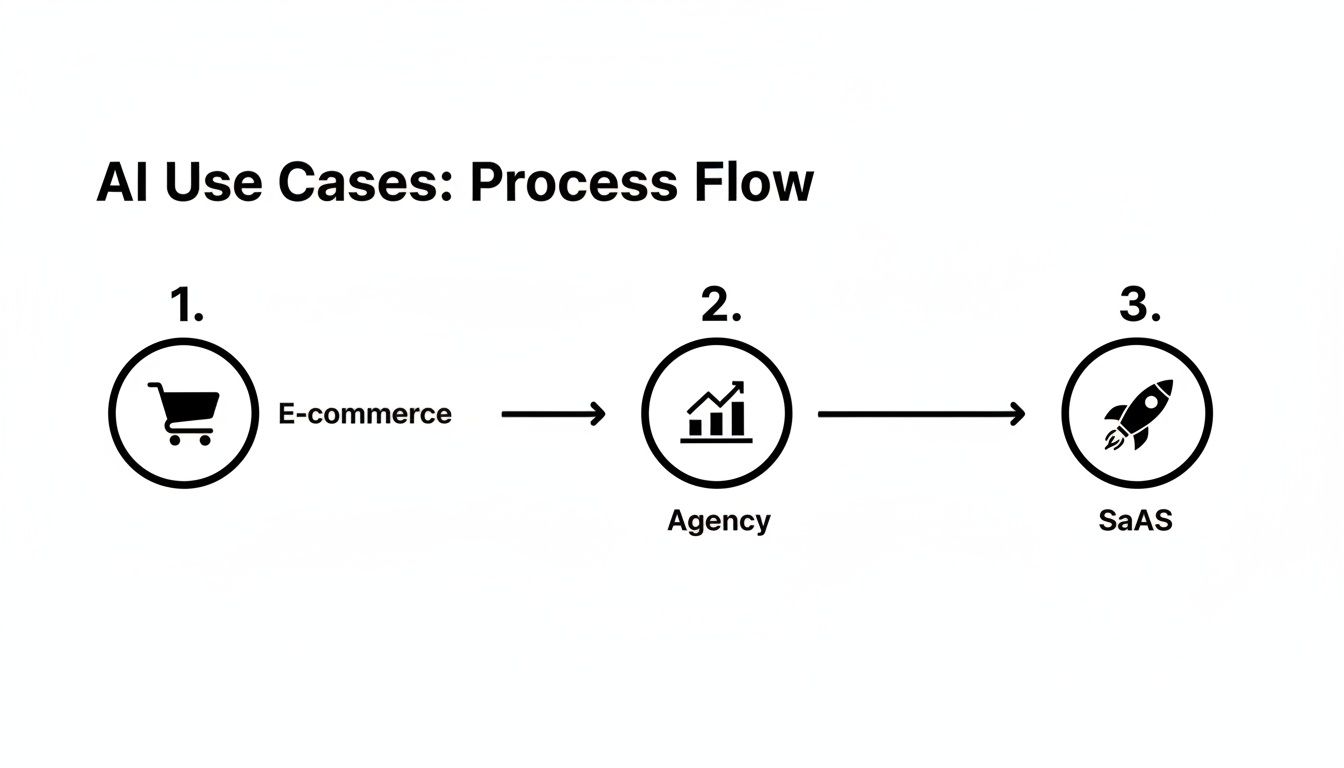
This flow shows how simple e-commerce automations can grow into more sophisticated strategies for agencies and SaaS companies.
Phase 3: Scale and Optimize
After a successful pilot, you've got proof, confidence, and team support on your side. Now you can expand your efforts. The scaling phase is about methodically applying what you’ve learned to other departments and processes across the business.
This is your chance to tackle more complex workflows, like multi-channel marketing campaigns or proactive customer support sequences. You’ll also use the data and analytics from your automation platform to constantly fine-tune performance.
1. **Expand Department by Department:** Roll out automation to your sales, marketing, and operations teams one by one, using the same successful pilot-and-prove model.
2. **Gather Continuous Feedback:** Regularly check in with your team. Find out how the automations are working for them and where they see new opportunities.
3. **Use Analytics to Refine:** Keep an eye on your dashboards. See which workflows are driving the most revenue or saving the most time, then double down on what’s working.
The market for these solutions is exploding, with projections showing it will grow from **USD 23.89 billion** in 2026 to **USD 80.57 billion** by 2035. This growth is driven by the urgent need for both efficiency and security, which is why something like SOC 2 compliance is a non-negotiable feature for any platform you trust with your data. Read more about the drivers of the workflow automation market.
Common Questions About AI Workflow Automation
It's smart to ask questions before jumping into any new technology. When it comes to something as powerful as AI workflow automation, it’s completely normal to wonder about the cost, the learning curve, and what it all means for your team.
Let's cut through the noise and tackle the most common questions business owners ask before they get started. We'll give you clear, honest answers so you can move forward with confidence.
Will AI Automation Replace My Team?
This is usually the first question on everyone's mind, and it comes from a very real place. But the goal here is **augmentation, not replacement**. The best way to think about AI workflow automation is as a tireless assistant for your team—one that makes them faster, smarter, and more focused on what matters.
These tools are designed to handle the tasks that drain human energy and creativity. We're talking about the mind-numbing data entry, the repetitive report pulling, and the manual follow-ups that eat up a huge chunk of the workday. By taking that work off their plates, you free up your people to focus on what humans do best.
Suddenly, your team has more time for:
* **Big-Picture Strategy:** Analyzing what’s working and planning what’s next.
* **Creative Problem-Solving:** Digging into tough customer issues that require real ingenuity.
* **Building Relationships:** Actually talking to customers and partners instead of just processing their data.
The result isn't a smaller team; it's a more engaged and impactful one. In fact, studies show that automation boosts job satisfaction for **90% of knowledge workers** because it gets rid of the boring tasks they never wanted to do in the first place.
Is This Too Complex or Expensive for a Small Business?
A few years ago, you would have been right to be skeptical. Early automation platforms were clunky, expensive, and often required a team of developers to get anything meaningful done. That's just not the world we live in anymore.
Modern **AI workflow automation tools** are built for everyone. With the rise of no-code and low-code platforms, you don’t need a technical background to build incredibly powerful automations. If you can clearly explain the steps in a process, you can automate it.
> The old barriers are gone. Today's tools put enterprise-level automation into the hands of startups, small businesses, and even solo entrepreneurs. You no longer need a massive budget to play the game.
The pricing has changed, too. Many of the best platforms offer flexible, credit-based plans and even 7-day free trials to get you started. This means you can begin with one or two high-impact workflows, see the results for yourself, and then scale up as you see a clear return. The days of giant, upfront financial commitments are over.
How Do I Measure the ROI of AI Automation?
Knowing your return on investment is non-negotiable. With AI automation, you can measure this in two ways: the hard numbers you can track on a dashboard and the "softer" benefits that are just as critical to your business's health.
First, let's talk about the cold, hard data—the metrics that directly impact your bottom line.
**Quantifiable ROI Metrics:**
* **Hours Saved Per Week:** It’s simple math. Calculate the time your team gets back and multiply it by their hourly cost.
* **Reduced Operational Costs:** See a drop in what you spend on freelancers or third-party services for repetitive admin work.
* **Increased Lead Conversion:** A/B test an automated lead-nurturing sequence against your old manual process and watch the conversion rate climb.
* **Higher Customer Lifetime Value (LTV):** Track how automated check-ins and proactive support reduce churn and keep customers coming back.
But the story doesn't end there. The qualitative returns often have the biggest long-term impact on your growth.
**Qualitative ROI Metrics:**
* **Faster Project Turnaround:** How much quicker can you get a new marketing campaign live or a new client onboarded?
* **Improved Consistency:** Every customer gets the same flawless experience, every single time. No more "oops, I forgot."
* **Higher Team Morale:** When your team isn't drowning in busywork, they're happier, more creative, and more likely to stick around.
The best platforms make tracking all of this simple. They have built-in analytics that connect the dots between every automated action and these crucial business outcomes, giving you a crystal-clear picture of the value you're getting.
---
Ready to stop managing tasks and start achieving goals? **SynthAI** assembles a coordinated team of AI assistants to run your marketing, sales, and operations on autopilot. See how you can achieve up to 4x efficiency gains in just 90 days. Start your free 7-day trial of SynthAI today.
Ready to Transform Your Business with AI?
Build your AI team and start automating your marketing today.