E-Commerce Virtual Assistant The Ultimate Guide to Store Efficiency
SynthAI Team
Content Team
An e-commerce virtual assistant is a remote professional—or a sophisticated AI—that takes on all those time-consuming tasks holding your business back. Think of it less as an employee and more as a dedicated operational partner, handling everything from customer support and order processing to social media updates, so you can finally get back to focusing on growth.
Why Your E-commerce Store Needs a Virtual Assistant
Picture this: someone is always on, managing customer questions, updating your product listings, and keeping your marketing channels active, all without needing a single coffee break. That’s the reality an **e-commerce virtual assistant** (VA) brings to your store. For so many online businesses, the biggest hurdles aren't big-picture problems; they're the small, repetitive tasks that eat up your entire day.
A VA isn't a luxury anymore. It's become a core part of scaling a business without burning out.

If you're like most e-commerce founders, your most limited resource is time. As your store grows, the administrative workload seems to grow even faster. This is exactly where a virtual assistant comes in, taking over the operational drag that keeps you bogged down in the day-to-day instead of pushing your business forward.
Quick Benefits of an E-commerce Virtual Assistant
By handing off these key responsibilities, you gain some immediate advantages that go straight to your bottom line and give you back your peace of mind. Here's a quick look at the immediate impact.
| Benefit Area | Impact on Your Business | Example Task |
| :--- | :--- | :--- |
| **Cost Efficiency** | Avoids the high overhead of a full-time hire (salary, benefits, office space). | Managing customer service tickets for a fraction of an employee's cost. |
| **Flexibility & Scale** | Easily adjust support levels for peak seasons or slow periods without HR headaches. | Adding extra VA hours to manage the Black Friday sales rush. |
| **Customer Experience** | Ensures fast, professional responses to inquiries, boosting satisfaction and loyalty. | Responding to "Where is my order?" questions 24/7. |
The return on investment isn't just about getting tasks done. It’s about building a more resilient, adaptable business that can handle whatever comes next.
Staying Competitive in a Crowded Market
Bringing a virtual assistant on board isn't just a small productivity hack; it reflects a massive shift in how businesses operate. The global virtual assistant market is expected to jump from around **$19.5 billion in 2025** to an incredible **$55.4 billion by 2035**—a **184%** increase. That's not just a trend; it's a fundamental change.
Why the rapid growth? The results speak for themselves. Businesses are reporting up to **4x efficiency gains** within 90 days of bringing on a VA. Brands using an e-commerce virtual assistant can process **35% more orders** without adding a single person to their payroll. If you're interested in the data, you can read more about these virtual assistant trends and their impact.
This growth means your competitors are likely already using these tools to work faster and smarter. Integrating a VA isn't about catching up; it's about building a lasting advantage that lets you thrive.
Essential Tasks an E-Commerce Virtual Assistant Can Handle
So, what can an e-commerce virtual assistant *actually* do for your store? Think of them as a remote team member who takes the endless, repetitive tasks right off your plate. Figuring out what to hand over can feel like a huge task in itself, so let’s break it down into the main pillars of any online business.
By delegating these specific duties, you're not just buying back time; you're trading operational drag for strategic growth.
Picture this: while you’re finalizing the designs for a new product line, your virtual assistant is already sending out abandoned cart reminders to recover lost sales. That’s the real-world difference a VA makes—turning the vague idea of "being more efficient" into concrete, measurable results.
Marketing and Sales Support
This is often where a virtual assistant delivers the quickest and most visible return. Instead of you personally scheduling every social media update or fighting with your email marketing platform, a VA can step in and run your marketing playbook with consistency.
* **Social Media Management:** A VA can schedule your posts across all channels, engage with comments from your followers, and pull together key engagement reports.
* **Email Campaign Setup:** They can build and launch your newsletters, promotional emails, and crucial follow-up sequences that nurture leads.
* **Basic Ad Management:** You can have them monitor the performance of your social media ads and report back on what's working and what isn't.
> By taking over these daily marketing duties, a VA keeps your brand active and in front of customers, even when you're completely focused on other things. That steady presence is vital, as a strong social media game can directly impact sales.
Customer Support and Experience
You already know that amazing customer service is non-negotiable. The problem is, it's also incredibly time-consuming. A virtual assistant can become the friendly, fast, and helpful face of your brand, answering questions and solving problems for your customers.
Considering that **90% of shoppers** say customer support impacts their decision to buy, this is a critical area to get right. A VA can easily manage:
* Answering the constant stream of "Where is my order?" inquiries.
* Processing returns and exchanges based on your store's policies.
* Keeping an eye on customer reviews and feedback across different platforms.
This pulls you out of the support inbox and gives you peace of mind that every customer is being taken care of promptly.
Operations and Administrative Duties
The backend of any e-commerce business is packed with small, essential tasks that have to get done. This administrative work is the perfect territory for a virtual assistant, ensuring your operations run smoothly without your direct involvement.
These are the foundational tasks that keep the lights on:
* **Order Processing:** From confirming new orders to generating shipping labels and updating tracking information.
* **Inventory Management:** Your VA can keep stock levels synced across your sales channels to prevent the headache of overselling.
* **Product Listings:** They can add new products to your store, write sharp descriptions, and make sure every detail is perfect.
Handing off these core duties creates a stable operational foundation. It allows your business to scale without hitting logistical roadblocks, because your VA is ensuring the day-to-day is handled perfectly while you build for the future.
Choosing Your Assistant: Human vs. AI Automation
When most people hear “virtual assistant,” they still picture a human freelancer working from a home office. That was true for a long time, but today, that definition includes powerful AI automation platforms. This leaves growing e-commerce brands at a critical crossroads.
The choice isn’t about which is "better." It’s about what your business needs *right now*. Think of it this way: are you looking for a master craftsman or an entire automated factory? The craftsman is perfect for custom, creative work that requires a human touch. The factory, on the other hand, delivers incredible speed and consistency for tasks you need done thousands of times over.
The Core Differences
A human e-commerce virtual assistant shines in roles that demand nuance, creative problem-solving, or emotional intelligence. You'd want a person building relationships with your VIP customers, brainstorming a new marketing campaign from scratch, or negotiating with a supplier.
AI assistants, in contrast, are built for scale and pure efficiency. An AI can handle **5,000** customer support tickets at once, analyze a year's worth of sales data in seconds, and run marketing workflows **24/7** without ever making a mistake. This is where platforms like SynthAI come in, offering a whole team of coordinated AI assistants, not just one.
You can see below how a platform like SynthAI organizes different AI agents to manage various parts of the business automatically.
The real power here is how these specialized AIs work together. The social media AI, the email AI, and the operations AI all communicate, creating a unified system. A single person, no matter how talented, simply can’t match that kind of speed and scope.
> The question isn't just about what tasks you want to offload. It's about your business model. Do you need one versatile helper, or do you need a scalable, automated workforce to power high-volume operations?
Human vs. AI: A Direct Comparison
To make the right call, it helps to see a direct, side-by-side comparison of how they stack up on the factors that matter most for an online store. We're talking about everything from cost and availability to how well they can scale as you grow.
Here's a breakdown to help you decide between hiring a person and implementing an AI automation platform.
Human Virtual Assistant vs. AI Assistant (SynthAI)
| Feature | Human Virtual Assistant | AI Assistant (e.g., SynthAI) |
| :--- | :--- | :--- |
| **Cost Structure** | Typically hourly (**$15-$75+**), can be unpredictable. | Fixed monthly subscription, predictable and scalable. |
| **Availability** | Limited by work hours, time zones, and holidays. | **24/7/365**, always on and ready to execute tasks. |
| **Task Consistency** | Varies based on skill, mood, and workload. | Flawless and consistent every time, no human error. |
| **Scalability** | Difficult to scale; requires hiring and training more people. | Instantly scalable; can handle **10x** the workload without issue. |
| **Skill Set** | Limited to one person's expertise. | Access to a team of specialized AIs for marketing, sales, and support. |
As you can see, the roles are quite distinct. While human VAs will always have a place for their strategic and creative input, AI automation is quickly becoming the backbone for executing repetitive, data-heavy tasks with perfect efficiency. For many brands, the answer is a hybrid approach—using AI for scale and humans for strategy.
How AI Assistants Personalize the E-Commerce Experience
Today’s shoppers don’t just want personalization; they expect it. For a human team, trying to deliver a unique experience to every single visitor is an impossible task. This is where an AI-powered e-commerce virtual assistant shines, turning a standard customer journey into what feels like a one-on-one conversation with a personal shopper.
Think of it this way: a good AI assistant doesn't just answer questions—it anticipates them. By analyzing a user's real-time behavior, like their clicks, searches, and what they add to their cart, platforms like SynthAI can figure out what a shopper wants, often before they do. It’s the digital equivalent of having a mind-reading sales associate for every person on your site.
More Than Just a Basic Chatbot
This is a world away from those simple chatbots that only respond to keywords. A truly smart AI system works proactively. It doesn’t just sit there waiting for someone to ask for a recommendation. Instead, it serves up tailored suggestions based on that person's browsing history and what similar shoppers have bought, which dramatically increases the odds of making a sale.
This proactive approach is also a powerful way to nurture leads automatically. An AI assistant can spot a hesitant shopper, maybe someone lingering on a product page, and trigger a timely pop-up with a special offer. Or it might send a follow-up email showcasing products they looked at, keeping your brand fresh in their mind and gently guiding them back to complete their purchase.
> By connecting all the dots—from website behavior to email opens—an AI assistant builds a living, breathing profile of each customer. This allows it to deliver the right message on the right channel at the perfect moment, something that's simply not possible to do manually when you're dealing with hundreds or thousands of customers.
This flowchart offers a simple way to think about when to use a human VA versus an AI assistant, depending on the job you need done.
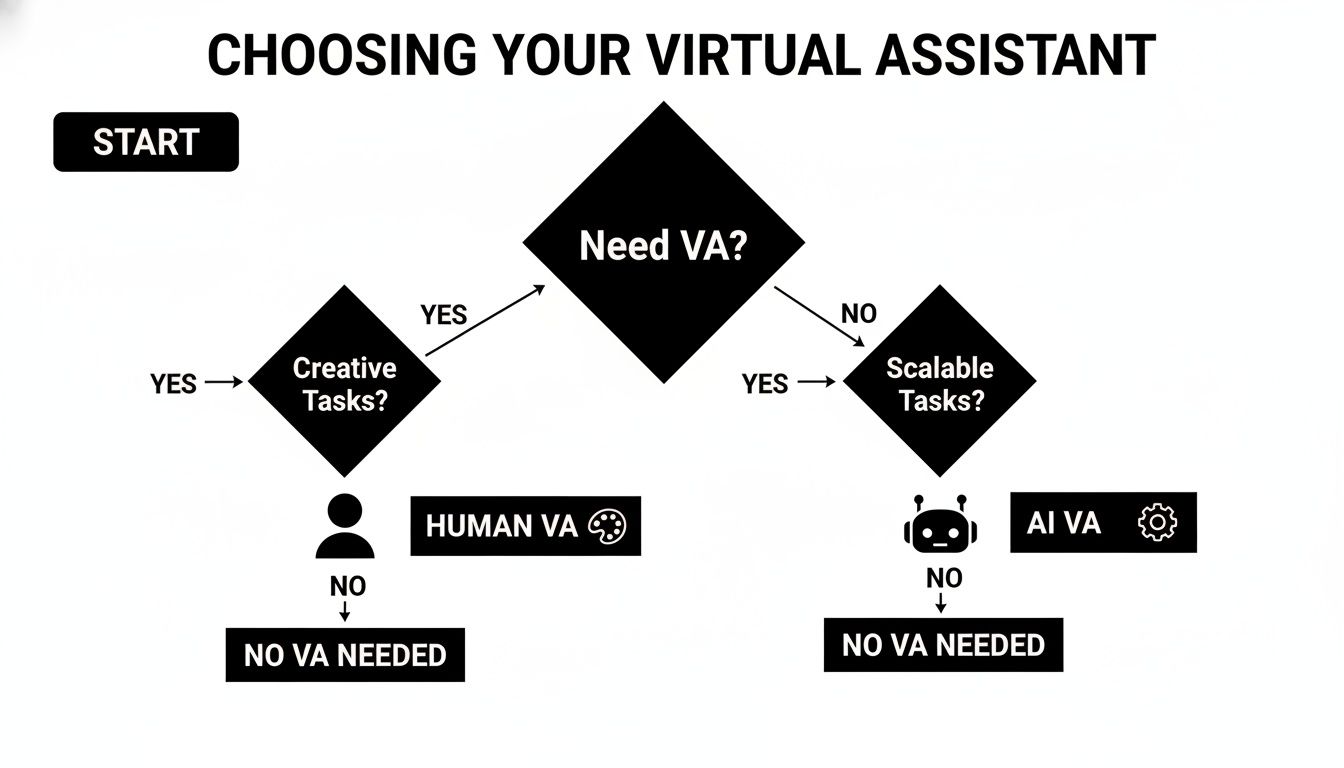
As you can see, for those repeatable, data-heavy, and scalable tasks—like personalization—an AI virtual assistant is clearly the better choice for boosting efficiency and driving real growth.
The Future of Personalized Shopping
The numbers behind this shift are staggering. The global market for AI-powered virtual shopping assistants was valued at **$4.33 billion** in 2025 and is expected to skyrocket to **$46.76 billion** by 2035. More importantly, research shows these assistants can lift e-commerce sales by **20%**. A significant **36%** of all interactions with a VA involve product searches that lead directly to a purchase.
Here in the US, AI in e-commerce is on track to become a **$13.94 billion** market by 2035. If you want to dig deeper into the data, you can explore the complete market analysis on virtual assistants to see the full picture.
In the end, using an e-commerce virtual assistant for personalization is about so much more than just showing customers relevant products. It’s about building a genuine relationship founded on understanding their needs. This is how you foster loyalty and create a shopping experience that turns one-time buyers into lifelong fans.
A Practical Guide to Implementing Your First Virtual Assistant
Bringing a virtual assistant into your business can feel like a massive project, but it’s really just a series of clear, manageable steps. Think of it less like a traditional hire and more like installing a new, hyper-efficient operating system for your brand. This guide will walk you through the process, turning the vague idea of "delegation" into a concrete plan with real returns.
The journey starts with a simple, honest audit of your own time. Where is your day *really* going? The first step is to figure out what's slowing you down.
Phase 1: Identify Your Bottlenecks
Before you can offload work, you have to know what's worth offloading. For just one week, keep a detailed log of everything you do. And be brutally honest with yourself. How many hours did you really spend answering "Where is my order?" emails, fiddling with product inventory, or manually posting on social media?
This exercise will shine a spotlight on your biggest time sinks—those repetitive, low-impact tasks that eat up your day. These are the perfect first jobs for an **e-commerce virtual assistant**. The goal isn't to hand over everything at once, but to target the tasks that will give you the most immediate relief and free you up for high-level strategy.
Phase 2: Define Clear Goals and KPIs
Once you know *what* you're delegating, you need to define what a "good job" looks like. Vague instructions only lead to mediocre results. Instead, you need to set clear, measurable goals and Key Performance Indicators (KPIs) for your assistant.
* **For Customer Support:** "Reduce first-response time to under one hour" or "Resolve **90%** of tickets without needing my help."
* **For Operations:** "Make sure **100%** of orders are processed within 24 hours" or "Keep inventory accuracy above **99%**."
* **For Marketing:** "Schedule **30** social media posts per month" or "Push email open rates up by **5%**."
> Setting specific targets turns your virtual assistant from a simple helper into a goal-oriented part of your team. It makes it incredibly easy to track their performance and see the direct impact they're having on your business.
Phase 3: Onboard and Integrate Your Assistant
Now it’s time to get them set up. The process looks a little different depending on whether you've chosen a human or an AI assistant, but the core principles of clear communication and tool integration are the same.
If you’re working with a human VA, you'll need to create standard operating procedures (SOPs) and give them access to your tools. With an AI platform like SynthAI, the process is much quicker. Integration is often just a few clicks—you connect your essential platforms like Shopify, Google Ads, and your email, and the AI immediately has the context it needs to start working.
For instance, with SynthAI, you don’t write complicated instructions. You just state your goal in plain English, like, "Launch a flash sale for our top-selling product this weekend." The system then coordinates its specialized assistants to:
1. Generate the social media announcements.
2. Write and schedule the promotional emails.
3. Monitor the ad performance in real-time.
This kind of automated workflow turns a simple goal into a fully executed campaign without you having to micromanage every step, making the whole "onboarding" process incredibly fast and painless.
Measuring the ROI of Your E-commerce Assistant
It’s easy to see an **e-commerce virtual assistant** as just another monthly expense on the balance sheet. But how do you prove it’s actually a profit center—an investment that pays for itself and then some?
Tracking your return on investment (ROI) means looking past the initial cost and seeing the complete value it brings, which includes both the hard numbers and the less obvious strategic advantages.
Calculating Your Tangible Returns
Let's start with the straightforward stuff: the metrics you can track in a spreadsheet. This is where your assistant’s work clearly connects to your bottom line.
Think about it this way:
* **Increased Conversion Rates:** When your assistant is on the job 24/7, answering questions instantly and nudging shoppers who abandoned their carts, more of those visitors will actually click "buy."
* **Higher Average Order Value (AOV):** A smart assistant doesn't just answer questions; it actively sells. By suggesting the perfect upsell or a relevant product bundle at just the right moment, it bumps up the value of each purchase.
* **Lower Support Costs:** This one is pure math. If an AI assistant handles **500 tickets** a month that would’ve taken a human team member **50 hours** to resolve, you've just pocketed a direct, measurable cost saving.
Tools like SynthAI make this incredibly simple. Their dashboards are built to show you exactly how much revenue your AI assistants are generating.
This screenshot from SynthAI's platform shows how you can see the revenue influenced by your AI assistants in real time.
Being able to draw a straight line from a specific AI-driven marketing campaign or customer chat directly to a sale is how you prove its financial worth without any guesswork.
The Hidden Value of Strategic Gains
But that's only half the story. The numbers don't capture the massive strategic return you get from freeing up your most valuable resource: your own time.
This "hidden ROI" includes things like having more mental space for product innovation, side-stepping founder burnout, and ensuring your brand's voice is perfectly consistent everywhere.
> When your e-commerce virtual assistant is managing the daily grind, you are freed up to be the visionary your business needs. This shift from operator to strategist is where the most significant long-term growth happens.
Got Questions About E-Commerce VAs? Let's Clear Things Up.
Alright, even after seeing the potential, you're bound to have some practical questions. That’s smart. Let's tackle the most common ones I hear from store owners so you can move forward with confidence.
How Much Does an E-Commerce Virtual Assistant Cost?
This is the big one, and the answer really depends on which route you take. If you hire a human VA based in the U.S., you're typically looking at an hourly rate of **$15 to $75+**. That rate swings based on their experience and skillset, and your total monthly bill can be a moving target, especially when things get busy.
On the other hand, AI assistants like SynthAI usually come with a flat monthly subscription. For many, this is a breath of fresh air. It makes budgeting a whole lot simpler because you know exactly what you're paying, even if the AI is working around the clock. You get predictable costs without any surprises.
Can a Virtual Assistant Handle Creative Marketing Tasks?
Yes, absolutely—but in very different ways. A human VA is fantastic for running with a marketing plan you’ve already mapped out. They can take your ideas, manage your social media presence, and write emails, but they generally need your strategic direction.
An AI assistant is a different beast entirely. Modern AI can build and run entire campaigns from the ground up. Imagine an assistant that creates a full social media calendar, writes all the email copy, and even generates promotional videos for you. It connects all the dots so your marketing feels cohesive, all without you having to orchestrate every single move.
How Difficult Is Integrating a VA with My Tools?
The difficulty of getting a new assistant plugged into your business depends completely on whether they're human or AI. Bringing a person on board means you have to train them on every single tool you use. You'll spend time walking them through your processes and carefully setting up permissions, which can be a headache and a potential security risk.
> Frankly, this is where AI platforms shine. They're built from the ground up to integrate securely and seamlessly. A solution like SynthAI can connect to your key tools—think Shopify, HubSpot, and Zapier—in just a few minutes. It’s a true plug-and-play experience that gets you up and running almost immediately.
---
Ready to see how a team of coordinated AI assistants can transform your e-commerce operations? **SynthAI** assembles specialized AIs to run your marketing, sales, and support around the clock. Start your 7-day free trial today and discover a smarter way to scale.
Ready to Transform Your Business with AI?
Build your AI team and start automating your marketing today.