How to Plan Social Media Content That Drives Real Growth
SynthAI Team
Content Team
Let’s be honest, the "post and pray" method of social media just doesn't work. If you want to see real business growth, you need a plan. It all boils down to three core elements: **defining your goals**, **understanding your audience**, and **establishing your content themes**. Get this trio right, and you'll stop wasting time on random posts and start creating content with a clear purpose.
Build Your Social Media Foundation for Growth
Before you even think about writing a caption or picking a filter, we need to lay the groundwork. A powerful social media presence isn’t an accident or a stroke of viral luck; it's built on a solid, intentional strategy. Without this foundation, you’re just shouting into the void and hoping someone, somewhere, is listening.
The first move is to look past vanity metrics. Likes are nice, but they don't pay the bills. Instead, let's tie your social media efforts to tangible business objectives. What do you *actually* want to achieve?
* **Generate qualified leads** by pushing traffic to a high-value landing page.
* **Improve customer retention** by fostering a genuine community around your brand.
* **Drive direct sales** for your e-commerce products with compelling showcases.
* **Become a thought leader** in your niche by consistently sharing expert insights.
This isn't just a list; it's about drawing a straight line from your goals, to your audience, to the content you create every single day.
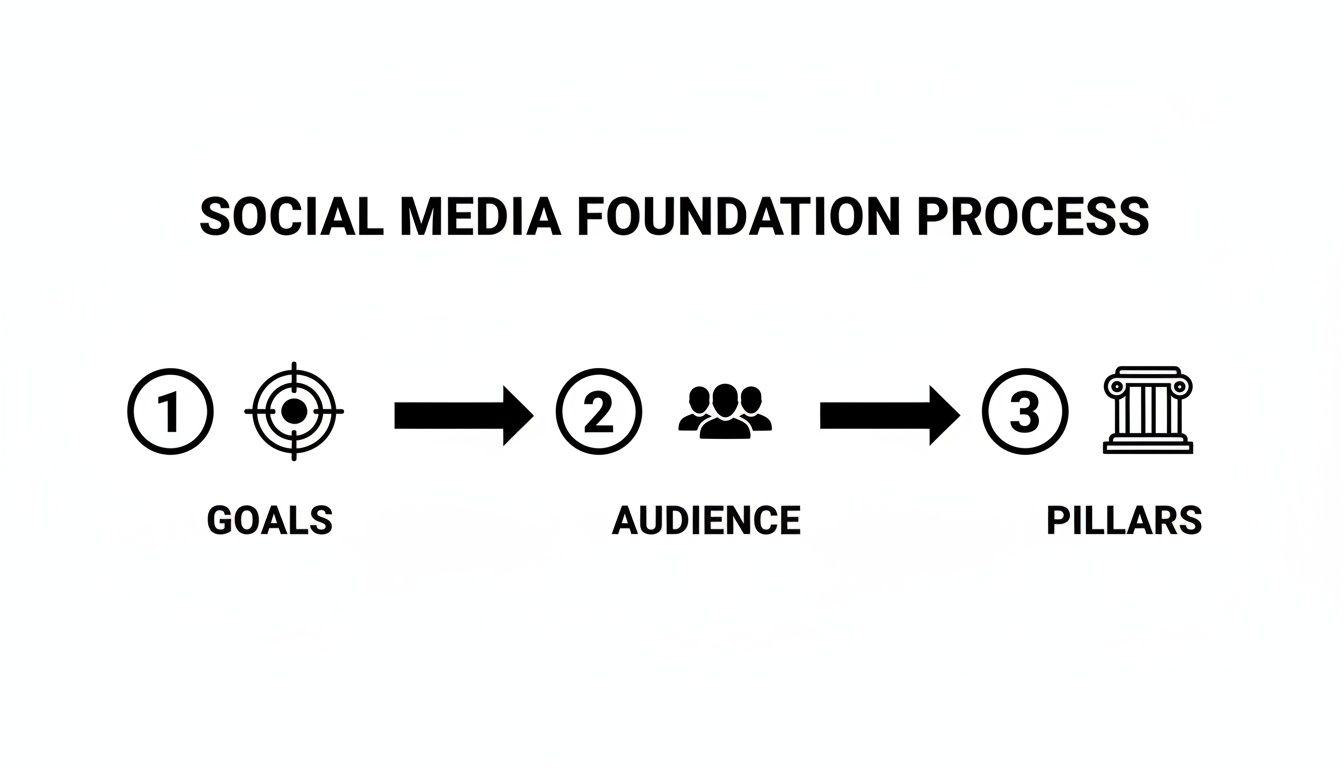
Think of it this way: each piece builds on the last, creating a sturdy framework that will support all your future content.
Know Who You're Talking To
Once you know *what* you want to accomplish, you have to figure out *who* you're talking to. And I mean *really* know them. This goes way beyond basic demographics.
A persona for a SaaS company isn't just "Marketing Manager, 30-45." It’s "Maria, a 38-year-old Marketing Director at a mid-sized tech company who feels completely swamped by data and is under constant pressure to prove ROI to her C-suite."
See the difference? Understanding Maria’s specific pain points and where she hangs out online informs everything—the platforms you prioritize, your tone of voice, and the solutions you present in your content.
Establish Your Content Pillars
With your goals and audience dialed in, it’s time to define your content pillars. These are the **3-5 core themes** your brand will own. Think of them as the main subjects you’ll return to again and again, ensuring every single post feels on-brand and relevant.
> For instance, an e-commerce brand selling sustainable activewear might build its strategy on pillars like *Eco-Friendly Fitness*, *Mindful Movement*, and *Behind the Seams*. This gives them a clear lane to talk about everything from workout tips to their ethical manufacturing process.
A focused framework like this is non-negotiable, especially when you consider the sheer scale of social media. We're talking about a projected **5.42 billion users** by 2026, with the average person juggling more than six different platforms a month. To cut through that noise and make an impact, you need focus, not a scattergun approach. For more context, check out the full breakdown of these social media statistics on Agorapulse.com.
If you’re using SynthAI, this foundational step gets a lot easier. The platform's assistant, Echo, can analyze your business goals and audience inputs to suggest effective content pillars for you, giving you a massive head start on your planning.
Develop Your Content Pillars and Ideation Engine
Alright, you've got your strategy mapped out. Now for the fun part: turning those big-picture content pillars into a steady stream of actual post ideas. This is where we build your creative engine—the system that keeps your channels buzzing with content that people actually want to see.
Think of your content pillars as the main themes of your show. If a pillar for a SaaS company is "Productivity Hacks," the individual episodes could be things like "Automating Repetitive Tasks," "Team Collaboration Tips," or "Maximizing Your Workday." This is how you stay focused and consistently deliver value.

From here, you can get creative with formats. A single idea can be spun into a ton of different posts, keeping your feed from getting stale.
* **Behind-the-scenes Stories:** Show your team actually using one of your productivity hacks.
* **Expert Q&A Sessions:** Go live on Instagram with a productivity guru.
* **User-Generated Content Campaigns:** Run a contest asking your audience for their best tips.
Suddenly, one core idea becomes a week's worth of content, each piece tailored to a different platform or audience segment.
Brainstorming with Purpose
Great ideas rarely come from staring at a blank screen. You have to go find them. Use social listening tools to track keywords and hashtags related to your pillars. What are people struggling with? What questions keep popping up? These conversations are a goldmine.
It's also smart to do a quick gut check on what your competitors are doing. Notice any gaps? If their feed is all polished graphics, maybe there’s a huge opportunity for you to win with authentic, unscripted video. You're not looking to copy them—you're looking for the empty space in the conversation that your brand can own.
> **Pro-Tip:** I always recommend creating **2-4 recurring content series**. Think "Tool Tip Tuesday" or a "Weekly Win" spotlight. These become predictable touchpoints that your audience looks forward to, and they make filling your calendar so much easier.
To get you started, here’s a quick breakdown of how different businesses might approach their content pillars and generate specific post ideas.
Sample Content Pillars and Post Ideas by Business Type
| Business Type | Content Pillar | Example Post Idea (Format) |
| :--- | :--- | :--- |
| **E-commerce** | Behind the Scenes | A Reel showing how a popular product is designed and made. |
| **E-commerce** | User-Generated Content | A carousel post featuring customer photos with a "tag to be featured" call to action. |
| **SaaS** | Customer Success | A short video testimonial from a power user sharing a specific win. |
| **SaaS** | Educational How-To | A screen-recorded tutorial solving a common user problem. |
| **Agency** | Industry Insights | A LinkedIn text post sharing a contrarian take on a recent marketing trend. |
| **Agency** | Case Study Showcase | A detailed carousel breaking down the results of a successful client campaign. |
These examples show how a single pillar can spawn a variety of formats, ensuring your content calendar always feels fresh and valuable.
Keeping It Authentic and Human
While tools can speed things up, people still connect with people. A recent Sprout Social report confirmed what many of us already knew: audiences want to see human-created content. AI is fantastic for crunching data and sparking ideas, but the final touch has to be authentic. The report suggests that social media managers should plan **2-4 recurring series** and map out **8-10 episodes** that are directly tied to goals like customer acquisition or retention.
This is where SynthAI's Echo can be a massive help. You can feed it a content pillar like "Customer Success" and ask it to generate sub-topics, suggest post formats, and even outline a recurring series. It takes care of the initial heavy lifting, so you can focus on adding that crucial human element.
Building Your Social Media Content Calendar: From Ideas to Action
Let's be real: all those amazing content ideas are just noise until you get them organized. This is where a solid content calendar comes in. It’s not just a spreadsheet; it's your command center, the actual roadmap that takes your strategy from a document to the real world. Think of it as the single source of truth for what gets posted, where, and when.

Honestly, the tool you use matters less than your commitment to actually using it. You can absolutely start with a simple Google Sheet or a Trello board. As your operation gets more complex or your team grows, you might find yourself graduating to a more robust platform that bundles scheduling and analytics. The key is to find a system that works for your team, not against it.
Whatever tool you land on, make sure it tracks a few essential details for every single post.
What Every Calendar Entry Needs
To keep things running like a well-oiled machine, each calendar entry should be a mini-brief. This is how you avoid those last-minute "Hey, where's the image for this?" panics and make sure everyone from the copywriter to the designer is on the same page.
Here’s what I recommend including for every post:
* **Publish Date and Time:** The exact moment it’s set to hit the feed.
* **Platform:** Which channel is this for? (e.g., Instagram, LinkedIn, TikTok).
* **Content Format:** Be specific. Is it a Reel, Carousel, single image, text-only?
* **Final Copy:** The exact caption, headline, and any text that needs to go on the visual.
* **Visual Asset:** A direct link to the final image or video file in your cloud storage.
* **Status:** A simple dropdown or tag to track progress (e.g., *Idea, In Progress, Awaiting Approval, Scheduled*).
This level of detail is a lifesaver. For an agency juggling multiple clients, that "Status" field becomes a crucial part of the approval process, creating a clear and seamless workflow so clients can sign off before anything goes live.
> A content calendar isn't just about scheduling; it’s about strategic oversight. It lets you see your content mix at a glance, spot gaps, and make sure you’re posting with purpose, not just filling a quota.
Getting the Content Mix Right
One of the fastest ways to lose followers is to turn your social feed into a 24/7 sales pitch. Nobody wants that.
A great guideline to prevent this is the **80/20 rule**. The idea is simple: **80% of your content** should deliver pure value. This means educating, entertaining, or inspiring your audience. The other **20%** can then be used for more direct promotion of your products or services.
Sticking to this ratio keeps your feed from feeling like one long advertisement. Your calendar is the perfect tool to enforce this balance, letting you see if you’re getting a little too sales-heavy in any given week.
For example, an e-commerce brand could plan four posts on how to style their new jacket before dropping one post with a direct "Shop Now" link. This builds a genuine community and fosters trust, which in the long run, drives way more growth than aggressive selling ever will.
This is another area where a tool like SynthAI can give you a major assist. The Echo assistant can generate a perfectly balanced content calendar based on your pillars and the **80/20 rule**. It will even populate it with post ideas, draft copy, and visual concepts, taking a huge chunk of the planning work off your plate.
Work Smarter with Content Batching and Repurposing
Let's be honest: the secret to a great social media presence isn't about grinding out new content every single day. It's about being strategic. Once you have a content calendar in place, the real hurdle becomes feeding it a steady stream of quality posts without completely burning out.
This is where two powerful tactics come into play: **content batching** and **repurposing**. They’re the difference between frantically scrambling for a post and having a well-oiled content machine.
Content batching is beautifully simple. You group similar tasks together and knock them out in one focused session. Instead of bouncing between writing a caption, designing a graphic, and then filming a video, you dedicate specific blocks of time to each task. Think "Video Day," "Writing Wednesday," or "Graphic Design Friday."
This method is a game-changer for productivity. It kills the constant context-switching that drains your mental energy and lets you get into a creative flow state.

You’ll find that top creators and brands live by this. They aren't shooting a new reel every morning before their coffee. They're filming all of their video content for the entire month in just one or two marathon sessions.
From One to Many with Repurposing
Now, let's talk about repurposing. This is the art of taking one substantial piece of content and spinning it into gold across multiple platforms. You do the heavy lifting just once, then slice, dice, and reformat it to get the most mileage out of your work.
Imagine you just hosted a one-hour webinar. That single asset is a content goldmine just waiting to be excavated.
* **Instagram Carousel:** Pull out the key takeaways and turn them into a swipeable, easy-to-digest carousel.
* **Short-Form Video:** Find the best **30-60 second soundbites** and clip them for TikTok and Instagram Reels.
* **LinkedIn Article:** Transcribe a particularly insightful segment and expand it into a thought-leadership post.
* **Quote Graphics:** Lift the most powerful quotes and design them as shareable images for X (formerly Twitter).
> This isn't just a time-saving hack. It’s about meeting your audience on their turf. The person scrolling through TikTok isn't likely to sit through your full webinar, but they'll happily consume your core message in a bite-sized video clip.
When you combine batching with repurposing, you create a truly sustainable content engine. You focus your energy on creating a handful of high-value "pillar" assets each month, then methodically break them down to fill your entire calendar with native content for each channel.
This is another area where SynthAI can be a huge help. You can upload a long-form video, and its assistant, Visio, will automatically pinpoint the most engaging segments, generate clips with captions, and even draft platform-specific headlines. It handles the most tedious parts of repurposing, freeing you up to think about the bigger strategic picture.
Get Your Content Scheduled and Measure What Actually Matters
You've done the heavy lifting—you have a stockpile of great, repurposed content ready to go. Now for the final pieces of the puzzle: getting it all published without losing your mind and figuring out if it's actually working. This is where smart scheduling and sharp analytics turn your plan into real, measurable growth.
Consistent posting is table stakes, but posting at the *right time* is how you win.
Thankfully, modern social media management tools have made manual posting a thing of the past. You can queue up an entire week or month's worth of content in one sitting. This frees you from the daily grind of publishing and lets you focus on what really moves the needle: engaging with your audience in the comments and DMs.
Tools like our own **SynthAI** take this even further. The Echo assistant, for instance, doesn't just post for you; it analyzes when your audience is most active on each platform and automatically schedules your content for those peak moments. It’s a data-backed approach that takes all the guesswork out of timing.
Focus on Metrics That Drive Business Goals
Hitting "publish" is just the beginning. The only way to know if your content plan is successful is to measure the right things. It’s incredibly easy to get distracted by vanity metrics like follower counts and likes, but they rarely paint the full picture.
The real question you should be asking is: **Is our social media activity helping us hit our business goals?**
To answer that, you need to tie your efforts back to specific Key Performance Indicators (KPIs).
Here's a quick guide to help you connect the dots between your business objectives and the social media metrics you should be tracking.
Matching Business Goals to Social Media KPIs
| Business Goal | Primary KPI to Track | Example Metric |
| :--- | :--- | :--- |
| **Brand Awareness** | Reach & Impressions | How many unique users saw your post? |
| **Lead Generation** | Click-Through Rate (CTR) | Percentage of users who clicked the link in your bio or post. |
| **Sales & Revenue** | Conversion Rate | The percentage of users who completed a purchase via a social link. |
| **Community Engagement** | Engagement Rate | The total number of comments, shares, and saves on a post. |
| **Customer Loyalty** | Brand Mentions | How often are users tagging your brand in their own content? |
Focusing on the right KPIs is what separates a social media "presence" from a social media *strategy*. It ensures every dollar and hour you invest is accountable.
This kind of targeted measurement is non-negotiable. Think about it: **64% of B2B buyers** are dedicating over an hour a week to consuming thought leadership content. With top-performing companies planning to spend over **$45k monthly** on content, you absolutely have to connect that investment to tangible outcomes.
It's precisely why **71% of marketers** are now using AI to track ROI and prove the link between social media activity and business results. You can dig into more of these marketing stats on The Digital Elevator's blog.
Creating Actionable Monthly Reports
You don't need a 50-page report that no one will read. A simple, actionable monthly summary is far more effective. The goal is to pull just enough data to answer three critical questions:
1. What really resonated with our audience this month?
2. What fell completely flat?
3. What adjustments should we make for next month?
> Your analytics should tell a story. If a certain video format consistently drives high engagement and website clicks, that’s your signal to double down. If your long-form text posts on LinkedIn are getting ignored, it's time to try something new.
This constant feedback loop is what makes a content plan truly powerful. It stops being a static document and becomes a dynamic engine for improvement, getting smarter and delivering better results for your business month after month.
Got Questions About Your Content Plan? We’ve Got Answers.
Moving from a high-level strategy to actually getting content out the door is where the real work begins. It’s also where some of the most common, nagging questions pop up. Let's walk through the ones I hear all the time and get you some practical answers.
How Often Should I *Really* Be Posting?
Everyone wants a magic number, but the honest answer is: it depends. The non-negotiable rule I tell every brand is that **consistency beats frequency**, every single time. It's far better to post three great pieces of content a week, every week, than to post three times a day for a week and then go silent because you're burned out.
If you’re looking for a solid starting point, here’s a general guide:
* **Instagram & Facebook:** Aim for **3-5 quality posts** a week. This keeps you present and top-of-mind without overwhelming your audience.
* **X (formerly Twitter):** This feed is a firehose. To stay part of the conversation, you'll likely need **1-3 relevant posts** per day.
* **LinkedIn:** Think of it as a professional journal, not a megaphone. **2-3 thoughtful updates** per week are more than enough to make an impact.
Ultimately, your own data is your best friend. Pay close attention to your analytics. They'll tell you exactly when your audience is listening and what posting rhythm gets the best reaction.
What Are the Best Tools for Planning Social Content?
Honestly, the best tool is the one your team will actually open and use every day. If you're flying solo or have a small crew, you don't need to overcomplicate things. A well-organized Google Sheets calendar paired with the free Meta Business Suite for scheduling can work wonders.
Once you start growing, you'll feel the need for something more robust. That's when platforms like Buffer, Hootsuite, or Agorapulse become invaluable. They bring all your channels, scheduling, and analytics into one place, which is a lifesaver for collaboration.
And if you’re looking to truly integrate your workflow with AI, a platform like **SynthAI** takes it a step further. It isn't just a planner. Its AI assistants, Echo and Visio, can help you brainstorm ideas, draft the copy, and even produce the video content, tying the entire process together from start to finish.
I'm Running Out of Content Ideas. Help!
We've all been there, staring at a blank content calendar. The trick is to stop waiting for inspiration and start building an "idea engine" that runs in the background.
Carve out a little time each week specifically for this. Here's where to look:
* **Listen in:** What are people talking about online? Use social listening to monitor hashtags, keywords, and even the comment sections of your competitors. The questions and complaints you see are pure gold.
* **Check your inbox:** Your customer support tickets and sales call notes are a direct line to your audience's pain points. Every question you get asked more than once is a perfect topic for a post.
* **Remix your greatest hits:** Find your top-performing blog post or video from last year. How can you break it down into a new format? Turn it into a carousel, a short video, or a quick-tip graphic.
> By making this a system, you're not just filling slots on a calendar. You're creating content that actively serves the audience you already have.
How Far Ahead Should I Plan My Content Calendar?
You need to find the sweet spot between planning and spontaneity. I've found that planning your core content—the stuff tied to your campaigns, promotions, and content pillars—at least **one month in advance** is a game-changer. It creates a solid foundation and eliminates that daily "what do I post?" panic. Some teams I know even map out their big themes quarterly.
But here’s the key: don't fill the calendar completely. I always recommend leaving about **20-30% of your schedule open**. This empty space is your playground for reactive content. It lets you jump on a trending sound, react to a piece of industry news, or share a cool customer story. These spontaneous posts often feel the most human and drive incredible engagement.
---
Ready to stop just planning and start automating? **SynthAI** assembles an entire AI business team to execute your social media strategy, from generating content calendars with Echo to creating video assets with Visio. See how it can 4x your efficiency and connect every post to real business growth. Start your free trial at getsynthai.com.
*Built with Outrank app*
Ready to Transform Your Business with AI?
Build your AI team and start automating your marketing today.