A Practical Guide on How to Write SEO Optimized Content
SynthAI Team
Content Team
Before you even think about writing, you have to get inside your reader’s head. SEO today is all about understanding *why* someone is searching, not just *what* they’re typing into the search bar. The whole game is matching your content to their need. Nail this, and you’re giving Google exactly what it wants to serve up.
Mastering Search Intent and Keyword Strategy

Seriously, don’t write a single word until you’ve decoded the *purpose* behind a search query. Chasing keywords with high search volume is an old-school tactic that just doesn't cut it anymore. Understanding **search intent** is the absolute bedrock of writing content that actually ranks and connects with people.
Think of it this way: if a customer walks into a hardware store and asks, "where are the hammers?" you don't launch into a lecture on the history of metallurgy. You point them to the right aisle. Your content needs to be that direct, that helpful.
Decoding the Four Types of Search Intent
Search intent usually boils down to four main categories. Figuring out which bucket your keyword falls into is crucial because it dictates the entire format and angle of your content.
* **Informational Intent:** Someone just wants to learn something. They're asking questions like "what is a sales funnel?" or looking up topics like "puppy training techniques." For these queries, you need to create comprehensive, educational content—think how-to guides, tutorials, or deep-dive blog posts.
* **Navigational Intent:** The user knows exactly where they want to go online. They’re searching for "SynthAI login" or "Amazon customer service" to get to a specific website. You generally don't target these unless it’s for your own brand.
* **Transactional Intent:** This person has their wallet out. They're using phrases like "buy nike air force 1" or "best price macbook pro." The best content here is a product page, a pricing page, or anything that lets them complete a purchase.
* **Commercial Investigation:** This is the "almost ready to buy" stage. The user is deep in research mode, comparing their options with searches like "SynthAI vs Jasper" or "best CRM for small business." Your best bet is to create comparison articles, product reviews, or detailed listicles.
Finding Keywords That Matter
Once you have a solid grip on intent, it's time to dig for keywords. Your goal isn't just to find popular terms. It’s about uncovering the phrases your audience is *actually* using and that you have a realistic shot at ranking for.
I always start by brainstorming a few broad "seed" keywords. If you sell running shoes, these might be things like "running shoes," "marathon training," or "trail running gear." From there, I use SEO tools to branch out into more specific, long-tail keywords.
Don't underestimate long-tail keywords. They’re longer, more specific phrases that, while having less search volume on their own, often convert like crazy because the user’s intent is crystal clear. Someone searching for "best waterproof trail running shoes for wide feet" isn't just browsing—they're ready to buy.
> **Pro Tip:** Look past search volume. Pay close attention to the Personal Keyword Difficulty (PKD) or a similar metric in your SEO tool. It estimates how hard it will be for *your site specifically* to rank for that term, helping you find those winnable battles.
Analyzing the SERPs for Clues
The final step is to put on your detective hat and analyze the Search Engine Results Page (SERP) for your target keyword. Google is literally handing you the answer key.
Go look at what’s already ranking on page one. Are they blog posts? Product pages? Videos? Are the top results listicles or in-depth guides? Take note of the titles, the headings, and the topics they all seem to cover. This isn't about copying; it's about understanding the proven formula for that specific query.
For those on our platform, the SynthAI Aura assistant can do a lot of this heavy lifting for you. It automates competitive analysis, pinpoints content gaps, and even suggests topic clusters, giving you a data-backed blueprint for your content in a fraction of the time.
Crafting a Bulletproof Content Outline and Title
Alright, you've got your keywords and you know what your audience is looking for. Now it's time to build the skeleton of your article. This is where a detailed outline comes in, and frankly, it's a step too many people skip.
An outline is your strategic map. It keeps you on track, ensuring you cover every crucial point and answer every question a reader might have. Without one, you risk rambling. With one, you create a piece that’s a breeze for both people and search engines to understand. This structural foundation is a non-negotiable part of writing SEO-optimized content that actually performs.
Building Your Outline from SERP Clues
So, where do you start? The best inspiration is already waiting for you on the first page of Google. Go search for your primary keyword and start reverse-engineering what's already working.
* **Look for Common Threads:** What H2s and H3s pop up again and again in the top 3-5 articles? These are the "table stakes" topics. You absolutely have to cover them, or your article will feel incomplete.
* **Spot the Gaps:** What *aren't* they talking about? Maybe there's a critical angle or a common question that everyone seems to be glossing over. That's your golden ticket to create something better and more comprehensive.
* **Check the "People Also Ask" Box:** Google is literally handing you a list of questions your audience is asking. Grab them! These make for perfect H2 or H3 headings in your outline.
Let's say you're targeting "how to start an e-commerce business." Your SERP analysis will quickly show that every top article covers legal structures, finding a niche, and marketing. But maybe you notice none of them dig deep into supply chain logistics or compare customer service software. Boom. That's your opportunity to provide more value.
> A clean, logical structure does more than just help readers. It sends a powerful signal to Google. When crawlers see a neat hierarchy (H1 -> H2 -> H3), they can easily figure out what your page is about and how all the different ideas connect.
This isn't just theory. Getting the structure right from the start has a real impact on things like how long people stay on your page—a key engagement metric.
Writing Titles That Demand a Click
Your title tag is your digital billboard in the search results. It has one job: earn the click. It’s your first and often only chance to convince someone that *your* link is the one they need.
A great title nails three things: it includes your main keyword, makes the reader curious, and accurately promises what's inside.
Here are a few battle-tested formulas I always come back to:
1. **The "How-To" Formula:** Simple, direct, and promises a clear solution.
* *Example:* "How to Write SEO Optimized Content That Ranks in 2026"
2. **The Listicle Formula:** Numbers signal a structured, easy-to-scan article. People love them.
* *Example:* "**12** Actionable Tips for Writing SEO Content That Converts"
3. **The "Mistakes to Avoid" Formula:** This one plays on our natural desire to avoid errors. It’s powerful.
* *Example:* "Avoid These **7** Common Mistakes in SEO Content Writing"
Just one final tip here: always try to keep your title under **60 characters**. Any longer and it's likely to get cut off in the search results, weakening your message. A winning title is a perfect mix of science (for the bots) and art (for the humans).
Writing and Optimizing Your On-Page Content
Alright, this is where all that research and planning really comes to life. You’ve got a solid outline, and now it's time to turn it into a living, breathing piece of content. The mission is simple: create the single best answer on the internet for your user's query, making your article the definitive resource they were hoping to find.
This isn't just about stuffing keywords into paragraphs. It's about crafting an introduction that grabs attention, building out a body that’s packed with insight, and polishing every on-page element until it shines.
Crafting a Compelling Introduction
Your introduction has one job: to stop the scroll. You have just a few seconds to convince someone they’ve landed in the right place. If you fail, they'll hit the back button, which tells Google your content wasn't a good match.
A knockout intro does three things, fast:
* **Connect with the reader’s problem:** Show them you get it. Acknowledge their question or pain point immediately.
* **Promise a clear solution:** Tell them exactly what they’ll learn or be able to do after reading your article.
* **Include your primary keyword naturally:** Weave your main keyword into the first paragraph or two. This confirms the topic for both the reader and search engine crawlers.
Skip the long, rambling preambles. Get straight to the point and deliver value from the very first sentence.
Building Topical Authority with Body Content
Once you've hooked them, the body of your content has to deliver on that promise. This is where you flex your expertise and build trust. The key to writing SEO-optimized body content isn’t about keyword density; it's about **topical depth and clarity**.
The best way to do this is to write naturally. Instead of robotically repeating your primary keyword, use synonyms and related concepts—what some people call LSI keywords. For example, if your article is on "email marketing software," you should naturally be talking about "newsletter platforms," "automation tools," and "campaign builders." This paints a richer, more complete picture for Google, helping it understand the full context of your topic.
> The secret is to write for humans, first and always. When you create something that is genuinely helpful, clear, and easy to digest, you’re also creating content that search engines love. The best SEO should feel completely invisible to the reader.
This is a great visual breakdown of how all the pieces of a well-structured article fit together, from the high-level title down to the final readability score.
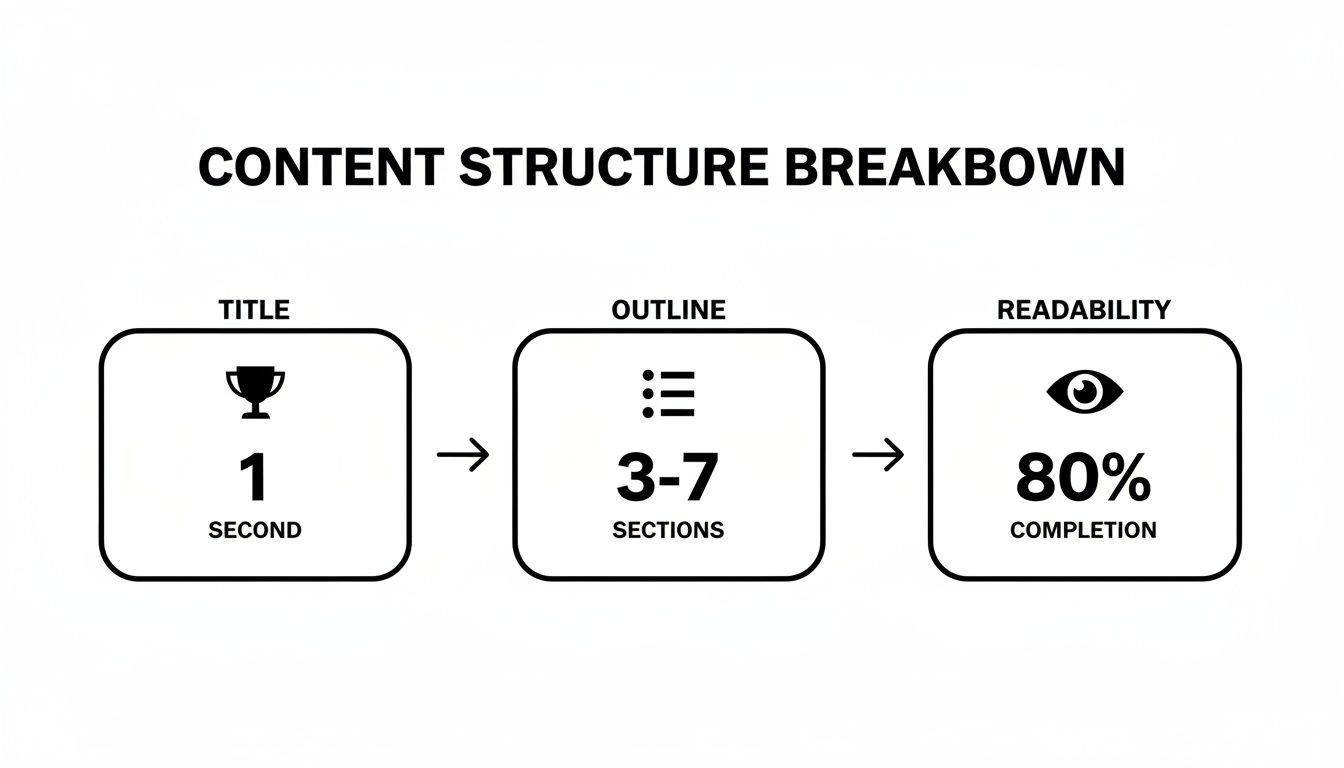
As you can see, each element builds on the last to create a piece that’s strong from top to bottom.
Why Content Depth Is So Critical
While quality will always beat sheer quantity, there's no denying that comprehensive content still has a major edge in the rankings. Why? Because longer, more in-depth articles tend to cover a topic more thoroughly, leaving the reader with no unanswered questions.
The data backs this up. The average word count for a top-ranking article is **around 1,447 words**, with some studies putting it closer to 1,890. More importantly, depth attracts authority signals; articles over **2,000 words** get an average of **77.2% more backlinks**. And it doesn't stop there. Content that breaks the **3,000-word** mark often pulls in **3x more traffic and 4x more shares**. If you want to dive deeper into the numbers, Incremys.com has a great compilation of SEO statistics.
Optimizing the Finer Details
Beyond your main copy, a handful of smaller on-page elements punch way above their weight in SEO. Never treat these as an afterthought; they're critical signals for search engines and users.
Before you hit publish, run through this quick checklist to make sure you’ve covered all your bases.
On-Page SEO Optimization Checklist
| On-Page Element | Best Practice | SynthAI Assistant Tip |
| :--- | :--- | :--- |
| **URL Slug** | Keep it short, descriptive, and include the primary keyword. Ex: `/seo-content-guide` | Ask SynthAI to suggest 3-4 clean, keyword-focused URL slugs based on your title. |
| **Meta Description** | Write a compelling 155-character summary. Include the keyword and a clear benefit to boost clicks. | Have SynthAI draft a meta description that includes a call-to-action to improve click-through rate. |
| **Image Alt Text** | Describe every image clearly for accessibility and SEO. Add a keyword where it fits naturally. | Prompt SynthAI to generate descriptive alt text for your images to ensure they're optimized. |
| **Image Compression** | Compress all images *before* uploading to ensure fast page load times, a key ranking factor. | While not an AI task, this is a non-negotiable step for a good user experience. |
Paying attention to both the big picture (your amazing content) and these crucial details is what separates good content from content that truly ranks and drives results. For teams using our platform, the **SynthAI** Aura assistant can take the guesswork out of this, suggesting optimized URL slugs, drafting persuasive meta descriptions, and generating accurate alt text in seconds.
Strengthening Your Site with Internal Links and Technical SEO
Writing a fantastic piece of content is a huge win, but honestly, it’s only half the job. If Google can't easily find, crawl, and make sense of your work, it’s like shouting into the void. This is where the less glamorous but absolutely critical side of SEO comes in, starting with a powerful strategy: internal linking.
Think of internal links as the hallways connecting all the rooms in your website. They're not just there for decoration; they guide both your readers and search engine crawlers from one relevant piece of content to the next. A well-thought-out internal linking structure does more than just lower your bounce rate—it builds a web of context that screams to Google which pages are the most important.
When you link from a high-authority page (like a popular guide) to a brand-new blog post, you're essentially passing some of that "link juice" along. You're giving your new content a valuable little boost right out of the gate. This is a core part of building an SEO strategy that snowballs over time.
Building a Smart Internal Linking Framework
Just dropping links here and there without a plan won't move the needle. You need a deliberate strategy that reinforces your site’s architecture and props up your most important content. The gold standard here is creating **topical clusters**.
The idea is simple: you have a main "pillar" page covering a broad topic, which is then supported by several more specific "cluster" articles that all link back to it.
Imagine you run an e-commerce store that sells coffee. Your pillar page might be a massive "Guide to Brewing Methods." From that guide, you'd link out to your cluster posts, like "The Best Grinders for French Press" or "How to Make Cold Brew Concentrate." Critically, each of those cluster articles must link *back up* to the main brewing guide.
This structure leaves no doubt in Google's "mind" that your brewing guide is the definitive authority on that topic for your entire website.
Here’s a simple way to approach this:
1. **Pinpoint Your Pillar Pages:** First, identify your most important content. These are the pages you want to rank for those big, competitive search terms.
2. **Find Relevant Linking Opportunities:** Use Google to find pages on your own site that are a perfect fit. Just search `site:yourdomain.com "your keyword"` to pull up every page where you’ve mentioned a relevant phrase. It's a surprisingly powerful trick.
3. **Use Descriptive Anchor Text:** The clickable text of your link (the anchor text) matters. Ditch "click here" and use something descriptive. Instead, try "our complete guide to brewing methods" to give both users and Google clear context about where they're going.
> An internal link is more than a simple navigation tool; it's a vote of confidence. By linking to another piece of your own content, you're telling search engines, "Hey, this page over here is important and highly relevant to the topic at hand."
Beyond Links: Technical SEO Essentials
While a smart internal linking strategy is a powerhouse, it works best when the rest of your site’s technical foundation is rock-solid. A few other technical factors have a direct impact on how search engines see and rank your content. If these are broken, even the world's best article will struggle to get seen.
**Key Technical SEO Checkpoints**
* **Page Speed:** Let's be real—nobody waits around for a slow website. If a page takes more than **2-3 seconds** to load, visitors are gone. You can dramatically improve this by compressing your images and optimizing your site's code.
* **Mobile-Friendliness:** With **over 60%** of searches happening on mobile devices, a responsive website isn't optional anymore. Your content has to look and work perfectly on a tiny screen.
* **Schema Markup:** This is a bit of code that helps search engines understand the *context* of your content on a much deeper level. By adding schema for articles, products, or FAQs, you can earn rich snippets—those eye-catching, beefed-up listings in search results that can seriously boost your click-through rate.
Nailing these technical details ensures your beautifully crafted content has a clear, unobstructed path to your audience. Don't let a simple technical hiccup hold you back.
Scaling Content Production with AI

Let's be honest: creating a steady stream of in-depth, high-quality content is a grind. For most teams, it’s a constant battle against the clock and a limited budget. This is exactly where AI can be a game-changer, helping you scale your output without letting quality suffer.
The secret isn’t to just hit a button and let a robot take over. It’s about treating AI as a powerful collaborator—a tireless assistant that handles the heavy lifting, freeing up your human experts to focus on strategy, creativity, and adding that final, irreplaceable layer of polish.
Weaving AI into Your Content Workflow
Think about your entire content process, from that first flicker of an idea to hitting "publish." AI can give almost every single step a serious speed boost. It doesn't replace your team; it amplifies their skills.
* **Brainstorming and Ideation:** AI assistants can tear through SERPs, competitor content, and Reddit threads in seconds. The result? A flood of relevant topic ideas and long-tail keywords you might have never found on your own.
* **Outline Generation:** Instead of manually piecing together an outline, an AI can instantly structure a comprehensive one based on the top-ranking articles for your keyword. This ensures you’re covering all the right subtopics from the get-go.
* **First Draft Creation:** This is where you see the biggest time savings. An AI can generate a solid first draft in minutes, which your writer can then refine, fact-check, and infuse with your brand's unique voice and perspective.
* **Copy Optimization:** AI tools are brilliant at flagging readability issues, suggesting semantic keywords to include, and drafting compelling meta descriptions and titles that get clicks.
Suddenly, content creation feels less like a manual slog and more like a strategic, efficient operation.
Practical AI Use Cases for Different Businesses
This isn't just theory. Businesses are already using AI to solve very specific, real-world problems.
**For E-commerce Stores:**
You have an online store with **500** products. Writing unique, SEO-friendly descriptions for every single one is a monumental task. With an AI assistant like **SynthAI's Aura**, you can feed it product features and target keywords to generate optimized descriptions at scale. Every product page becomes a distinct asset for search engines.
**For SaaS Companies:**
A huge challenge for SaaS companies is building out a comprehensive knowledge base. An AI can help draft step-by-step tutorials, flesh out answers to common user questions, and even help script video walkthroughs. This helps you build a support library that reduces churn and gets new users up to speed faster.
> The key is to see AI not as an outsourced writer, but as an efficiency multiplier. It handles the 80% of content work that's often process-driven, so your team can focus on the 20% that requires deep human expertise and creativity.
We're already seeing the impact of this shift. The amount of AI-generated content in Google’s top 20 results has exploded, hitting **17.3%** of articles in 2025—a massive jump from just **2.3%** in 2020. Companies using AI are churning out **42%** more content each month, and among B2B marketers, an incredible **87%** say it has improved their productivity. To get a better sense of how the ground is shifting, you can explore more SEO statistics and trends on SERanking.
Keeping Quality and Authenticity High
Of course, the big fear with AI is producing a mountain of generic, soulless content. This is where your team becomes more critical than ever.
**Human Oversight is Non-Negotiable**
* **Fact-Checking:** AI can get things wrong or pull from outdated sources. A human expert must always verify every claim, statistic, and date.
* **Injecting Brand Voice:** The AI gives you the skeleton, but a human writer needs to give it a personality—your brand's unique tone, humor, and point of view.
* **Adding Unique Insights:** Your team's firsthand experiences, customer stories, and hard-won opinions are what make your content truly valuable. AI simply can't replicate that.
When you pair the speed of AI with the strategic oversight of your human experts, you get a system that can produce top-tier, SEO-optimized content at a volume that would be impossible otherwise. This is how you win in a crowded field.
Common Questions About SEO Content Writing
Even when you've got the basics down, a few questions always seem to pop up. Let's tackle some of the most common ones I hear from teams just getting their sea legs with SEO writing. My goal here is to give you straight answers so you can move forward without any confusion.
What’s a Good Keyword Density?
Ah, the age-old question. The short answer? There’s no such thing anymore. Seriously. This is one of the biggest myths that just won't die.
Back in the day, SEO was a numbers game—you had to hit a certain percentage. But search engines have grown up. They're much smarter now and can spot a forced keyword from a mile away.
Instead of obsessing over percentages, focus on **topical relevance**. Think about it: if you write a genuinely helpful, in-depth article on a topic, you'll naturally mention your main keyword and a bunch of related terms (like synonyms and other relevant phrases). It just happens. Trying to cram keywords in where they don't belong makes for clunky reading and can even get you flagged for keyword stuffing.
> Forget about density. Just write for your reader. If you create something that’s actually useful, the keywords will take care of themselves.
How Important Is E-E-A-T for Ranking?
It's *incredibly* important. E-E-A-T—which stands for **Experience, Expertise, Authoritativeness, and Trust**—is Google's lens for judging content quality. It’s especially critical for any topic that could affect someone's health, money, or well-being, what Google has famously called "Your Money or Your Life" (YMYL) content.
So, how do you actually *show* you have E-E-A-T? It’s not just about saying you're an expert. You have to prove it.
Here are a few practical ways to do it:
* **Show off your authors:** Write detailed author bios that highlight their credentials, qualifications, and real-world experience on the topic.
* **Bring in other experts:** Don't be afraid to feature quotes or insights from other recognized leaders in your field. It adds weight to your claims.
* **Back it up:** Always link out to authoritative sources like studies, data, or original research. Show your work.
* **Keep it fresh:** No one trusts stale information. Regularly update your content to keep it accurate and current. In fact, a recent study showed content freshness is a big factor in showing up in AI-powered search results.
How Long Does It Take to See SEO Results?
I know, I know—the classic "it depends" answer is frustrating, but it’s the truth. SEO is a marathon, not a sprint. While you might see a few small traffic spikes early on, you're really playing the long game.
The timeline really hinges on a few key things:
* **Your website’s authority:** A well-established site with a solid history and good backlinks will see results much faster than a brand-new domain starting from scratch.
* **How tough the competition is:** Trying to rank for a term like "best running shoes" is a massive uphill battle that will take ages. But targeting something more specific, like "best waterproof trail running shoes for wide feet," can get you there much quicker.
* **Your own effort:** How often are you publishing great content? The more consistently you put out high-quality, comprehensive articles, the faster you'll build momentum.
As a general rule of thumb, you can start looking for real, meaningful traction within **6 to 12 months** of consistent work. If it happens faster, that’s fantastic, but patience is an absolute must. Trust the process, and the results will come.
---
Ready to produce high-quality, optimized content at a speed you never thought possible? **SynthAI** assembles a team of specialized AI assistants to automate everything from keyword research and outline generation to drafting and optimization, freeing you to focus on strategy. See how it works at https://www.getsynthai.com.
Ready to Transform Your Business with AI?
Build your AI team and start automating your marketing today.