Boost Your Store: Learn how to improve ecommerce conversion rate
SynthAI Team
Content Team
If you want to actually improve your ecommerce conversion rate, you need to stop thinking about just getting more traffic. The real growth comes from optimizing the entire journey for the visitors you already have. It's about finding every little point of friction and systematically smoothing it out, making the path from seeing a product to clicking "buy" as effortless as possible.
Your goal isn't just to make a sale possible; it's to make it feel easy, intuitive, and even enjoyable.
Why Your Conversion Rate Is the Ultimate Growth Lever
In ecommerce, traffic without conversions is just a vanity metric. You can drive thousands of visitors to your site, but if only a few of them end up buying something, you're just spinning your wheels. This is where conversion rate optimization (CRO) comes in—it’s the single most powerful tool you have for sustainable growth.
Think of it this way: CRO is the art and science of turning your existing traffic into revenue. A higher conversion rate means more sales from the *same number of visitors*. That directly lowers your customer acquisition costs and sends your profitability soaring.

This guide is designed to give you a clear, actionable framework to get this done. We're cutting through the vague advice to focus on a structured process that has been proven to get results. This isn't about guessing what might work; it's about a methodical approach to understanding your customers and making improvements backed by real data.
What the Data Tells Us
A quick look at global ecommerce conversion rates shows a massive gap between the average store and the top performers. Most sites are lucky to convert between **2%** and **3%** of their traffic. In fact, the global average sits somewhere between **2.35% and 2.9%**.
But the top **20%** of online stores? They're hitting rates between **3.5% and 5%**. Some highly-focused retailers even break into double digits. This data, highlighted in recent ecommerce conversion benchmarks, points to a huge opportunity for any store that isn't reaching those upper tiers.
The difference isn't luck. The top stores don't leave conversions to chance. They methodically analyze, test, and refine every single element of their online experience.
The Four Pillars of Ecommerce CRO
I've found that a truly successful strategy to improve your ecommerce conversion rate is built on four core pillars. When you master these, you create a powerful, continuous cycle of improvement that builds on itself over time. Each pillar covers a crucial stage of the optimization journey, from figuring out what's wrong to scaling what works.
> The core idea of CRO is simple: find out why your visitors aren't converting and fix it. By focusing on the user experience, you're not just increasing sales—you're building a brand that customers trust and return to.
This structured approach makes sure your efforts are focused where they'll have the biggest impact. The table below breaks down these foundational components.
The Four Pillars of Ecommerce CRO
A summary of the core components of a successful conversion rate optimization strategy.
| Pillar | Objective | Key Activities |
| :--- | :--- | :--- |
| **Diagnostics & Audits** | Identify why and where users are dropping off. | Analyzing web analytics, reviewing heatmaps, and conducting user surveys. |
| **Tactical Fixes** | Implement high-impact changes to remove friction. | Optimizing product pages, streamlining checkout, and improving site speed. |
| **Experimentation** | Validate changes with data before full implementation. | A/B testing headlines, calls-to-action, images, and offers. |
| **Monitoring & Scaling** | Track performance and automate successful strategies. | Setting KPIs, using analytics dashboards, and employing automation tools. |
By building your strategy around this framework, you can turn CRO from a series of random guesses into a reliable system for growth. And it gets even better. Platforms like SynthAI can orchestrate this entire process, using intelligent assistants to coordinate everything from deep-dive analytics to campaign execution, helping you and your team work smarter, not harder.
Finding and Fixing Your Conversion Leaks
Before you can start fixing things, you have to play detective. Every e-commerce site has conversion leaks—places where potential customers lose interest, get confused, or just give up. Your job is to find them. This isn't about guesswork; it's about following the data trails your visitors leave behind.
The whole point is to move from a vague feeling like, "I think our conversions are low," to a concrete diagnosis like, "We're losing people at mobile checkout because the payment options are a mess." That kind of clarity is where real optimization begins.
Assembling Your Diagnostic Toolkit
To find these leaks, you need to see your store through your customers' eyes. This means blending quantitative data (the 'what') with qualitative insights (the 'why'). I always start by making sure a few essential tools are in place.
* **Google Analytics 4 (GA4):** Think of this as your mission control for user behavior. The most important thing here is to set up your conversion funnels properly. You need to visualize the exact steps where users are dropping off, from the moment they hit a product page all the way to the thank-you screen.
* **Heatmap & Session Recording Tools:** You can't beat tools like Hotjar or Microsoft Clarity for this. Heatmaps give you a visual aggregate of where people click and scroll, but the real gold is in session recordings. You're literally watching anonymized videos of real people trying (and sometimes failing) to use your site.
* **On-Site Surveys & Feedback Polls:** Sometimes, the fastest way to find a problem is to just ask. A simple, non-intrusive poll asking, "Was anything preventing you from buying today?" can uncover issues you'd never find in your data.
These tools are powerful on their own, but they're unbeatable together. For example, GA4 might tell you that **40%** of users abandon their carts. That's the 'what'. But a session recording will show you *why*—maybe a promo code field is bugged on mobile, and you can watch them getting frustrated in real-time.
Translating Data into Actionable Insights
Once you have your tools running, it's time to start looking at the evidence. The trick is not to get overwhelmed by all the metrics. Instead, focus on the numbers that scream "friction" and point directly to an opportunity.
> Your data isn't just a collection of numbers; it's the voice of your customer. Learning to interpret it correctly is the most important skill in conversion rate optimization.
Zero in on these key diagnostic metrics to see where your funnel is bleeding money.
Key Metrics to Investigate
* **Funnel Abandonment Rate:** Where, exactly, are you losing people? Is it between adding to the cart and starting checkout? Or is it when they get to the shipping page? A huge drop-off at the shipping step is a classic sign that your shipping costs are a nasty surprise.
* **Bounce Rate on Key Pages:** A high bounce rate on a product page could mean anything from bad product photos to a confusing description. If it’s your homepage, your core value proposition might not be landing with new visitors.
* **Exit Rate by Page:** This tells you the *very last page* someone saw before leaving your site. High exit rates on any of your checkout pages are a massive red flag that you need to investigate immediately.
Let's say you see in GA4 that your "Payment Details" page has a **60%** exit rate. That's a huge problem. You could then jump over to Hotjar and filter for session recordings of users who left from that specific page. You might see a pattern: people hesitate, scroll up and down, and finally bail after realizing you don't offer PayPal or Apple Pay. Boom—you’ve just found a major conversion leak.
Automating Discovery with AI
Manually digging through all this data is time-consuming. Honestly, it can feel like a full-time job. This is where AI-powered platforms can give you a serious edge by doing the heavy lifting for you.
An intelligent system can monitor your analytics 24/7, flagging issues before they spiral into bigger problems. For instance, platforms like SynthAI use assistants like **Vantage** to automate this entire discovery process. It connects to your store's data, identifies anomalies in real-time—like a sudden spike in cart abandonment just on Android devices—and gives you an alert with a ready-made hypothesis to test.
This gives you an incredible head start. It turns what could have been hours of painful analysis into a clear, actionable starting point. You get to spend less time hunting for problems and more time actually fixing them, which is how you create a sustainable cycle of improvement.
High-Impact Strategies to Boost Conversions Now

Alright, you've pinpointed where your conversions are leaking. Now it's time to roll up our sleeves and start plugging those holes. This is the hands-on part of the process, where we make targeted changes that can deliver immediate, noticeable results.
We're not talking about a full-site redesign here. Forget that. The goal is to make smart, strategic tweaks to the elements that matter most to your customers on their path to purchase.
Supercharge Your Product Pages
Think of your product page as your best digital salesperson. If it’s not compelling, customers will simply walk away. I see so many stores making the classic mistake of using generic manufacturer descriptions and a couple of low-quality photos. That's a surefire way to kill a sale.
Start by treating your visuals as your most valuable asset. Customers can't touch or feel your product online, so your images and videos have to do all the heavy lifting.
* **Bring Products to Life with Imagery:** Show multiple high-resolution angles, lifestyle shots of the product in use, and even a 360-degree view if you can swing it. Help customers visualize it in their own lives.
* **Invest in Product Videos:** A quick video demonstrating the product can do wonders for conversion rates. It answers questions and builds confidence in a way that static images just can't.
* **Write Copy That Sells Benefits, Not Features:** Don’t just list specs. Translate them into tangible benefits. Instead of saying "10,000 mAh battery," try "All-day power for work and play, no need to hunt for an outlet."
The final piece of the puzzle is social proof. Displaying customer reviews, ratings, and user-generated content (UGC) is non-negotiable in today's market. People trust other shoppers way more than they trust slick marketing copy.
Create a Frictionless User Journey
How easy is it for someone to actually find what they're looking for on your site? A clunky or slow user experience (UX) is a notorious conversion killer. Site search is a perfect example. We know from the data that visitors who use site search can convert at rates up to **50% higher** than those who don't. Yet, so many stores have a search function that's practically useless.
> A seamless user experience isn't a luxury; it's a fundamental expectation. Every moment of confusion or frustration is an open invitation for your visitor to leave and buy from a competitor.
Make sure your navigation is intuitive and your search bar is powerful. A good search function should understand synonyms, forgive typos, and offer smart autocomplete suggestions. If a user searches for "running shoes" and gets zero results because you only call them "sneakers," you’ve just lost a sale. It’s that simple.
Craft Calls-to-Action That Actually Convert
That call-to-action (CTA) button might be the single most important element on any given page. Vague, passive CTAs like "Learn More" or "Submit" create hesitation and uncertainty. Your job is to make the next step totally obvious and irresistible.
Use action-oriented language that tells the user *exactly* what will happen when they click. "Add to Cart" is the standard, but something like "Get Your Free Trial Now" or "Reserve My Spot" can be even more effective because they create a sense of urgency and communicate clear value.
Here's a quick look at the difference:
| **Weak CTA** | **Strong CTA** | **Why It Works** |
| :--- | :--- | :--- |
| Submit | Get My Free Ebook | Specifies the value and outcome. |
| Continue | Go to Secure Checkout | Builds trust and clarifies the next step. |
| Search | Find Your Perfect Fit | Makes the action feel personalized. |
And please, make your main CTA pop. It should be the most visually prominent button on the page, using a contrasting color that grabs the eye without clashing with your brand design.
Streamline Your Checkout Process
The checkout is the final hurdle, and it's where most brands stumble. According to the Baymard Institute, nearly **70% of all shopping carts** are abandoned. When you dig into the reasons why, it almost always comes down to friction—unexpected costs, forcing account creation, or just a long, confusing process.
Every single field you ask a customer to fill out is another chance for them to give up and leave.
Here’s how to fix it:
1. **No Surprise Costs:** Show all costs, including shipping and taxes, as early as possible. Surprise fees are the number one reason people abandon their carts.
2. **Always Offer Guest Checkout:** Forcing users to create an account is a massive conversion killer. Make checking out as a guest the easiest path forward.
3. **Provide Multiple Ways to Pay:** Offer popular payment methods like PayPal, Apple Pay, and Google Pay alongside credit cards. This reduces friction and signals that your site is trustworthy.
It’s also smart to know where you stand. Recent industry-specific data shows that personal care and food & beverage brands lead the pack with conversion rates of **6.8%** and **4.9%**, respectively. In contrast, home decor (**1.4%**) and general retail (**1.9%**) often lag behind, partly due to higher price points and longer consideration phases. This just goes to show how critical a smooth checkout is, especially in industries where customers are already more hesitant. You can dig into more of these industry conversion rate variations on Statsig.com.
By working through these high-impact areas one by one, you can start moving the needle on your conversion rate right away. This is also where AI tools like SynthAI's **Basis** can help by automating the creation and testing of optimized landing page copy, while assistants like **Lumen** can deploy targeted email campaigns to recover those abandoned carts, making this whole process faster and more effective.
Building Your Ecommerce Experimentation Engine
Real optimization isn't about making a few fixes and calling it a day. It's about creating a continuous loop of learning, testing, and improving. You need to build a system—an experimentation engine—that turns the insights you've gathered into actual, measurable growth. This is how you create a culture where every change is a chance to learn more about your customers.
Making data-backed decisions is what separates the stores that grow from the ones that stagnate. Instead of just going with your gut, you can systematically test your ideas to find out what *really* works. This ensures every effort you make is actually pushing your conversion rate in the right direction.
Crafting a Strong Hypothesis
Every valuable experiment kicks off with a solid hypothesis. This isn't a wild guess; it's an educated statement rooted in the data you've already collected. The idea is to clearly state what you're changing, what you expect to happen, and why you think it will happen.
A good hypothesis follows a simple formula: **If I change X**, then **Y will happen**, because **Z**.
Let's walk through a real-world example. Say your heatmap data shows that hardly anyone on mobile is tapping your main "Add to Cart" button, which is currently a muted grey.
* **Your Hypothesis:** "If we change the CTA button color from grey to a high-contrast orange, then we will see an increase in add-to-carts on mobile, because the new color will stand out more against the white background and grab the user's attention."
This statement is specific, it's testable, and it’s directly linked to a business goal. It gives a logical reason for the expected outcome, making it the perfect starting point for an A/B test.
Prioritizing Your Tests for Maximum Impact
You're going to have a long list of testing ideas. The trick is to avoid testing random things and instead focus on what will give you the biggest bang for your buck. A simple prioritization framework is your best friend here.
> The point of experimentation isn't just to find "winners." It's to learn. Even a "failed" test gives you priceless information about what your audience *doesn't* respond to, which is just as important as knowing what they do.
By scoring your ideas, you can build a clear roadmap for your testing program. This makes sure you’re always working on the changes most likely to actually move the needle.
To make this easier, you can use a simple scoring system to decide where to start. This helps you focus your limited resources on the tests that matter most.
A/B Testing Idea Prioritization Framework
A simple framework to help you decide which optimization ideas to test first for maximum impact.
| Test Idea | Potential Impact (1-5) | Confidence (1-5) | Ease of Implementation (1-5) | Priority Score |
| :--- | :--- | :--- | :--- | :--- |
| Change CTA Button Color | **3** | **4** | **5** | **12** |
| Redesign Entire Homepage | **5** | **3** | **1** | **9** |
| Rewrite Product Descriptions | **4** | **4** | **3** | **11** |
| Add a New Payment Option | **4** | **5** | **2** | **11** |
*Note: The Priority Score is calculated by adding Impact + Confidence + Ease. Higher scores get tested first.*
Looking at this table, changing the CTA button color is the obvious first choice. It’s a quick fix, and you’re pretty confident it will work based on your data. The full homepage redesign might have a huge impact, but it's a massive project and can wait.
Running and Interpreting Your Experiments
With your prioritized hypothesis ready to go, it’s time to set up the A/B test. One version of your page (the **control**) stays the same, while the other (the **variant**) gets the change you’re testing. You split your traffic between the two and measure which one performs better against your target metric—in our example, the add-to-cart rate.
Once the test runs its course and you have a statistically significant result, you can make a call. If the orange button won, you roll it out to **100%** of your traffic. If it lost or made no difference, you’ve learned something important and can move on to the next test on your list.
Managing this whole workflow—from hypothesis to analysis—can get overwhelming fast, especially as you start running more tests. This is where a platform like SynthAI can be a huge help. You can use its **Basis** assistant to automatically deploy test variants of your pages and have **Vantage** track the performance in real-time. This lets you run multiple experiments at once without all the manual overhead, turning your optimization engine into a well-oiled machine that constantly finds new ways to grow your revenue.
Automating Growth with an AI-Powered CRO Team
Let's be honest. Manually running diagnostics, implementing fixes, and building out a full-blown experimentation program is a massive undertaking. It takes a dedicated team, a serious budget, and countless hours staring at data. For most e-commerce businesses, that kind of manual effort just isn't in the cards.
This is where intelligent automation completely changes the game. Instead of hiring an entire crew of analysts, copywriters, and marketers, you can deploy a coordinated team of AI assistants. They’ll run your entire optimization program around the clock, working tirelessly to **improve your e-commerce conversion rate**.
Orchestrating a Closed-Loop Optimization System
Imagine a system that doesn’t just flag problems but actually jumps in to fix them. That’s the whole idea behind an AI-powered CRO team, like the one offered by SynthAI. This isn't just a single tool; it's a collection of specialized assistants that work together—a lot like a human team, but operating at machine speed and scale.
Here’s a real-world example of how this plays out. Let's say **Vantage**, the analytics assistant, spots a sudden **15%** drop in the conversion rate for one of your top-selling products over the last 24 hours. Instead of just shooting you a static report, it triggers an entire workflow.
It immediately pings **Nexus**, the central coordinator, which then organizes a response on multiple fronts:
* **Aura**, the SEO and ads specialist, gets tasked with checking whether a recent algorithm update or ad campaign glitch is tanking qualified traffic.
* **Lumen**, the email marketing assistant, is instructed to launch a targeted retargeting campaign for users who abandoned their cart with that specific product.
* **Basis**, the landing page expert, is assigned to create and A/B test a new product description or headline to see if it resonates better with visitors.
This creates a powerful, closed-loop system. It identifies an issue, diagnoses the likely causes, and deploys solutions all at once, without anyone needing to lift a finger. It’s a proactive approach that moves lightyears faster than any human team could.
Real-World AI Workflows for E-commerce Growth
Beyond just putting out fires, an AI team can drive growth by automating the entire content and campaign lifecycle. This goes way beyond basic chatbots or content spinners. We're talking about integrated workflows designed to lift conversions at every single stage of the customer journey.
You can instruct a platform like SynthAI with simple, natural language goals. For instance, you could ask it to "create a social media calendar for our new summer collection to drive traffic to the product pages."
The system would then activate the right assistants for the job:
1. **Echo** (social media) would generate a month's worth of posts—complete with images and captions—tailored for Instagram, Facebook, and TikTok.
2. **Visio** (video) could be tasked with creating short, punchy video ads from your existing product photos to use in the social campaigns.
3. **Vantage** (analytics) would keep an eye on the performance of every post and ad, tracking click-through rates and on-site conversions to report back on ROI.
> The real power of AI in CRO isn't just speed; it's coordination. When specialized AI assistants work together, they can execute complex, multi-channel strategies that would be impossible for a small team to manage manually. This is how you truly scale your optimization efforts.
This diagram breaks down the core, repeatable process that an AI-powered experimentation engine can run for your store, day in and day out.
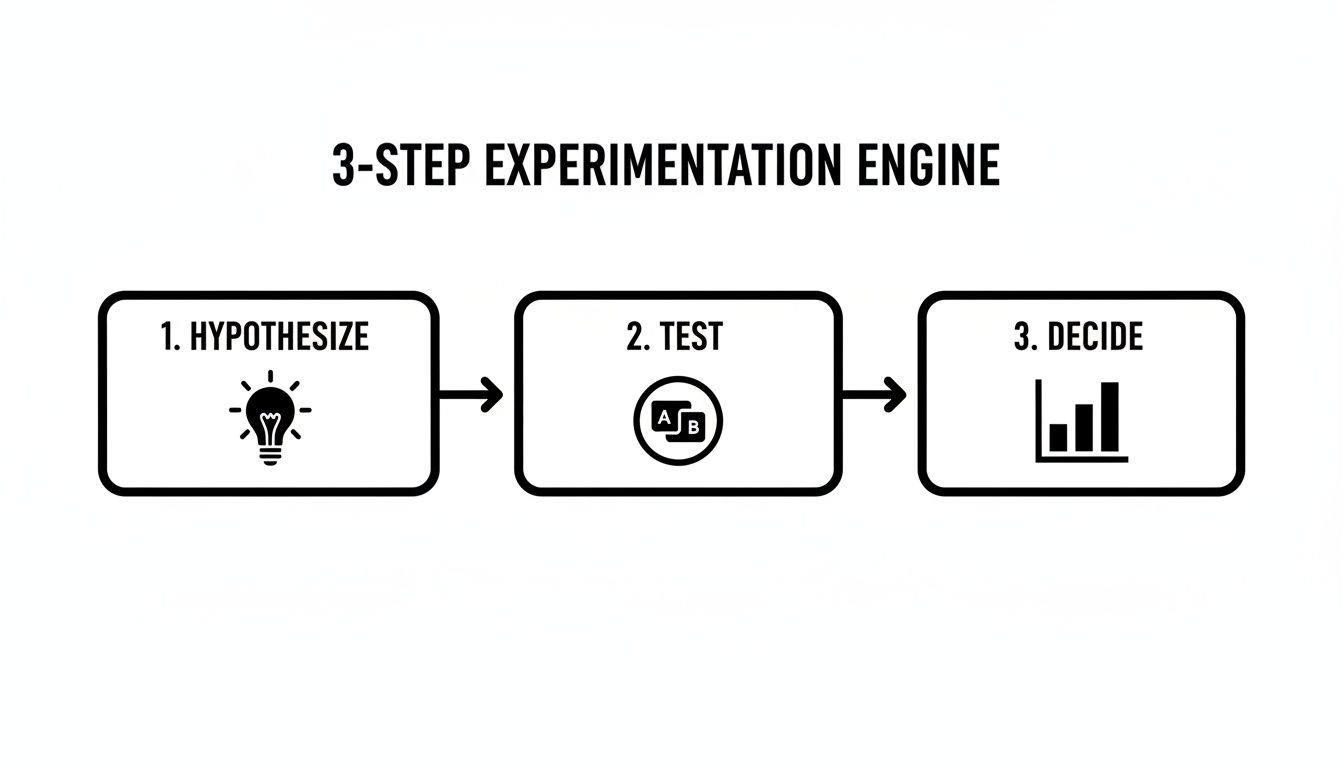
This simple but powerful "Hypothesize, Test, Decide" loop becomes the foundation for every automated optimization, ensuring every single change is driven by data.
Staying Agile in a Volatile Market
The e-commerce world is anything but predictable. Recent conversion rate trends show just how volatile some sectors can be, with certain categories seeing monthly swings of over **40%**.
Just look at the period between December and January: the Food & Beverage sector saw an **11.76%** surge in conversions, while Fashion and Apparel took a dramatic **24.45%** nosedive. These rapid shifts, detailed in market benchmark reports, highlight why you absolutely need continuous monitoring and the ability to react fast. You can explore more insights on e-commerce conversion benchmarks to see how your own sector is tracking.
This is precisely where an AI team delivers its greatest value. It can adapt to market changes in real time—adjusting ad spend, tweaking email campaigns, and testing new offers on the fly. This agility helps you capitalize on upward trends and soften the blow from downturns, ensuring your strategy to improve your e-commerce conversion rate is always in sync with current customer behavior.
Common Questions About Ecommerce Conversion
As you start putting these CRO strategies into play, some very practical questions are bound to pop up. It's totally normal. Let's tackle some of the most common ones we hear from store owners so you can move forward with confidence.
Think of this as the "rubber meets the road" part of the guide. We'll get into the nitty-gritty of timelines, budgets, and where to put your energy first.
How Long Does It Take to See Conversion Rate Improvements?
This is the big one, and the honest answer is, "it depends." The speed at which you see results really boils down to two things: how much traffic your store gets and how significant the changes you're making are.
If you’re running a high-traffic store, a simple A/B test on something like a button color could give you a statistically significant winner in just a few days. For sites with less traffic, that same test might need to run for a few weeks to collect enough data to be sure.
On the other hand, a massive change, like a complete overhaul of your checkout flow, can create an immediate, noticeable lift in sales. Smaller tweaks, like rewriting a product description, often lead to more gradual, subtle gains.
> The most important thing to remember is that CRO is a marathon, not a sprint. Consistency is what drives sustainable growth over the long term, not a single quick fix.
Should I Focus on More Traffic or a Higher Conversion Rate?
Ah, the classic dilemma. But the answer here is almost always the same: **focus on your conversion rate first.**
Driving more visitors to a site that leaks customers is like pouring water into a bucket full of holes. It's an incredibly expensive and inefficient way to grow.
Once you have a solid foundation—a smooth user experience, compelling product pages, and a checkout process that doesn't cause headaches—every single dollar you spend on ads or marketing will work harder for you. Fix the engine before you add more fuel. A higher conversion rate makes all your traffic-driving efforts more profitable.
Can I Improve Conversions Without a Big Budget?
Absolutely. While there are some powerful analytics and testing platforms out there with hefty price tags, many of the most effective CRO tactics cost very little or are completely free. At its core, optimization isn't about expensive software; it's about getting inside your customer's head and removing any friction they experience on their path to purchase.
Here are a few budget-friendly ideas you can start with today:
* **Sharpen Your Product Copy:** Don't just list features; write benefit-driven descriptions that connect with what your audience actually wants.
* **Upgrade Your Product Images:** You don't need a professional studio. A modern smartphone and some good natural light can work wonders for your product and lifestyle photos.
* **Lean into Social Proof:** Actively ask for and showcase customer reviews and ratings. Nothing builds trust faster.
* **Simplify Your Navigation:** Ask a friend or family member to find a specific product on your site. Watch where they get stuck—it’s free user testing!
* **Run Simple A/B Tests:** Use free tools like Google Optimize or the built-in features on platforms like Shopify to test small, impactful changes.
How Does Mobile Optimization Affect My Conversion Rate?
Let's be clear: mobile optimization isn't just a "nice-to-have" anymore. It's absolutely critical. With a massive chunk of ecommerce traffic coming from smartphones, a bad mobile experience is a direct line to lost sales and sky-high bounce rates. A clunky, slow, or hard-to-navigate mobile site will absolutely kill your conversion rate.
Adopting a mobile-first mindset is non-negotiable for any serious online store. This means you need to be obsessed with:
* **Responsive Design:** Your site must look great and work flawlessly on every screen size, from a small phone to a large desktop.
* **Thumb-Friendly Navigation:** Are your buttons and links easy to tap? Or are users fat-fingering the wrong thing?
* **Painless Forms:** Checkout and contact forms have to be short and dead simple to fill out on a tiny screen.
* **Blazing-Fast Load Speeds:** Mobile users are notoriously impatient. Every second of loading time is costing you customers.
---
Ready to stop guessing and start growing? **SynthAI** assembles a coordinated team of AI assistants to run your marketing, sales, and operations 24/7, turning your optimization strategy into an automated growth engine. See how it works at https://www.getsynthai.com.
Ready to Transform Your Business with AI?
Build your AI team and start automating your marketing today.