Your SEO Lead Generation Playbook for Predictable Growth
SynthAI Team
Content Team
SEO lead generation is all about turning your website into a magnet for high-intent customers who are actively looking for solutions you offer. It’s the art and science of creating genuinely useful content and optimizing your site to show up in organic search, creating a reliable, always-on source of qualified leads.
Building Your SEO Lead Generation Foundation

Before you even think about writing, you need a blueprint. A powerful SEO lead generation strategy isn't built on guesswork—it’s built on a deep, almost obsessive understanding of your customers and the exact words they use when they need help. This first phase is all about mapping their journey from having a problem to finding your solution.
The data backs this up, big time. Organic search is a beast, with **57% of B2B businesses** saying they get more leads from search than any other channel. And position is everything. That top organic result gets a staggering **39.8% clickthrough rate**, which drops like a rock to just **18.7%** for the second spot. If your foundation is weak, you're invisible. You can dig into more of these lead generation statistics and trends to see just how much is at stake.
Mapping Customer Intent to Keywords
Great SEO lead gen isn't about chasing huge, generic keywords. The real magic happens when you focus on **search intent**—the *why* behind the search. Is someone just trying to learn something? Are they comparing their options? Or are they ready to pull out their credit card?
Think about it. A person searching for "what is project management" is in a completely different headspace than someone searching for "best project management software for small teams." The first query is purely informational. The second one screams commercial intent. Your job is to create content that speaks to both, guiding them from one stage to the next.
> **Key Takeaway:** Don't just target what people search for; target *why* they are searching. Aligning your content with user intent is the single most important factor in turning traffic into leads.
This is where a keyword map becomes your most valuable tool. It's not just a list of terms; it’s a strategic plan that ties specific keywords to different stages of the buyer's journey and connects them to the right piece of content on your site.
To get this right, you need to match the type of content you create to the intent of the searcher. This table is a great starting point for making those connections.
Mapping Search Intent to Content Type
A quick reference guide to align your content creation efforts with the four primary types of user search intent to maximize lead generation potential.
| Search Intent | Keyword Modifiers | Best Content Type | Lead Gen Goal |
| :--- | :--- | :--- | :--- |
| **Informational** | "how to," "what is," "guide," "tips," "tutorial" | Blog Posts, How-To Guides, Checklists | Nurture via Newsletter |
| **Navigational** | "Brand Name pricing," "Product login" | Homepage, Product Pages, Pricing Page | Drive to key pages |
| **Commercial** | "best," "review," "comparison," "alternative," "vs" | Comparison Pages, In-depth Reviews | Offer a Free Trial or Demo |
| **Transactional** | "buy," "price," "discount," "get a quote," "demo" | Landing Pages, Pricing Pages, Demo Request | Direct Conversion (Sale/Demo) |
By mapping your content this way, you ensure you have the right answer ready for the right person at the right time, dramatically increasing your chances of capturing a lead.
Analyzing the Competitive Landscape
Before you jump into the ring, you have to scout your opponents. Start by identifying who consistently ranks for your most valuable, commercial-intent keywords. Then, dive deep into their content to figure out what they’re doing right and—more importantly—where the gaps are.
Ask yourself these questions while you're snooping around:
* What topics are they absolutely owning?
* What kind of content formats are they leaning on (blog posts, guides, case studies, etc.)?
* Are there pain points or questions they've totally missed?
* What's their user experience like? Is it a dead end, or do they make it easy to convert?
The goal here isn't to copy them. It's to find an opening to create something **better, more thorough, or more niche**. For instance, if a top competitor has a great blog post but no downloadable template to go with it, that's your shot. Create that lead magnet and start capturing the leads they’re leaving on the table.
Accelerating Research with an AI Assistant
Let's be honest: manually researching intent, pulling apart SERPs, and spotting competitor weaknesses is a massive time sink. This is a perfect place to bring in an AI assistant like **SynthAI's Aura** to supercharge your workflow.
With an AI tool, you can instantly:
* **Generate keyword clusters** around a core topic, and have them automatically sorted by user intent (informational, commercial, etc.).
* **Analyze the top-ranking content** for any keyword, getting a summary of the main themes, headings, and common questions people are asking.
* **Spot content gaps** by comparing your site's content against what’s already ranking.
By letting AI handle the heavy data crunching, you can free yourself up to focus on high-impact strategy—like crafting a unique angle and building content that actually connects with your ideal customer. This sets the perfect stage for every other step in your SEO lead gen playbook.
Creating Content and Assets That Actually Convert

Alright, you’ve done your keyword research and have a solid map. Now for the fun part: building the destinations that will actually capture leads. Traffic without conversions is just a vanity metric on a dashboard; it doesn’t pay the bills. The real engine of an **SEO lead generation** strategy is the content itself—the blog posts, landing pages, and downloads that turn a curious searcher into a real prospect.
This isn't just about writing articles. It's about architecting an entire content ecosystem. You need to build something that proves your authority, gives people the answers they're looking for, and then naturally guides them toward taking the next step with you. The goal is to create a magnetic pull for the right audience and make it incredibly easy for them to say "yes."
Building Topic Clusters for Authority and Reach
The old-school approach of targeting one keyword with one page is dead. Search engines today are far smarter; they want to see deep expertise on a subject. The best way I've found to signal this is by building **topic clusters**.
The model is simple but powerful. You create a central "pillar" page covering a big, important topic. Then, you surround it with multiple "cluster" pages that dive deep into related, more specific subtopics.
Imagine it's a wheel. Your pillar page is the hub, and your cluster pages are the spokes. This structure tells Google you’re a comprehensive resource, which can give your rankings a serious boost across the entire topic.
Here’s a real-world example from a B2B SaaS company:
* **Pillar Page:** "The Ultimate Guide to Project Management"
* **Cluster Content:** "How to Choose Project Management Software," "Agile vs. Waterfall Methodologies," "Best Project Management Tools for Small Teams," and "Tips for Effective Team Collaboration."
Every cluster article links back to the main pillar page, and the pillar links out to each cluster piece. This weaves a strong internal linking web that spreads authority and keeps people clicking around your site—all fantastic signals for search engines.
> **Pro Tip:** Aim for broad, high-volume keywords with your pillar page. For the cluster pages, go after more specific, long-tail keywords. This strategy lets you capture traffic at every stage of the buyer's journey, from "just browsing" to "ready to buy."
Designing High-Converting SEO Landing Pages
While your blog content is great for attracting an audience, your dedicated landing pages are where the conversion magic happens. An SEO-optimized landing page is a specialist—it has one job and one job only: capture a lead. Whether you're offering a demo, a free trial, or a guide, every single element on that page has to support that one goal.
From my experience, a winning SEO landing page must have these key ingredients:
* **A Crystal-Clear Value Proposition:** Your headline needs to immediately answer "What's in it for me?" Don't be clever; be clear.
* **Frictionless Forms:** Keep your forms short. Seriously. Only ask for what you absolutely need. Every extra field you add is another reason for someone to bounce.
* **Compelling Social Proof:** Nothing builds trust faster. Add testimonials, snippets from case studies, or logos of clients people recognize.
* **A Singular, Powerful Call to Action (CTA):** There should be zero confusion about what to do next. Use active, benefit-driven language like "Get Your Free Template" or "Start My Trial," not a lazy "Submit."
For instance, a marketing agency's landing page for "PPC Management Services" shouldn't just list features. A headline like "Stop Wasting Ad Spend. Get a Free PPC Audit Today." cuts right to the pain point and offers an immediate, valuable solution.
Creating Irresistible Lead Magnets
A lead magnet is the currency you use to buy someone's contact information. You're trading your expertise for a lead, so you'd better make it a good deal for them. A great lead magnet solves a very specific problem for your audience and provides instant value, making the exchange feel like a total no-brainer.
The trick is to match the lead magnet to the content they're already on. If someone is reading your post about "How to Choose Project Management Software," a generic newsletter signup isn't going to cut it. They need something more specific and immediately useful.
Here are a few types of lead magnets that I've seen work time and time again:
* **Checklists or Templates:** A "Project Kickoff Checklist" or a "Content Calendar Template" is instantly actionable.
* **Comprehensive Guides or Ebooks:** These are your deep dives, offering much more detail than a standard blog post.
* **Webinars or Video Trainings:** An on-demand webinar has a high perceived value and helps you build a more personal connection.
* **Interactive Tools or Calculators:** A simple "ROI Calculator" or a "Website Grader" can be an incredibly effective and engaging way to generate high-quality leads.
By thoughtfully creating these assets—from broad topic clusters to laser-focused landing pages and genuinely helpful lead magnets—you're not just attracting traffic. You're building a well-oiled machine that systematically turns that traffic into qualified leads, the true lifeblood of any business.
Turning Clicks Into Customers: How to Optimize Your Site for Conversion

Getting traffic to your site feels like a huge win, but let’s be honest—it’s only half the job. If those hard-won visitors just browse and bounce, your SEO efforts are generating noise, not leads. This is where Conversion Rate Optimization (CRO) comes in, and it's arguably the most important piece of the entire **SEO lead generation** puzzle.
CRO is the art and science of turning a passive browser into an active lead. Every single page on your website has the potential to be a lead-gen workhorse, but only if you deliberately guide people toward that next step. It’s about moving past just keywords and getting into the psychology of what makes someone click, sign up, or buy.
Crafting Title Tags and Metas That Demand a Click
Long before a visitor even lands on your page, you have a chance to win them over. Your title tag and meta description are your tiny billboard in the search results. They’re often your only shot to make an impression, and optimizing them is a massive, and frequently overlooked, CRO win.
Don’t just cram them full of keywords. Think like your customer. What problem are they trying to solve? A truly compelling title tag hints at the solution or offers a clear benefit right there in the SERP.
For instance, a generic title like "Project Management Software Features" is forgettable. But what about "Project Management Software That Saves Teams **10** Hours a Week"? Now *that* gets a click. It speaks directly to a pain point and offers a real, tangible outcome. Your meta description should then echo that promise, giving a quick preview of the value waiting for them on the page.
Designing Calls to Action That Actually Work
I’ve seen it a thousand times: a weak Call to Action (CTA) is the number one reason qualified leads just drift away. Vague, passive buttons like "Submit" or "Learn More" are conversion killers because they create uncertainty. Your CTAs need to be direct, action-oriented, and visually impossible to ignore.
A great CTA uses a strong verb and spells out exactly what the user is getting.
* **Instead of "Download," try "Get Your Free Marketing Template."**
* **Instead of "Sign Up," try "Start My 7-Day Free Trial."**
* **Instead of "Contact Us," try "Request a Custom Quote."**
The button's design is just as crucial. Use a color that pops against the rest of the page, and for goodness' sake, make it big enough to tap easily on a phone. This isn’t about making things pretty; it’s about creating an unmissable visual cue that screams "click here for the good stuff."
> Your website is not a museum where people just come to look. It’s a tool designed to achieve a business goal. Every page, every headline, and every button should be engineered to guide the visitor toward that goal.
Building Lead Capture Forms People Don't Hate
The form is the final hurdle. A long, complicated form is where a huge number of would-be leads give up and leave. My rule here is simple: **only ask for what you absolutely need *right now*.**
Every extra field you add is another reason for someone to abandon the process. Do you *really* need their phone number and company size just to send them a checklist? Probably not. You can always gather more intel later on as you nurture them.
For a top-of-funnel offer like an ebook, asking for just an email can dramatically boost your sign-ups. For a bottom-of-funnel request like a demo, it makes sense to ask for a name, email, and company. The key is to perfectly match the friction of the form to the value of what you're offering.
A Practical A/B Testing Roadmap
You should never just guess what works. The only way to know for sure is to test, measure, and refine. This is where A/B testing becomes your secret weapon.
Here are a few high-impact tests you can run right away:
* **Headline Variations:** Test a headline that focuses on a benefit versus one that asks a provocative question.
* **CTA Button Copy:** Pit a straightforward "Get Started Now" against a value-driven "See Pricing Plans."
* **Form Length:** Try a single-field form (email only) against a two-field form (name and email).
* **Social Proof:** Does placing testimonials above the fold work better than having them right next to the CTA? Test it!
By constantly running these small, controlled experiments, you start making decisions based on data, not hunches. Over time, these small wins compound, leading to a major lift in your overall **SEO lead generation** machine.
How to Actually Measure SEO Lead Generation
If you’re not measuring your SEO efforts, you’re just guessing. Tossing content out there and hoping for the best is a surefire way to burn through your budget and time. The real magic happens when you can connect every single SEO action to a real business outcome—moving past vanity metrics like traffic and focusing on what actually pays the bills: revenue.
This is how you prove your work’s value, plain and simple. It’s about creating a system that follows a lead from their first Google search all the way to swiping their credit card. When you can draw a straight line from a blog post to a closed deal, you stop talking about rankings and start talking about ROI.
Laying the Measurement Groundwork
Before you can track anything, you need the right tools in place and a clear game plan. The main goal is to get data flowing smoothly from your website straight into your CRM. This concept, often called closed-loop reporting, is the secret to seeing the true impact of your SEO.
Your go-to toolkit should include:
* **Google Analytics 4 (GA4):** This is mission control for your website traffic. You'll use it to see how people arriving from organic search behave, what content they engage with, and where they convert.
* **Google Search Console:** Think of this as a direct line to Google. It’s essential for watching your keyword rankings, checking click-through rates from search results, and spotting technical site issues.
* **A CRM (like HubSpot or Salesforce):** This is where your leads end up after they fill out a form. Getting your CRM and analytics to talk to each other is non-negotiable if you want to trace sales back to their source.
The setup process involves creating specific conversion events in GA4 for every important action—a lead magnet download, a demo request, a contact form submission. These events are the signals that tell your CRM a new lead has arrived from a particular organic channel.
KPIs That Genuinely Matter for Generating Leads
Let's be honest, not all metrics are created equal. Organic traffic is a nice starting point, but it doesn't tell you much on its own. To really understand how well your SEO is doing at generating leads, you have to track KPIs that tie directly to lead quality and business growth.
It's time to ditch the generic reports and focus on these instead:
* **Conversion Rate by Piece of Content:** Which blog posts, landing pages, or guides are actually bringing in the most leads? Answering this tells you exactly what kind of content your audience loves, so you can make more of it.
* **Lead Quality Score:** Not every lead is a good fit. By working with your sales team to score leads (based on things like job title, company size, or engagement), you can quickly see which content is attracting your ideal customers.
* **Cost Per Lead (CPL) from Organic Search:** This one is simple but powerful. Add up your total SEO investment (content creation, tools, salaries) and divide it by the number of leads you generated. This gives you a concrete number to stack up against other channels, like paid ads.
* **Lead-to-Customer Conversion Rate:** This is the ultimate report card. What percentage of the leads from organic search actually end up becoming paying customers? This KPI draws a direct line from your SEO work to the company's bottom line.
> **Pro Tip:** Your goal should be to shift the conversation from reporting on "traffic" to reporting on "pipeline." When you can walk into a meeting and show that a specific topic cluster generated **$50,000** in new business last quarter, the value of your work becomes undeniable.
Connecting SEO Data with Your CRM
This is where the entire system comes full circle. When you integrate tools like GA4 with a CRM—like the one built into **SynthAI's** sales assistant, Ascent—you get a complete, 360-degree view of the customer's path. You can finally see the exact page someone was on right before they decided to fill out your form.
Imagine this: your CRM shows that a new high-value client originally found you by searching for "best project management software for small teams." They landed on your detailed comparison guide, downloaded a project plan template, and then, two weeks later, requested a demo. That kind of attribution is incredibly powerful. It gives you the evidence you need to double down on what’s working and prove the value of your SEO lead generation strategy to anyone who asks.
Scaling Your Strategy with Automation and AI
So, you've built the foundation, created the content, and optimized everything for conversions. Fantastic. But what happens when the leads start pouring in faster than you can handle them?
This is where you build a system that runs itself. The final, and arguably most powerful, piece of the **SEO lead generation** puzzle is automation and AI. This is how you transform all that hard work into a scalable, 24/7 lead-generating machine.
Trying to manually nurture every lead, track every keyword, and create every single piece of content just isn't sustainable for growth. The real goal is to build smart workflows that take care of the repetitive, time-consuming tasks. That frees you up to focus on high-level strategy and actually closing deals.
Orchestrating Your Lead Nurturing on Autopilot
Think about it: when someone downloads one of your guides, what’s the very next step? If your answer is "they land in a spreadsheet," you are leaving a ton of money on the table. This is where marketing automation comes in, acting as the bridge between a brand new lead and a prospect who's ready to talk to sales.
By connecting your lead capture forms directly to an automation platform, you can kick off personalized follow-up sequences the moment someone converts.
* **Welcome Series:** Instantly deliver the asset they requested. Follow that up with a couple of emails over the next week that offer related content, answer common questions, and gently introduce your solution.
* **Behavioral Triggers:** Did a lead just visit your pricing page after reading an ebook? That's a huge buying signal. Automatically send them a targeted email with a relevant case study or a direct invitation for a demo.
* **Lead Scoring:** Assign points to leads based on their actions—opening emails, visiting key pages, watching a webinar. Once they hit a certain score, you can automatically create a task for your sales team to make a call.
A system like this ensures no lead ever falls through the cracks. Every single prospect gets timely, relevant communication that moves them through your funnel without you lifting a finger.
An AI-Powered Workflow from Keyword to Conversion
Now, let's take automation a step further. Imagine an entire system where specialized AI assistants work together to run your SEO lead generation strategy from end to end. This isn’t science fiction anymore; it’s exactly what platforms like **SynthAI** are built for.
Here’s what that kind of automated workflow actually looks like in practice:
1. **Spotting the Opportunity:** An AI assistant like Aura is constantly scanning search trends and what your competitors are doing. It flags a new, low-competition keyword that has high commercial intent.
2. **Creating the Content:** It then hands that keyword off to a content assistant. This AI drafts a comprehensive blog post fully optimized for that term, complete with headings and smart internal link suggestions.
3. **Generating the Assets:** At the same time, an assistant like Basis builds a dedicated landing page for a related lead magnet, while Visio might even create a short video summary of the blog post.
4. **Promoting and Nurturing:** As soon as the content goes live, Echo schedules social media posts to drive traffic, and Lumen gets an email nurture sequence ready for anyone who downloads the new lead magnet.
This kind of integrated AI ecosystem can do in a few hours what would take a human team weeks. It lets you scale content production and lead nurturing at a speed that was impossible until now.
> **Key Insight:** True scale isn't about working harder; it's about building systems that work *for* you. An AI-powered workflow automates the execution so you can stay focused on the strategy.
Measuring the impact of all this automation is crucial. It really comes down to a simple, three-part process: Track, Analyze, and Report.
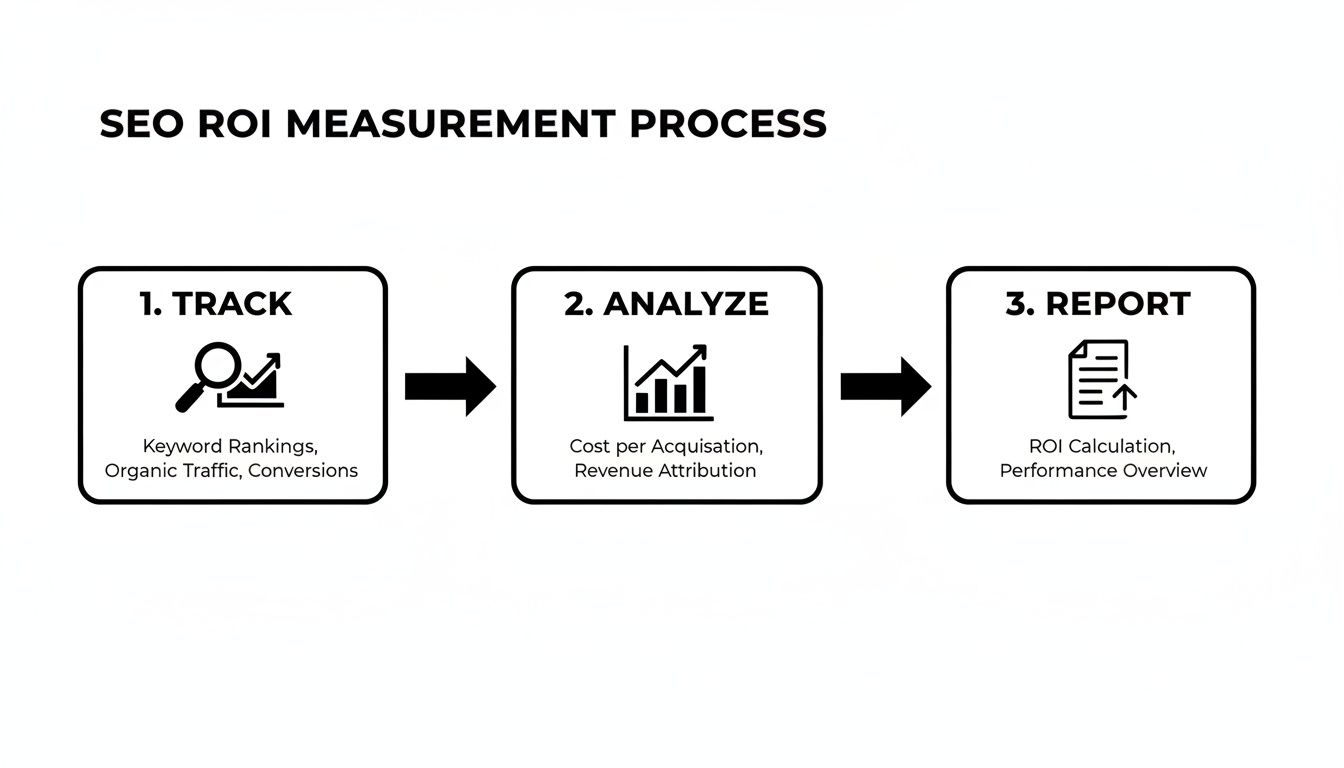
This straightforward flow is your key to proving the value of your automated SEO engine and getting buy-in for even more investment down the road.
The entire market is sprinting in this direction. The global lead generation market is on track to hit around **$15.55 billion by 2031**, growing at a compound annual rate of **17.5%**. A huge driver of that growth is the integration of AI into these exact workflows. You can dig into more of these fascinating lead generation statistics and projections.
By building an intelligent, automated system now, you're not just keeping up—you're creating a powerful competitive advantage for years to come.
Common Questions About SEO for Lead Generation
When you're first mapping out a full-scale SEO lead generation strategy, a lot of questions come up. I've been in the trenches with this stuff for years, and I've noticed the same handful of queries pop up again and again. Let's get those out of the way so you can move forward and start building.
How Long Does It *Really* Take to Get Leads from SEO?
This is the big one, and the answer is always "it depends," but I can give you a realistic ballpark. SEO isn't like flipping a switch on a paid ad—it's more like planting a garden. You have to prepare the soil, plant the seeds, and nurture them before you see a harvest.
Generally speaking, you can expect to see the first real, meaningful trickle of leads from a fresh SEO push within **4 to 6 months**. This can change depending on how competitive your industry is, the authority your website already has (or doesn't have), and how aggressively you're creating high-quality content. You might see a small bump from initial technical fixes sooner, but the steady, reliable flow of leads comes from patiently building that topical authority over time.
What’s the Difference Between SEO for Traffic and SEO for Leads?
This is a critical distinction. Getting it wrong is the fastest way to spin your wheels and burn your budget with nothing to show for it.
SEO for traffic is a volume game. It's all about chasing broad, high-search-volume keywords to get as many eyeballs on your site as possible. Great for brand awareness, but not so great for your bottom line.
SEO for lead generation is surgical. It's all about targeting keywords that signal clear **commercial or transactional intent**.
Here’s what that looks like in the real world:
* **Traffic Focus:** A blog post targeting "what is digital marketing" will get tons of visitors. Most of them will be students or researchers just looking for a definition.
* **Lead Focus:** A landing page targeting "digital marketing agency for small business" gets way less traffic, but the people who *do* land there are actively looking to hire someone. The intent is completely different.
> When you're focused on leads, the goal isn't to get the *most* visitors. It's to get the *right* visitors and make it incredibly easy for them to take the next step, whether that's booking a demo or downloading a resource.
Can I Actually Do This on a Small Budget?
You absolutely can. In fact, SEO has one of the best long-term ROIs of any marketing channel out there. A paid ad stops working the second you turn off the spend. A blog post that ranks on page one is an asset that can keep generating leads for you for years, often with very little upkeep.
If you're working with a tight budget, you just need to be smart and focused.
* **Go Niche:** Don't try to rank for "best CRM software." Instead, target long-tail keywords like "best CRM for real estate agents in Austin." The competition is lower, and the leads are far more qualified.
* **Prioritize Epic Content:** It's better to pour your resources into creating one truly amazing, in-depth piece of content per month than four shallow, mediocre ones. Quality crushes quantity every time.
* **Master the Free Tools:** You can get an incredible amount of powerful, actionable data from free platforms like Google Analytics and Google Search Console without ever spending a penny.
By being scrappy and strategic, you can build a powerful lead generation engine that pays for itself many times over.
---
Ready to build a system that runs your lead generation on autopilot? **SynthAI** assembles a team of specialized AI assistants to execute your marketing, sales, and content strategy 24/7. See how it works and start your free trial.
Ready to Transform Your Business with AI?
Build your AI team and start automating your marketing today.