Guide: virtual assistant for customer service in 2026
SynthAI Team
Content Team
At its core, a **virtual assistant for customer service** is your digital frontline. Think of it as an AI-powered team member that works around the clock to give customers instant answers to their most common questions, help with routine tasks like tracking an order, and knows exactly when to bring a human expert into the conversation.
The New Standard in Customer Support

Let's face it: customers today expect help *now*, not tomorrow. This demand for immediate, 24/7 support is a huge challenge for most businesses, especially smaller teams trying to compete. Staffing a support team for every time zone is expensive and often out of reach, which can lead to lost sales and unhappy customers who feel ignored.
This is where a virtual assistant stops being a "nice-to-have" and becomes a fundamental part of your business strategy. It’s not about replacing your human team; it's about giving them a powerful partner. The assistant fields all the repetitive, predictable questions that eat up your team's day, freeing them to focus on the tricky problems and high-touch interactions where they truly shine.
For any e-commerce store or SaaS company, this is a game-changer. An AI assistant can juggle thousands of conversations at once—whether about shipping updates, feature walkthroughs, or billing issues—without breaking a sweat. Every single customer gets a fast, helpful response, no matter when they reach out.
Driving Growth and Efficiency
This isn't just a passing trend. The market for virtual assistants is booming, expected to jump from **USD 5.3 billion** in 2025 to **USD 6.5 billion** by 2026. For online retailers, the results are even more direct: implementing a virtual assistant can cut service costs by a staggering **30-50%**. Even better, it can help a business handle **35%** more orders without hiring a single new person. You can dig into more of this data in the latest virtual assistant industry report.
That efficiency fuels both your bottom line and a better customer experience. When simple problems are solved on the spot, satisfaction goes up, and your human agents can apply their skills where they make the biggest impact.
> A virtual assistant for customer service doesn't just answer questions; it creates operational leverage. By automating the predictable, you empower your human team to excel at the exceptional.
To see how these benefits stack up, here’s a quick overview.
Table: Virtual Assistant Impact at a Glance
| Benefit Area | Key Outcome | Example Metric |
| :--- | :--- | :--- |
| **Operational Costs** | Reduced headcount needs for simple, repetitive tasks. | **30%** decrease in cost-per-contact. |
| **Agent Productivity** | Human agents focus on high-value, complex issues. | **25%** increase in complex tickets solved per agent. |
| **Customer Satisfaction** | Instant, 24/7 answers to common questions. | **20%** reduction in average first response time. |
| **Business Scalability** | Handle spikes in volume without service degradation. | **90%** of routine queries deflected during a holiday sale. |
Ultimately, this data shows a clear path to running a leaner, more effective support operation that doesn't sacrifice quality.
From Luxury to Necessity
What used to feel like a tool only for giant corporations is now completely accessible for businesses of any size. Modern platforms like SynthAI offer specialized assistants, such as **Pax for support**, that deliver enterprise-grade service without the enterprise price tag. These systems plug right into the tools you already use, learn from your existing help docs, and start adding value from day one.
Choosing Your Digital Support Team

When you bring a **virtual assistant for customer service** on board, you’re not just buying a piece of software. You're building a digital support team. And just like any great human team, different members have different skills and strengths. Getting to know their roles is the key to building a system that’s smart, fast, and genuinely helpful.
A great way to think about this is like a tiered support system. Each level is built to handle tougher and tougher tasks, making sure every customer gets the right help, right when they need it. Let’s break down the key players on your new digital crew.
Level 1: The Rule Follower
First up, you have the basic AI chatbot. This is the dependable rule-follower of your team. It’s built for one thing: handling simple, repetitive questions with lightning speed and perfect accuracy. It works off a script or a decision tree, making it the ideal first line of defense.
Think of it as your FAQ page, but interactive. It can instantly answer things like, "What are your business hours?" or "How do I track my package?" It’s perfect for businesses that need to get a handle on a high volume of straightforward questions, freeing up your human agents from the most predictable work.
Level 2: The Mind Reader
Next on the roster is the context-aware AI assistant—the mind reader. This is a huge step up. Instead of just matching keywords, this assistant uses machine learning and natural language processing (NLP) to figure out what customers *really mean*, even when they don’t say it perfectly.
For example, a customer might type, "This is taking forever, where's my stuff?!" The context-aware assistant picks up on the frustration and the core issue. It can then check the order history, pull up the latest tracking info, and offer a personalized, helpful response. This is where a **virtual assistant for customer service** starts to feel less like a bot and more like an expert who gets it.
Level 3: The Ultimate Collaboration
The most powerful support systems aren’t just AI—they’re a smart partnership between AI and people. This hybrid model is the dream team, where the AI fields the initial contact and knows exactly when to pass the baton to a human expert. It's the perfect blend of automation and a personal touch.
> This synergy creates incredible efficiency without losing the human element. The AI can often resolve up to **80%** of routine queries on its own, leaving your human agents to focus on situations that require creative problem-solving and real empathy.
Here’s how that flow looks in practice:
1. **Initial Contact:** A context-aware assistant (Level 2) greets the customer and quickly understands their problem.
2. **Automated Resolution:** For most common issues, the AI provides an instant, accurate solution.
3. **Smart Escalation:** If the problem is too complex, the customer is getting upset, or a specific approval is needed, the AI executes a "warm handoff." It transfers the full conversation history and customer data to the right human agent.
This kind of coordinated system—like what SynthAI’s **Nexus** coordinator does—means customers never have to repeat themselves. The agent gets everything they need to pick up right where the AI left off and solve the problem, making the entire experience feel smooth and effortless.
The Real-World Wins of AI-Powered Support
Bringing a virtual assistant into your customer service isn't just a minor operational tweak—it's a fundamental shift in how you connect with and keep your customers. These AI tools deliver real business results by hitting the core challenges of modern support head-on: speed, availability, cost, and the ability to scale up or down.
Let's break down the four main ways an AI assistant becomes a critical asset for any business looking to grow.
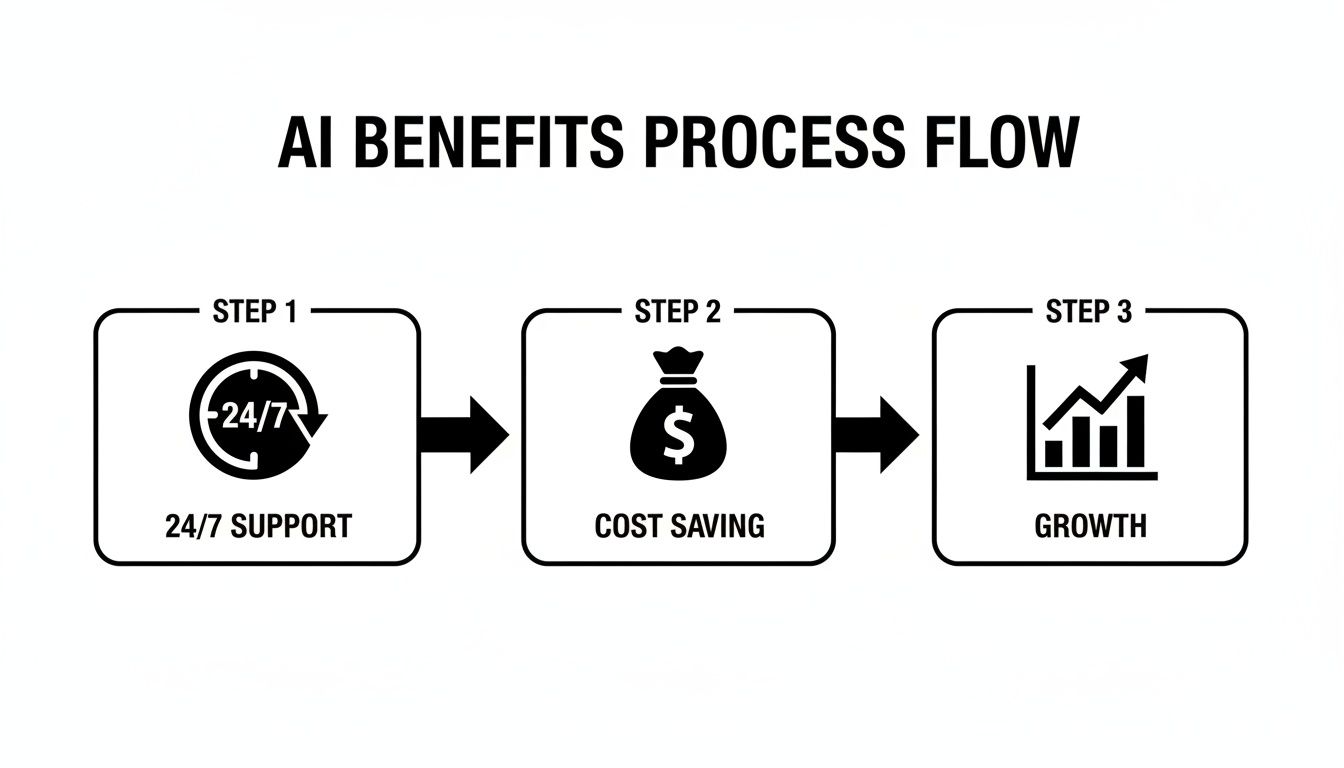
Offer 24/7 Support That Actually Converts
The most obvious win is being able to ditch the traditional 9-to-5. In a global economy, your next customer could be shopping at 3 AM your time. With a human-only team, their questions go unanswered, and you likely lose the sale.
Think of a virtual assistant as your always-on digital clerk. It’s there to answer questions about shipping, product specs, or return policies, giving visitors the instant answers that turn them into paying customers, no matter the time of day. This 24/7 presence means you stop missing out on easy opportunities.
Slash Your Operational Costs
Beyond being available around the clock, the financial impact is huge. Just think about what it takes to staff a 24/7 human support team. You'd need at least five full-time agents to cover all the shifts and weekends—a massive payroll expense that’s simply not feasible for most small and medium-sized businesses.
A **virtual assistant for customer service** can handle the work of multiple agents for a tiny fraction of the cost. By automating all the common, repetitive questions, it frees you from needing a large frontline team. This is about spending smarter, letting you put that budget toward growth instead of just keeping the lights on.
The numbers don't lie. We consistently see e-commerce businesses cut their support costs by **30-50%** after bringing in a virtual assistant. It's a direct result of better efficiency and a much leaner operation.
Give Customers Instant Answers, Every Time
Modern customers don't like to wait. They want answers now, and any delay is a quick path to frustration and a lost customer. A virtual assistant tackles this demand for speed by providing instant, accurate answers to the vast majority of questions that come in.
A well-trained AI can resolve up to **80% of common customer questions** without ever needing to escalate to a human. That kind of instant gratification is a powerful way to build loyalty. Instead of sitting in a queue, customers get their problem solved on the spot, turning a moment of friction into a positive experience with your brand.
> The move to digital self-service is undeniable. By 2024, **61% of customers** were already choosing digital channels to contact brands, and **52% said they were more loyal** to companies with live chat. An AI assistant takes this to the next level by delivering the speed and quick resolutions people value most. You can dig into more of the latest customer service statistics to see where things are headed.
It's not just about being fast; it's about building a reputation for being a company that's responsive and reliable.
Grow Without the Growing Pains
Scalability is where a virtual assistant really shines. Picture a SaaS company launching a big new feature. The launch is a hit, but it also creates a tidal wave of support tickets from users asking how to use it.
Without AI, that flood of requests would completely overwhelm a human team. Wait times would skyrocket, and the first experience with your shiny new feature would be a frustrating one. A virtual assistant, on the other hand, can handle a virtually unlimited number of conversations at once. It just absorbs the spike in volume, making sure every single user gets immediate help.
This lets your business grow fast without the usual growing pains of frantically hiring and training more support staff, ensuring your customer experience stays smooth even when demand is through the roof.
Your Implementation Roadmap to Automated Support
Bringing a virtual assistant on board might feel like a huge technical lift, but it’s much more manageable when you have a solid plan. Think of it less like installing software and more like hiring and training a new digital team member. If you break the process down into a few key stages, you can build an assistant that genuinely helps customers and delivers a real return.
This roadmap will walk you through getting your AI connected, teaching it the ropes, creating a seamless handoff to your human team, and, most importantly, measuring its success.
This process is all about creating a central hub for your customer interactions. Platforms like SynthAI’s **Axis** are designed for exactly this, making it simple to link your virtual assistant to all the essential tools that power your business.
Step 1: Connect Your Brain
First things first, your virtual assistant needs a "brain." A bot that’s cut off from your other systems is just a fancy FAQ page—it can't actually *do* anything. The real magic happens when it can tap into real-time information and take action for the customer.
This means plugging it directly into your core business platforms. You're aiming for a smooth flow of information so the assistant can give personalized, accurate answers instead of generic ones.
Here are the must-have integrations:
* **Customer Relationship Management (CRM):** By connecting to something like Salesforce or HubSpot, the assistant can see a customer's history and tailor the conversation accordingly.
* **E-commerce Platform:** For any online store, a direct line to Shopify or a similar platform is non-negotiable. This is how the assistant handles order tracking, returns, and inventory checks.
* **Helpdesk Software:** Tying into your existing support system ensures every conversation is logged and can be passed seamlessly to a human agent when the time is right.
Getting this foundation right is what turns a simple chatbot into a true problem-solver that understands where each customer is in their journey.
Step 2: Teach It the Ropes
With the connections in place, it’s time to train your new assistant. This is basically its onboarding period. You need to arm it with all the knowledge it needs to handle real customer scenarios with confidence. The better the training, the more it can handle on its own.
A great starting point is to feed it all your existing resources—your entire knowledge base, product manuals, return policies, and even saved replies from past support tickets. Modern AI can absorb all this and learn to formulate helpful, natural-sounding answers.
> A well-trained virtual assistant can automate up to **80%** of routine customer inquiries. This frees up human agents to focus their expertise on complex, high-stakes issues that require a human touch.
From there, you’ll want to build specific workflows for your most frequent requests. For an e-commerce business, the classic "Where Is My Order?" (WISMO) query is the perfect example. You’ll teach the AI to ask for an order number, look it up in your system, and give the customer the latest shipping update—all in a matter of seconds.
Step 3: Create the Human Safety Net
Let’s be realistic: no matter how intelligent your AI gets, some situations will always need a person. That’s where a "human safety net" comes in. It’s a system for gracefully passing the baton from the AI to a human agent without frustrating the customer.
This means setting up smart escalation triggers—basically, rules that tell the assistant when to tag in a person.
Common triggers for a handoff include:
* **High Negative Sentiment:** The AI picks up that a customer is getting upset.
* **Complex or Unusual Queries:** The question is way outside of its training.
* **Multiple Failed Attempts:** The assistant has tried and failed to solve the problem a couple of times.
* **Direct Request:** The customer simply types, "I want to talk to a person."
This hybrid approach gives you the best of both worlds: the instant response of automation and the expert problem-solving of your human team.
Step 4: Measure What Matters
Finally, you can’t improve what you don’t measure. To know if your investment is paying off, you need to track the right Key Performance Indicators (KPIs). This data will show you what’s working, what’s not, and where you can make improvements.
Focus on metrics that tie directly to efficiency, customer happiness, and cost savings. Here are the big ones to watch:
1. **First Contact Resolution (FCR) Rate:** What percentage of issues does the assistant solve on its own, first try?
2. **Containment Rate:** How many conversations are handled completely by the AI without needing a human? A high rate here is a direct indicator of time saved.
3. **Customer Satisfaction (CSAT):** Are customers happy with the help they got? Simple post-chat surveys will tell you.
4. **Ticket Deflection Rate:** How many potential support tickets did the assistant prevent from ever being created?
Keeping an eye on these numbers gives you hard proof of how your **virtual assistant for customer service** is impacting your bottom line and making your entire support operation run smoother.
How to Choose the Right AI Partner
Picking the right platform for your **virtual assistant for customer service** is a make-or-break decision. Seriously. The right partner sets you up for growth, keeps your data safe, and helps you deliver an incredible customer experience. The wrong one? Well, that's a fast track to security headaches, messy workflows, and seriously unhappy customers.
Think of this less like buying software and more like hiring a key business partner. You need a platform that’s not only intelligent but also secure and able to plug into the tools you already use every day. This checklist will help you cut through the marketing fluff and find a partner who can actually deliver on their promises.
Fort Knox Security
In a world full of data breaches, security isn't just a nice-to-have feature—it's the absolute minimum requirement. Your virtual assistant will be handling sensitive customer info, and one slip-up can completely shatter the trust you've spent years building. You have to find a platform that takes security as seriously as you do.
Here are the non-negotiables to look for:
* **SOC 2 Compliance:** This is the gold standard for data security. It’s an independent verification that a vendor has the right internal controls to protect customer data from prying eyes.
* **Data Encryption:** All data, whether it's sitting on a server or zipping across the internet, needs to be encrypted. This scrambles the information, making it useless to anyone who shouldn't have it.
* **Clear Data Privacy Policies:** The vendor must be upfront about how they collect, use, and protect your data—and your customers' data. No fuzzy language allowed.
> **Why It Matters:** Getting SOC 2 compliant is a tough, ongoing commitment. It's a clear signal that a vendor is all-in on top-tier security, giving you the confidence that your business and customer data are in safe hands.
Deep Intelligence and Analytics
A great virtual assistant does more than just parrot back answers. It understands the *context* of a conversation and, just as importantly, provides you with valuable insights. This "deep intelligence" is what elevates a basic bot into a strategic part of your business. The platform's ability to learn from conversations is what drives real improvement.
Your AI partner should give you powerful analytics that show you what your customers are *really* asking about. It should pinpoint common frustrations, track how many issues get resolved, and measure overall customer satisfaction. This data is pure gold—it tells you exactly how to improve your products, services, and support guides. Platforms like SynthAI build this right into their core, so you can see exactly how AI interactions are moving the needle on your business goals.
Plays Well with Others
Your virtual assistant can't live on an island. To be truly useful, it needs to connect seamlessly with the rest of your tech stack. This is how it goes from just *providing information* to actively *solving problems*.
Let’s be real: a surprising **79% of Americans** still prefer talking to a human over an AI, and **56% have a negative view** of AI-powered experiences. These customer service insights prove that a hybrid model is essential. Platforms like SynthAI nail this with a coordinated architecture. A central coordinator like **Nexus** can route simple questions to a specialized assistant like **Pax** for instant help, but it always knows when to bring in a human for the tricky stuff, ensuring a smooth handoff every time.
Essential integrations to look for include:
* **E-commerce Platforms:** Direct links to tools like Shopify are a must for handling order tracking, returns, and inventory questions on the spot.
* **CRM Systems:** Connecting with your HubSpot or Salesforce gives the assistant the customer's full history, allowing for truly personal support.
* **Helpdesk Software:** This ensures every chat is logged and can be escalated to a human agent with the full conversation history, so the customer never has to repeat themselves.
When you're vetting a virtual assistant provider, you're not just buying a tool—you're choosing a partner to represent your brand. Before you sign on the dotted line, it's crucial to evaluate their core capabilities with a critical eye.
Essential Features for a Customer Service VA Platform
| Feature Category | What to Look For | Why It's Critical for Your Business |
| :--- | :--- | :--- |
| **Security & Compliance** | SOC 2 Type II, GDPR/CCPA readiness, end-to-end encryption. | Protects you and your customers from data breaches, building trust and avoiding costly fines. This is non-negotiable. |
| **Integration Capabilities** | Pre-built connectors for your CRM, helpdesk, and e-commerce platforms (e.g., Salesforce, Zendesk, Shopify). | Prevents data silos and allows the VA to perform actions (like checking order status), not just answer questions. |
| **AI & NLP Quality** | Intent recognition accuracy, context-awareness, and the ability to handle multi-turn conversations. | A "smart" assistant understands what customers *mean*, not just what they type, reducing frustration and improving first-contact resolution. |
| **Analytics & Reporting** | Dashboards tracking conversation volume, resolution rates, CSAT, and top customer issues. | Gives you actionable insights into customer pain points, helping you improve products, documentation, and overall support quality. |
| **Scalability & Performance** | Ability to handle sudden spikes in traffic without a drop in performance. | Ensures your VA is reliable during your busiest times (like Black Friday), so customers always get a fast response. |
| **Human Handoff Workflow** | Seamless, context-aware transfer to live agents with full conversation history. | Creates a smooth, frustration-free experience when a human touch is needed, blending the best of AI and human support. |
In the end, choosing the right AI partner boils down to finding a platform that is secure, smart, and deeply connected to your business. Making the right choice here will pay off for years to come in the form of happier customers, lower costs, and a support team that can focus on what they do best.
Answering Your Top Questions About Virtual Assistants
Stepping into automated support naturally brings up a lot of questions. I hear them all the time from business owners who are curious but cautious. They want to know about the real costs, the customer experience, and the long-term impact before they commit. It’s smart to get the full picture.
So, let's cut through the noise and tackle the most common questions head-on. My aim here is to give you direct, no-fluff answers so you can make a confident, well-informed decision.
How Much Does It Really Cost To Get Started?
The startup cost for a virtual assistant can swing quite a bit depending on the provider, but it's almost always a fraction of hiring a full-time human agent. Instead of a salary, benefits, and overhead, you’re typically looking at a monthly subscription. This fee is usually tied to your usage—like how many customer conversations the AI handles.
What’s great about modern platforms like **SynthAI** is their flexibility. They often use credit-based plans that grow with you. You can start with a small, manageable investment, and as you see the ROI, you can scale up. The math is pretty simple: compare the monthly subscription to the cost of one agent’s salary. The savings are usually clear from day one.
Will My AI Assistant Sound Like a Clunky Robot?
That’s a classic (and totally valid) concern. We all have memories of frustrating, robotic phone trees. But the technology has come a *long* way. Today’s best virtual assistants use sophisticated natural language processing (NLP) to grasp what a customer truly means, even picking up on their sentiment. This allows for interactions that feel much more human and conversational.
The real magic is in the training. You can feed the AI your brand’s unique voice and tone, making sure it sounds like *you*. When an assistant like **SynthAI's Pax** is trained on your company’s internal knowledge, it doesn’t just spit out generic answers. It learns to respond in a way that’s genuinely helpful and natural, not cold and impersonal.
> The goal isn’t to fool customers into thinking they're talking to a person. It's to give them an experience so fast, accurate, and helpful that they don't care whether it's human or AI.
How Can I Actually Measure the ROI?
Measuring your return on investment is absolutely essential, and it’s about more than just cutting salary costs. To see the full picture, you’ll want to track a few key performance indicators (KPIs).
* **Containment Rate:** What percentage of customer questions does the AI completely handle on its own, without needing to escalate to a person? A high containment rate is a huge win for efficiency.
* **First Contact Resolution (FCR):** How many issues get solved during that first interaction? For all those common, repeatable questions, AI is an FCR powerhouse.
* **Customer Satisfaction (CSAT):** A quick "Did this solve your problem?" survey after a chat gives you immediate feedback on the customer experience.
* **Agent Productivity:** With the AI handling the easy stuff, are your human agents now focused on solving more complex, high-value problems?
By keeping an eye on these numbers, you can draw a straight line from implementing a **virtual assistant for customer service** to a more effective support team, happier customers, and a healthier bottom line.
---
Ready to see how a coordinated team of AI assistants can transform your customer support and business operations? Discover how **SynthAI** delivers 24/7, intelligent support that scales with your needs. Start your 7-day free trial today!
Ready to Transform Your Business with AI?
Build your AI team and start automating your marketing today.