Your Guide to an AI Chatbot for Small Business in 2026
SynthAI Team
Content Team
An AI chatbot is no longer some far-off, futuristic concept reserved for massive corporations. For a small business, it's a practical, hard-working digital employee that’s on the clock **24/7**, handling customer conversations so you don't have to. Think of it as a crucial team member that helps you compete and grow, taking care of support, sales, and marketing while you focus on the bigger picture.
Why an AI Chatbot Is Your Small Business Superpower
Imagine your business running smoothly even when you're not there. Questions get answered, leads are captured, and even abandoned carts are chased down—all while you're asleep. That's what an AI chatbot brings to the table. It’s not just a little chat bubble in the corner of your website; it's a virtual assistant that can manage countless conversations at once, freeing you and your team from the grind of repetitive tasks.
As a small business owner, you know your time is your most precious asset. You're juggling everything—from being the CEO to the head of marketing and the entire customer support department. An AI chatbot takes a huge chunk of that work off your plate. It becomes your first line of defense for customer questions, a persistent salesperson who never needs a coffee break, and a marketing coordinator working behind the scenes.

The Immediate Impact on Your Business
But does all this actually move the needle? The answer is a clear yes. These aren't just theories; they're measurable results that show up in your bottom line. Small businesses that use AI chatbots are seeing real, tangible improvements. For instance, eCommerce shops using bots to recover abandoned carts are boosting their revenue by **7-25%**. Across the board, businesses report a staggering **58% average increase in sales** after getting a chatbot up and running.
The data shows a clear trend: chatbots aren't just about saving costs—they're about making money.
> It's no surprise that **64% of small businesses** plan on using chatbots by 2026. Smarter bots, like the specialized assistants from SynthAI, can even **triple conversions** and increase the average order value by **35%**. You can explore more chatbot statistics to see the full picture.
The table below breaks down exactly where you can expect to see an immediate boost after launching your AI chatbot.
Immediate Impact of an AI Chatbot on Key Business Areas
| Business Area | Metric Improvement | Example Application |
| :--- | :--- | :--- |
| **Sales** | Increased Conversion Rates | Guiding a hesitant customer to the right product and helping them check out. |
| **Support** | Faster Response Times | Instantly answering "Where is my order?" or "What's your return policy?" 24/7. |
| **Marketing** | Higher Lead Capture | Engaging website visitors with a special offer and collecting their email for follow-up. |
As you can see, the impact is felt across every part of your operation, turning simple interactions into valuable business outcomes.
A Virtual Team Ready in Minutes
The best part? This kind of technology is more accessible than ever. Gone are the days when you needed a team of developers and months of complex setup. With modern tools like SynthAI, you can build an entire "business team" of specialized AI assistants in just a few minutes.
These bots come ready to work, pre-trained for specific roles that your business needs right now:
* **Marketing Assistant:** Helps manage ad campaigns and drafts social media posts.
* **Sales Rep:** Qualifies new leads and can even schedule appointments on your calendar.
* **Support Agent:** Handles common customer questions and creates support tickets for complex issues.
By connecting the tools you already use—like Shopify, Gmail, or HubSpot—you create a powerful, automated system for your business. This virtual team doesn't just talk; it acts. It executes tasks on its own to drive growth around the clock, giving you a serious competitive edge.
The Core Features Every Small Business Needs
When you start looking for an **ai chatbot for small business**, you'll see a lot of options. But don't just settle for a basic chat bubble in the corner of your site. The right features can turn a simple tool into a real workhorse for your business.
At the absolute minimum, any chatbot worth its salt must provide **24/7 availability** and instant replies. This is table stakes. It means you never have to worry about missing a customer just because it's after 5 PM or on a weekend.
But that's just the foundation. The real magic comes from the bot's intelligence. This is where **Natural Language Processing (NLP)** comes in. Think of it as the bot's brain. It allows the AI to understand what people are actually asking, even with typos or slang, instead of just hunting for keywords. This leads to genuinely helpful conversations, not frustrating dead ends.
Automation That Drives Business Forward
Beyond just understanding questions, a great chatbot gets things done. This is where you'll see a tangible return on your investment, moving from passive Q&A to active business growth. You want to look for features that do the heavy lifting for you.
* **Proactive Engagement:** A good bot doesn't just sit and wait. It should be smart enough to start a conversation based on what a visitor is doing—like offering help if they're lingering on the pricing page. It turns browsers into buyers.
* **Lead Qualification:** Let the bot play gatekeeper. It can ask a few smart questions to figure out if a visitor is a hot lead or just kicking tires. This means your sales team only spends time on pre-qualified prospects.
* **Appointment Scheduling:** Stop the endless email chains trying to find a time to meet. A chatbot can sync with your calendar and book demos or consultations on the spot. It's a huge time-saver.
> The most advanced platforms go even further. Think of them not just as chatbots, but as autonomous agents that take action. A system like SynthAI offers specialized assistants that don't just chat—they work.
Introducing Agentic AI Assistants
This leads us to a really exciting development: **agentic AI**. A basic chatbot follows a script. It can answer questions it's been taught, but it can't think for itself. An agentic AI assistant is different. It can understand a goal and then figure out the steps needed to get there, even if it involves working across multiple apps.
Here’s a practical example. A customer asks about a delayed order. A standard chatbot might just give them a tracking number. An agentic assistant, on the other hand, can check the order status in Shopify, pull real-time data from the shipping carrier, and then email the customer a personal update with a sincere apology and maybe a discount code for the trouble.
It does all of this on its own, without anyone lifting a finger. This is what makes an **ai chatbot for small business** a true partner, not just a piece of software.
How to Integrate Your Chatbot for Maximum Automation
A chatbot on your website is a great start. It's like having a friendly greeter at your digital front door. But when you connect that chatbot to the other tools you use to run your business? That's when things really get interesting. It’s the difference between a simple widget and a true **ai chatbot for small business** that works for you.
Think of it this way: a standalone chatbot is like a receptionist who can only answer the phone and take messages. An *integrated* chatbot is a receptionist who not only answers the phone but also instantly updates the customer's profile in your CRM, adds them to a follow-up email sequence, and pings your sales team on Slack with the conversation details.
This connection is what turns simple conversations into automated actions that save time and actually drive revenue. It’s about making your existing software work together, seamlessly.
Unlocking E-Commerce and Marketing Automation
For any online store, integrations aren't just a nice-to-have; they're essential. Hooking your chatbot up to a platform like **Shopify** is a perfect example.
Suddenly, when a customer asks, "Where's my order?" the bot doesn't just give a generic, "We'll look into it." It securely pulls that customer's order history and provides real-time tracking information on the spot. It can even see what they've bought before and make smart recommendations, turning a routine support question into an opportunity for another sale.
The same logic applies to your marketing. By connecting your bot to tools like:
* **HubSpot:** Any lead the chatbot captures lands directly in your CRM. The full chat transcript is attached, so your sales team has all the context they need without you lifting a finger.
* **Gmail:** Your bot can trigger entire email campaigns. If someone shows interest in a particular service, the bot can add them to a nurturing sequence designed to guide them toward a purchase.
* **Meta:** Connecting your bot to your Meta Business account lets it handle conversations on Facebook Messenger and Instagram DMs. It can capture leads from social media and feed them right back into your main systems.
This isn't just a futuristic idea; it's happening right now. Over a third of small businesses have already woven AI into their daily work, and **71% are planning to invest even more** next year. For e-commerce specifically, this leads to a **45% reduction in customer response times** and a **22% boost in satisfaction**. The proof is in the results. You can discover more insights about AI adoption in the workplace and its expected ROI.
Creating a Collaborative AI Team
The best platforms are pushing this concept even further. It’s no longer just about one bot connecting to many apps. Now, you can have a team of specialized AI assistants working together through hubs like **Slack** or using connectors like **Zapier**.
> Imagine your support bot, "Pax," is helping a customer and realizes they're a perfect fit for your premium service. Pax can instantly tag your sales bot, "Ascent," in a private Slack channel. Ascent then takes over, qualifies the lead, and even uses its calendar integration to book a demo—all without any human stepping in.
This is where automation is heading: an entire team of AI specialists working in perfect sync, 24/7. With tools like Zapier, you can connect your chatbot to thousands of other applications, creating a powerful, automated workforce that never stops looking for ways to grow your business.
Practical Use Cases That Drive Real Business Results
Alright, let's move past the theory. The real "aha!" moment with AI chatbots comes when you see them solving the everyday headaches that cost your small business time and money. It’s one thing to talk about technology, but it’s another to see it working for you.
This map gives you a bird's-eye view of how a single AI chatbot can become the central hub for automating tasks across your entire operation—from sales and marketing to the nitty-gritty of e-commerce.
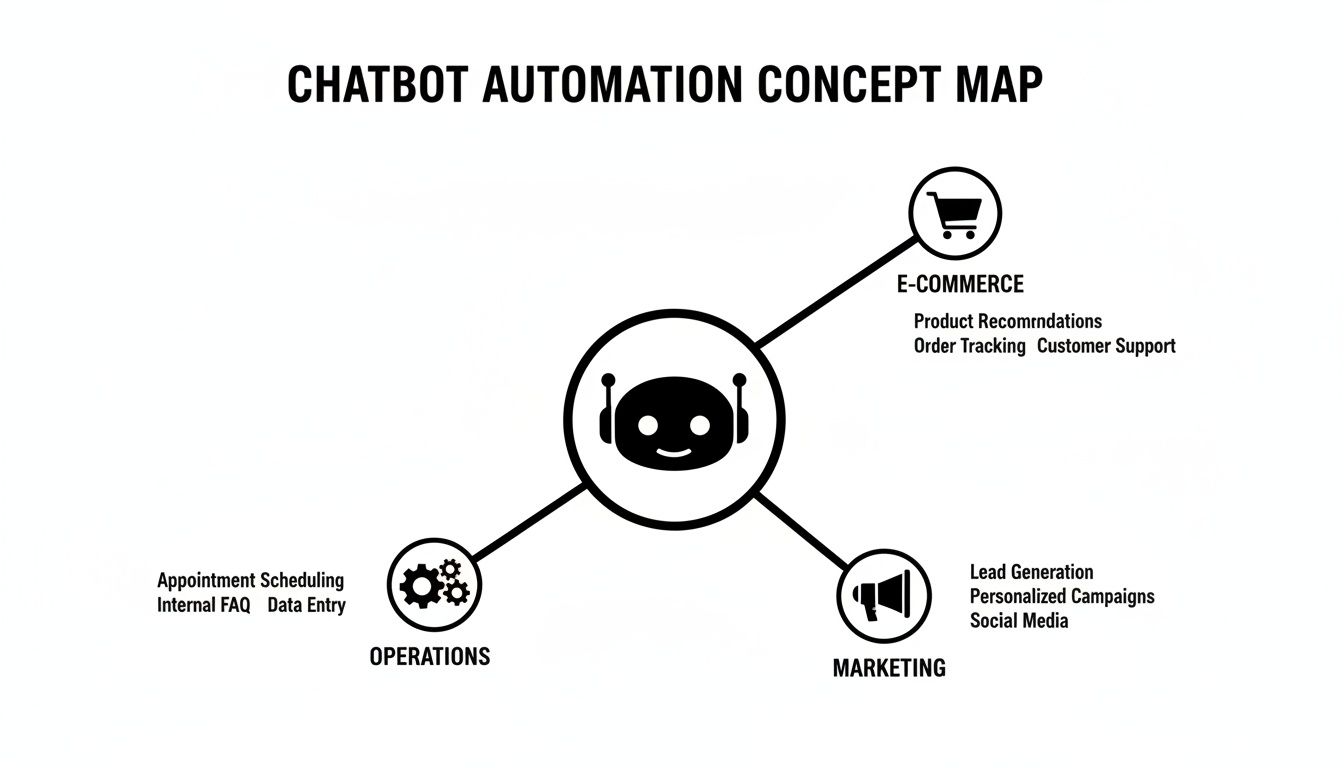
The key takeaway here is that you're not just plugging in a single-purpose tool. A well-integrated chatbot creates a ripple effect, bringing automation and efficiency to almost every part of your business.
Get Your Customer Support Under Control
Does your support inbox feel like a broken record? "Where is my order?" "What's your return policy?" "Do you ship to Canada?" An AI chatbot can step in and immediately handle that repetitive grind.
In fact, chatbots can resolve up to **80% of routine customer questions** on their own, with no human needed. This instantly frees up your team to focus on the tricky, high-stakes conversations that actually need their expertise.
Think about it this way: a customer lands on your website at 10 PM with a question. Instead of getting frustrated and leaving, they get an instant answer from your bot. If the problem is more complex, the bot can collect all the essential info—name, order number, and a description of the issue—and automatically create a support ticket. When your agent logs in the next morning, they have everything they need to solve the problem on the first try. No back-and-forth, just a quick resolution.
Turn Your Website Into a 24/7 Sales Machine
Your website is your storefront, but what happens when you’re not there to greet visitors? An AI chatbot acts as your tireless salesperson, engaging prospects the second they arrive. It never gets tired, never takes a break, and works around the clock to turn website traffic into qualified leads.
> A chatbot never sleeps. It can engage prospects, qualify them, and even book meetings while you're asleep, ensuring you never miss an opportunity just because it's after hours.
Here’s a real-world example. A potential client is browsing your pricing page late on a Friday night. The chatbot pops up and offers to help. It asks a few smart, qualifying questions to figure out their needs and budget. If they look like a solid lead, the bot syncs with your team’s calendar and books a demo for next week. That whole process takes two minutes and happens automatically.
Put Your Marketing on Autopilot
Marketing automation can feel overwhelming, often requiring complicated and expensive tools. A chatbot simplifies everything, creating automated workflows that nurture leads and bring back lost sales. One of the biggest wins here is tackling abandoned carts.
Here’s how it works for an online store:
1. A customer adds a few items to their cart but gets distracted and leaves your site.
2. A few minutes later, the chatbot sends a friendly, personalized message through Facebook Messenger or an on-site pop-up.
3. The message might offer a small discount code or answer a common question that causes hesitation, like your shipping policy.
This one simple, automated sequence can recover a surprising amount of otherwise lost revenue. Bots are also fantastic for lead generation. They can offer visitors valuable content—like an ebook or a webinar invite—in exchange for their contact info, automatically feeding new leads right into your marketing funnel.
Your Step-By-Step Implementation Checklist
Getting an **AI chatbot for your small business** up and running might sound like a massive undertaking. The good news? It's not. Modern chatbot platforms are built for people who don't have time for a months-long IT project. If you break it down into a few simple steps, you can have a bot working for you in minutes.
The absolute first thing you need to do is decide what you want the bot to accomplish. I’ve seen so many businesses get bogged down because they try to make their bot do everything at once—it's a surefire way to get frustrated and give up.
So, pick one thing. Is your inbox flooded with the same questions over and over? Your goal is to **reduce support tickets**. Need a better way to find good leads? Your goal is to **increase sales leads**. Nailing down one clear objective makes every other decision a whole lot easier.
Phase 1: Define Your Core Task
Before you even start window shopping for chatbot platforms, you need a plan. Getting this part right is the foundation for everything else.
1. **Identify the Main Pain Point:** What's the one thing that's driving you crazy? Is it losing potential customers after you've logged off for the day? Or is your team wasting hours answering "Where is my order?" Pinpoint that single biggest headache.
2. **Choose One Primary Goal:** Now, turn that pain point into a measurable goal. Something like, "Automate answers for our top 5 most common questions," or "Qualify website visitors and book at least one demo a day." Be specific.
3. **Outline a Basic Conversation:** Sketch out what a perfect chat would look like. For a sales bot, it could be as simple as: Greet the visitor -> Ask what they're looking for -> Suggest a product or service -> Get their email -> Offer to schedule a call.
Phase 2: Choose and Connect Your Tools
Once you know exactly what you're trying to achieve, you can find the right tool for the job and hook it into the software you already use. This is where the real power of automation comes to life.
> A common mistake is choosing a chatbot platform before defining the goal. It's like buying a bunch of power tools before you've even decided what you're building. Start with your "why," and finding the right "how" is simple.
Look for a platform that easily connects with the tools your business runs on. A modern system like SynthAI is built for this, letting you link your most important apps with just a few clicks.
* **Connect Your Storefront:** If you're running an ecommerce site, integrating **Shopify** is a must. This gives your bot the power to pull up order details and give customers real-time updates.
* **Link Your Communication Hubs:** Hooking up **Gmail** or **Slack** is huge. It means the bot can alert your team when a human needs to step in or send summaries of conversations right to you.
* **Sync Your CRM:** An integration with a CRM like **HubSpot** is critical for sales. Every lead your bot finds can be automatically sent to your pipeline, complete with the full chat history for context.
This "start small, then scale" approach takes the mystery out of getting started. Focus on that one key objective, connect your most important tools, and you’ll have an invaluable AI assistant working for your business before you know it.
Alright, you've launched your new AI chatbot. Now what? How can you be sure it's actually helping your business and not just creating digital small talk? To figure out if it’s pulling its weight, you need to look past vanity metrics like “total conversations” and focus on what really matters: your return on investment (ROI).
Think of your chatbot as a new employee. You wouldn't judge their performance just by how many people they spoke to during the day. You’d want to know how many customer problems they actually solved, how many sales they helped close, and whether they made your customers' lives easier. The same exact thinking applies to your bot.
> A chatbot's success isn't about how busy it is—it's about the real-world business results it delivers. The right metrics will draw a straight line from every automated chat to your bottom line, proving its value beyond a doubt.
Key Metrics for Business Impact
To get a true sense of your chatbot's performance, you have to track the Key Performance Indicators (KPIs) that connect directly to the goals you set in the first place. This is all about measuring real savings, new revenue, and happier customers.
For instance, if you brought in a chatbot to lighten the load on your support team, you’ll want to zoom in on support-specific data.
* **Ticket Deflection Rate:** This is a big one. It tracks how many customer questions the chatbot answers on its own, preventing a support ticket from ever being created. A high deflection rate is a direct measure of money and time saved.
* **Customer Satisfaction (CSAT) Score:** A simple "How did we do?" survey after a chat can tell you a lot. If your CSAT scores are climbing, it’s a great sign that your bot is providing fast, accurate help that people appreciate.
Connecting Chatbot Activity to Revenue
If your main goal is to drive sales, your metrics need to be tied directly to your finances. Here, you're looking for proof that the bot is helping you grow.
For sales and marketing, keep a close eye on these KPIs:
* **Lead Conversion Rate:** Of all the website visitors who chat with your bot, what percentage turn into qualified leads by sharing their contact details? This shows you just how effective your bot is at stocking your sales pipeline.
* **Chatbot-Influenced Revenue:** This is the holy grail of chatbot metrics. By tracking which customers interact with the bot and then go on to make a purchase, you can put an actual dollar amount on its contribution.
To make this easier, many modern platforms like SynthAI have built-in dashboards. They give you a single place to see all these metrics, so you can watch how your chatbot's activity directly affects critical numbers like monthly recurring revenue and customer churn.
Measuring your chatbot's ROI isn't just about looking at one number; it's about understanding its impact across your entire business. The best way to do this is to assign specific metrics to each department that interacts with the bot.
Below is a breakdown of which KPIs matter most for your support, sales, and marketing teams.
Key Metrics for Measuring Chatbot ROI by Department
| Department | Primary Metric | Secondary Metric | Why It Matters |
| :--- | :--- | :--- | :--- |
| **Customer Support** | **Ticket Deflection Rate** | CSAT Score | Measures direct cost savings by quantifying the number of human interactions avoided. High deflection with a good CSAT score is the ideal outcome. |
| **Sales** | **Chatbot-Influenced Revenue** | Lead Conversion Rate | Directly attributes a dollar value to the chatbot's sales activities, proving its contribution to top-line growth. |
| **Marketing** | **Cost Per Lead (CPL)** | Engagement Rate | Shows how efficiently the chatbot is generating leads compared to other channels like paid ads. A lower CPL means a better return on your marketing spend. |
By tracking these department-specific metrics, you move beyond a vague sense of "it's working" and get to a data-backed understanding of exactly how your chatbot is adding value. This approach makes it easy to justify the investment and find new opportunities for automation.
Frequently Asked Questions About AI Chatbots
Diving into any new technology brings up questions. We get it. Here are a few of the most common ones we hear from business owners, along with some straight-to-the-point answers.
Is an AI Chatbot Too Technical for Me?
This is probably the biggest worry we see, but the answer is a firm no. Gone are the days when you needed a developer on standby. Modern AI chatbot platforms are built for the rest of us.
Think of it this way: if you can set up a social media page or an email newsletter, you can launch a chatbot. Most of the setup involves simply connecting your existing tools with a few clicks and describing what you want the bot to do in plain English. Many even come with pre-built templates, so you can have a lead generation or support bot running in minutes, with absolutely **no code** required.
Will a Chatbot Sound Robotic and Hurt My Brand?
Another valid concern. Nobody wants their business represented by a clunky, impersonal robot. Luckily, today's AI has come a long way. You have complete control over the bot's personality and tone.
You can fine-tune your chatbot to match your exact **brand voice**, whether it's friendly and casual or formal and professional. The goal isn't to fool customers into thinking they're talking to a person.
> It’s about delivering instant, accurate help around the clock. The best systems know their limits and ensure a smooth handoff to a real person for more complex issues, so the customer always gets the best possible experience.
How Much Does an AI Chatbot Cost?
You don't need a massive budget. The pricing has changed significantly, moving away from huge upfront installation fees. Most platforms now offer flexible, subscription-based plans that are designed to fit a small business budget.
This pay-as-you-go approach means you can start small and see a return on your investment before scaling up. The cost is predictable, and you're not locked into a massive, long-term contract.
---
Ready to see how a coordinated team of AI assistants can run your business around the clock? Get started with **SynthAI** and launch your virtual team in minutes. Start your 7-day free trial today!
Ready to Transform Your Business with AI?
Build your AI team and start automating your marketing today.