Boost Growth with ai automation for small business: A Practical Guide
SynthAI Team
Content Team
Picture this: you’re trying to run a bustling café, but you’re stuck scribbling orders on paper pads, manually counting every coffee bean for inventory, and trying to remember to post on social media. You could probably make it work, but you'd be at a huge disadvantage. For small businesses today, trying to operate without **AI automation** is becoming that exact kind of handicap.
Why AI Automation Is Now Essential for Small Businesses
For a long time, many small business owners wrote off artificial intelligence as some futuristic fantasy, something only giant corporations with bottomless budgets could afford. That's simply not true anymore. Today, AI automation is an accessible, practical tool that helps you stay in the game, directly tackling the biggest headaches for any entrepreneur: not enough time, tight budgets, and the feeling that you’re always playing catch-up.
This isn't just a fleeting trend. It’s a real shift in how business gets done. Just look at the numbers—an estimated **57% of U.S. small businesses** plan to invest in AI by 2025. That's a massive **58%** jump in just two years. It's already happening, with daily AI use among employees hitting **30%**. You can explore more insights on this workplace shift and what it means for businesses like yours.
Leveling the Playing Field
Think of AI automation as your ultimate digital employee. It's a specialist that works around the clock to handle the tedious stuff, analyze data, and run marketing plays—all without needing a single coffee break. This gives smaller companies a shot at the same kind of efficiency that used to be reserved for the big players.
Instead of losing hours to manual data entry or staring at a blank screen trying to write a social media post, you can have an AI assistant knock it out in seconds. This frees you and your team up for the work that actually moves the needle.
* **Build real customer relationships:** Spend more time talking to your customers instead of just managing their data in a spreadsheet.
* **Focus on strategic growth:** Step back and think about the big picture, rather than getting stuck in the weeds of daily operations.
* **Solve creative problems:** Put your human brainpower toward the unique challenges that no machine can solve.
> The real power of AI for a small business isn't just about doing things faster. It's about unlocking the capacity to do the *right* things—the strategic work that drives real, sustainable growth.
Let's see the immediate difference AI makes. This table breaks down common business tasks, comparing the old manual way with the new automated approach to highlight gains in speed, cost, and scale.
Manual Work vs AI Automation: a Quick Comparison
| Business Function | Manual Approach (The Old Way) | AI-Automated Approach (The New Way) | Key Business Impact |
| :--- | :--- | :--- | :--- |
| **Marketing** | Hours spent brainstorming, writing, and scheduling social media posts one by one. | AI generates a month's worth of content in minutes, tailored to your brand voice. | **Time Savings:** Frees up 10+ hours per week. |
| **Sales** | Manually emailing every new lead from your website, with slow follow-up times. | AI instantly engages leads with personalized emails and qualifies them automatically. | **Increased Revenue:** 24/7 lead nurturing means more conversions. |
| **Customer Support** | Answering the same questions over and over via email or phone. | An AI chatbot provides instant answers to common questions on your website, 24/7. | **Improved Experience:** Customers get help immediately, boosting satisfaction. |
| **Operations** | Tediously copying customer data from order forms into your CRM system. | AI automatically syncs data between your e-commerce platform and your CRM. | **Reduced Errors:** Eliminates costly human errors from manual data entry. |
As you can see, the contrast is stark. By automating these key functions, you're not just saving a few minutes here and there; you're building a more resilient and scalable business from the ground up.
A great AI automation platform can act as your marketing coordinator, sales assistant, and support agent all at once. For instance, a platform like SynthAI can automatically create and schedule your social media calendar, follow up with leads from your website, and give instant answers to customer questions—all from one place. This kind of integrated system closes the resource gap and truly empowers you to compete.
Understanding What AI Automation Really Means

Let's cut through the buzzwords and get real about what "AI automation" actually is. Forget the sci-fi robots. Imagine having a brilliant intern who learns instantly, never gets tired of repetitive tasks, and can spot golden opportunities buried in your data. That, in a nutshell, is **AI automation for small business**.
It’s not about becoming a coder or building some complex system from the ground up. It’s about using smart, modern tools to take over the tedious, time-draining jobs that clog up your day. This frees you and your team to focus on what really matters: strategy, building customer relationships, and growing the business—the things humans excel at. Think of it as a smart system that streamlines your most annoying processes, boosting your efficiency and cutting down on costly mistakes.
The Brains Behind the Operation
So, how does it all work? AI automation relies on a few key technologies working in concert. You don't need a PhD to use them, but knowing the basics helps you see just how powerful they can be. Think of them as a specialized digital crew, each with a unique job.
* **Machine Learning (The Analyst):** This is the "brain" of the outfit. It's incredibly good at finding patterns in your business data. For example, it can analyze your sales history to predict which products will fly off the shelves next month or pinpoint your most profitable customer groups.
* **Natural Language Processing (The Communicator):** These are the "ears and voice." NLP is what allows AI to understand, interpret, and even write like a human. It's the magic behind tools that can draft personalized marketing emails, generate a month's worth of social media content, or instantly answer customer questions.
* **Robotic Process Automation (The Doer):** This is the set of "hands." RPA is designed to follow rules and execute tasks across your different software programs. It’s like a digital assistant that can copy-paste data from a spreadsheet into your CRM, fill out online forms, or organize files, all without you lifting a finger.
The best part? Modern platforms like SynthAI bundle all this incredible technology into a simple, intuitive interface. You never have to mess with the complicated stuff directly.
> Your job isn't to be a tech wizard; it's to define your business goal. You simply tell the system what you want to achieve in plain English, like "get more leads from our website" or "answer common customer questions faster."
From Complex Tech to Simple Commands
This is the real breakthrough for small businesses. We've moved from needing technical know-how to just needing a clear goal. The focus is entirely on the outcome, not the process. You're the director, and the AI is your production team, ready to bring your vision to life.
For example, instead of manually mapping out a social media calendar, you could just tell the system: "Create a week of Instagram posts promoting our new shoe collection, focusing on comfort and style." The AI then gets to work, using its different skills to get the job done:
1. It **understands** your goal using Natural Language Processing.
2. It **analyzes** what made past posts successful using Machine Learning.
3. It **generates** engaging captions, suggests visuals, and even schedules the posts for you.
This simple, instruction-based approach is making a huge difference. In fact, research shows that **56% of companies** using AI to manage daily tasks report saving around **30%** of their time. For a small team juggling a dozen priorities, getting that time back is everything. It’s the difference between constantly playing catch-up and finally getting ahead of the curve.
High-Impact AI Use Cases to Drive Real Growth
Knowing that AI automation can help is one thing, but seeing exactly *how* is where it all clicks. Let's move past the theory and look at the real-world, high-impact ways **AI automation for small business** can deliver tangible results. These aren't futuristic ideas; they are practical applications you can put to work right now to fuel genuine growth.
This shift is already happening all around us. A recent report found that a massive **87% of small businesses** are already seeing a positive impact from using AI. Digging into the data, owners are most comfortable automating marketing content creation (**84%**), handling customer service inquiries (**59%**), and personalizing customer recommendations (**57%**). As you can see, the focus is clearly on improving customer interactions and internal workflows. You can read more about these small business AI trends to see how your peers are already winning.
Supercharge Your Marketing Efforts
For most small business owners, marketing feels like you’re always running out of time. AI completely flips that script by automating the most repetitive tasks, so you can finally focus on big-picture strategy. Just imagine drafting a month's worth of quality social media posts in the time it takes to finish your morning coffee.
An AI platform like SynthAI can learn your brand voice, analyze what’s worked in the past, and understand your target audience. With that knowledge, it can generate a full content calendar—complete with engaging captions, on-point hashtags, and even ideas for visuals. But it goes much further than that.
* **Email Marketing on Autopilot:** Instead of sending the same generic message to everyone, AI helps you create deeply personal campaigns. It can write welcome sequences for new subscribers, abandoned cart emails for your online store, or re-engagement campaigns for quiet customers, all triggered and tailored by individual actions.
* **Smarter Ad Campaigns:** AI gets the most out of every dollar you spend on ads. It continuously analyzes performance to pinpoint the best-performing audiences and ad creatives, ensuring your budget is always working as hard as you are.
> **Real-World Example:** A small online boutique uses AI to analyze its Shopify sales data. The system notices a pattern: customers who buy a specific sundress often come back a few weeks later to browse sandals. The AI then automatically launches a targeted email campaign, sending a personalized "complete your look" message with sandal recommendations directly to those customers, turning browsing interest into another sale.
Transform Your Sales Process
Success in sales comes from building strong relationships, but tedious admin work constantly gets in the way. AI automation takes care of the grunt work that slows your sales team down, freeing them up to do what they do best—talk to customers and close deals.
One of the biggest wins here is automating lead management. The moment a potential customer fills out a form on your website, an AI can instantly follow up with a personalized email, qualify them based on their answers, and even get a follow-up call booked on your calendar. This simple automation ensures no hot lead ever goes cold.
Streamline Your Customer Support
Great customer service builds unshakable loyalty, but it can drain your resources. This is where AI assistants make a world of difference. An AI-powered chatbot on your website can give customers instant, 24/7 answers to their most common questions.
In fact, research shows AI chatbots can successfully handle up to **80% of routine customer queries** without needing any human help. This creates a win-win: your customers get the immediate support they want, and your team is freed from answering the same questions over and over. They can then dedicate their expertise to solving the complex issues that truly require a human touch.
**How AI Elevates Your Support:**
1. **Instant Resolutions:** The AI provides immediate answers to questions like "Where is my order?" or "What's your return policy?".
2. **Smart Routing:** If a question is too complex, the AI doesn't just give up. It intelligently routes the conversation—along with the full chat history—to the right person on your team.
3. **Sentiment Analysis:** Modern AI can even detect a customer's frustration in their writing. It can then automatically prioritize their ticket, helping you quickly turn a potentially negative experience into a positive one.
Optimize Your Daily Operations
Beyond sales and marketing, AI can bring incredible efficiency to the very core of your business operations. Just think about all the time you and your team spend on manual data entry, pulling reports, and trying to get different software tools to talk to each other.
AI acts as the central hub, connecting your disparate systems and automating the flow of information between them.
For example, when you make a sale in your Shopify store, an AI workflow can instantly and automatically:
* Update the customer's profile in your HubSpot CRM.
* Log the transaction details in your QuickBooks account.
* Send a notification to your team's Slack channel so everyone is in the loop.
This completely eliminates manual data entry, which not only gives you back countless hours but also dramatically reduces the risk of costly human errors. A platform like SynthAI is designed to integrate with the tools you already rely on, creating a powerful operational backbone for your business. It works silently in the background, keeping everything perfectly in sync—a key principle of effective **AI automation for small business**.
Your Simple Roadmap to Implementing AI
Jumping into AI automation can feel like a massive undertaking, but it doesn’t have to be. The secret isn't to tear down your entire business and rebuild it overnight. Instead, think of it as a series of small, smart steps that build on each other, delivering real value from the very first day. This is a practical roadmap for busy owners, not a technical manual for developers.
The whole journey starts with a simple question: Where does your time go? We're looking for the biggest bottlenecks—those repetitive, soul-crushing tasks that drain your team's energy and budget. Is it the endless copy-pasting of data? Answering the same three customer questions a dozen times a day? Or the constant scramble to come up with new social media content?
Once you’ve found those pain points, you can aim for a “quick win.” This is a single, high-impact automation that solves a real problem right away. This approach gives you immediate results and builds momentum, proving the value of **AI automation for small business** without requiring a huge upfront investment.
Step 1: Identify Your Biggest Bottlenecks
Before you can find the right solution, you have to know exactly what problem you're solving. Take a hard look at your daily and weekly workflows. Where do things get stuck?
A great exercise is to track your own time for a week, or ask your team to jot down their most repetitive tasks. The culprits will become obvious very quickly.
* **Marketing Pains:** Do you spend hours staring at a blank screen, trying to brainstorm social media posts or write another email campaign?
* **Sales Hurdles:** Is your sales team drowning in manual data entry, just moving lead info from a web form into your CRM?
* **Support Overload:** Are you constantly fielding basic questions about business hours, shipping policies, or returns?
* **Operational Drag:** How much time is lost manually updating inventory lists or trying to get data to sync between different software tools?
> Pinpointing the single most time-consuming, repetitive task in your business is the most critical first step. Solving this one problem will provide a clear, measurable return on investment and build confidence for future automations.
Step 2: Target a Quick Win
With your biggest bottleneck in your sights, it's time to pick your first project—a "quick win." This should be an automation that's simple to set up but delivers an immediate, visible benefit. The goal here is to see results fast, because that’s what builds the motivation to do more.
For instance, if content creation is your main headache, a fantastic quick win would be using an AI platform to generate a week’s worth of social media posts. If customer support is the issue, setting up an AI chatbot to handle all your frequently asked questions is a perfect first move.
This diagram shows how you can apply AI across your business to score these kinds of wins.
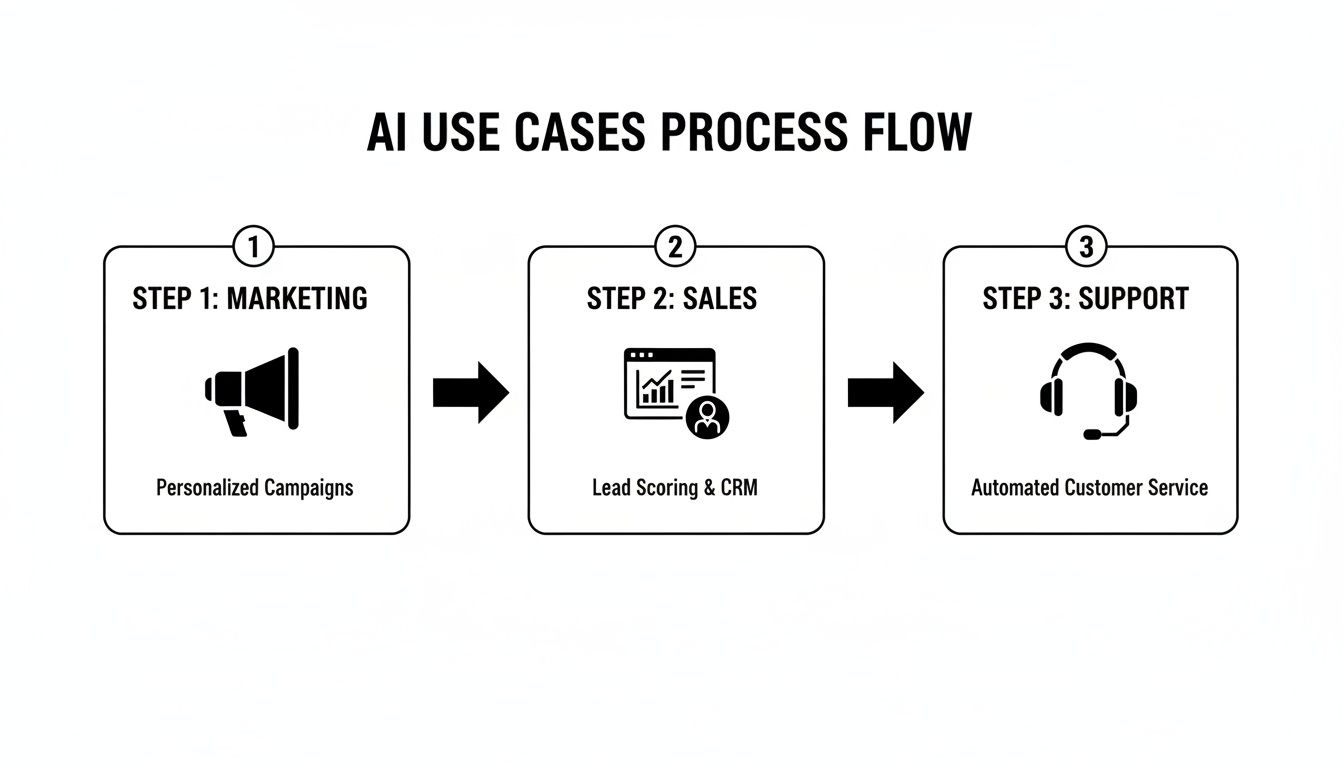
As you can see, AI can create a connected workflow that starts with marketing to attract customers, moves to sales to convert them, and finishes with support to keep them happy.
Step 3: Choose an Integrated Platform
Now that you have a goal, you need the right tool. While there are plenty of single-task AI tools out there, a unified platform is almost always the better choice. Juggling multiple, disconnected apps often creates more work than it saves, leading to messy data and wasted time.
An integrated platform like SynthAI brings your marketing, sales, and support automation together in one place. The key is finding a solution that plays nice with the tools you already rely on, like Shopify, Google Analytics, or your CRM.
The setup should be straightforward. Modern platforms let you connect your data sources in just a few minutes, giving you powerful automation capabilities without needing to write a single line of code.
Step 4: Measure Success and Scale Intelligently
The final step is to measure your results. Did your quick win actually save you time? Did it bring in more leads or make customers happier? Tracking these metrics is the only way to know if your investment is paying off.
Here are a few key performance indicators (KPIs) to keep an eye on:
* **Time Saved:** Track the number of hours your team gets back each week. Research shows **56% of companies** using AI for daily tasks save around **30%** of their time.
* **Cost Reduction:** Calculate what you're saving from less manual labor and fewer human errors.
* **Lead Conversion Rate:** Are automated follow-ups turning more prospects into customers? Measure it.
* **Customer Satisfaction:** Monitor your support ratings and response times after launching an AI chatbot.
Once you’ve proven the value of your first automation, you can start scaling. Use your initial success as a blueprint to tackle the next bottleneck on your list. By taking this steady, step-by-step approach, you can build a more efficient, resilient, and profitable business.
Picking the right AI platform can feel like a huge decision, but it doesn't have to be complicated. Forget about just adding another piece of software to your plate. The real goal is to find a strategic partner that will save you time, cut costs, and actually help you grow your business.
Think of it like making a key hire. You wouldn't bring someone onto your team who can't communicate clearly, work well with others, or take on more responsibility as you expand. The same exact logic applies when choosing your platform for **AI automation for small business**.
Focus on Ease of Use
Your time is your most valuable asset, period. The last thing you need is a tool that feels like it requires a computer science degree just to get started. The best AI platforms are built for business owners, not engineers, allowing you to set up powerful automations using plain English.
Can you just describe what you want to do—like "create a social media campaign for our upcoming sale"—and have the AI figure it out? If a platform forces you to learn complex jargon or, worse, write code, it’s just another bottleneck. This is why a tool like SynthAI, which runs on natural language commands, is so effective. It keeps the focus on your business goals, not on technical roadblocks.
> The real test of a great AI platform is its simplicity. If you can write an email, you should be able to create an automation. This accessibility is what makes AI a practical tool for small businesses, not just a gadget for big corporations.
Prioritize Strong Integration Capabilities
Your business already has a tech stack—your e-commerce store, your CRM, your analytics tools. The right AI platform doesn't try to replace them; it works *with* them. It should act as a central hub, connecting all your existing software so it finally works together as one cohesive system.
This is the fundamental difference between a bunch of single-task AI tools and a truly integrated platform. Juggling disconnected tools creates data silos and inefficiencies, which is the very problem you’re trying to solve in the first place. A coordinated platform eliminates that friction entirely.
Before committing, it's worth weighing your options. Are you better off with a collection of specialized tools or a single, unified platform?
Choosing Your AI Tools: Point Solutions vs. an Integrated Platform
This table can help you decide between juggling multiple niche AI tools and adopting a unified platform that streamlines your entire workflow.
| Evaluation Criteria | Multiple Single-Task AI Tools | An Integrated AI Platform |
| :--- | :--- | :--- |
| **Ease of Use** | Learning curve for each individual tool. Can be complex to manage. | One unified interface. Learn one system to manage everything. |
| **Workflow Efficiency** | Disconnected. Requires manual work or complex integrations to pass data between tools. | Seamless. Automate entire workflows across different business functions. |
| **Data & Insights** | Data is siloed in each tool. Hard to get a complete picture of performance. | Centralized data. Provides a single source of truth for better insights. |
| **Cost** | Multiple subscriptions add up quickly. Costs can become unpredictable. | Often a single, predictable subscription. Better value in the long run. |
| **Scalability** | Can be difficult to scale. Adding new tools increases complexity. | Designed to grow with your business. Easily handle more data and users. |
While specialized tools can be great for a single, specific need, an integrated platform like SynthAI offers a more holistic and scalable solution. It’s built to be the central nervous system of your business operations.
**Key Questions to Ask About Integrations:**
* **Does it connect to my essential tools?** Look for native integrations with platforms like Shopify, Google Analytics, and HubSpot.
* **How long does setup take?** Connecting your data sources should take minutes, not days.
* **Can it automate workflows across apps?** The real magic happens when you make different tools "talk" to each other, like automatically adding a new Shopify customer to a specific HubSpot mailing list.
Ensure Scalability and Security
The platform you choose today needs to be able to support your business tomorrow. A scalable solution grows with you, handling more customers, more data, and more complex automations without breaking a sweat. This foresight saves you from the painful and expensive process of switching platforms down the road.
Just as important is security. When you connect an AI platform to your business data, you're handing over the keys to sensitive information. That trust has to be earned.
Look for non-negotiable security credentials like **SOC 2 compliance**. This certification means the provider has passed a rigorous, independent audit of its security, availability, and confidentiality controls. It's the gold standard for data protection, giving you peace of mind that your business and customer data are being handled responsibly. Choosing a platform that invests in enterprise-grade security is critical for protecting your reputation and your bottom line.
What Does an AI-Powered Business Actually Look Like?

It's easy to get lost in the technical details, so let's zoom out for a moment. What if you could get back the **15-20 hours** you spend every week on mind-numbing marketing tasks? Imagine what you could do with that time—actually talk to your best customers, brainstorm new products, or even just take a Friday afternoon off. This isn't just wishful thinking; it's the reality for small businesses using **AI automation**.
Think about your customer support desk. Instead of being buried under a mountain of "where's my order?" and "what's your return policy?" emails, they’re now free. With AI handling up to **80%** of those common questions, your team can focus on the tricky problems and provide the kind of memorable, personal service that turns a one-time buyer into a lifelong fan. This is the difference between working harder and working smarter.
From Overwhelmed to Empowered
This isn't about small tweaks or marginal gains. It’s a complete shift in how your business runs, moving you from playing defense to offense. You’ll be trading late-night firefighting for clear-headed, strategic planning.
> AI automation isn't just another app you have to manage. It's a system that executes your business playbook for you, so you can finally get out of the weeds and focus on steering the ship.
When you bring on an integrated AI platform like SynthAI to act as your digital employee, here’s what you can realistically expect:
* **You Get Your Time Back:** All the tedious work—data entry, social media scheduling, pulling reports—gets done for you. This frees you up to work *on* the business instead of getting stuck *in* it.
* **You Create Predictable Growth:** With AI running campaigns and analyzing data around the clock, you build a reliable engine for bringing in new leads and sales, month after month.
* **Your Team Becomes More Valuable:** By automating the boring stuff, you let your people focus on the creative, high-impact work that actually moves the needle and keeps them engaged.
Your Journey Starts Now
Getting to this point starts with one simple decision. When you choose the right platform, you don’t need to be a tech wizard. You can just tell it your goals in plain English and start seeing results almost immediately. This is how you build a stronger, more profitable, and frankly, more enjoyable business to run. The tools are here, and getting started is easier than you think.
Frequently Asked Questions About AI Automation
Even with all the exciting possibilities, jumping into any new technology brings up fair questions. Let’s tackle some of the most common concerns small business owners have when they think about AI automation.
Is AI Automation Too Expensive for My Small Business?
Not anymore. It's true that custom-built AI used to be incredibly expensive, something only large corporations could afford. But that has completely changed. Modern platforms offer affordable, scalable plans designed specifically for small business budgets.
Honestly, when you factor in the return on investment from saved time, reduced operational costs, and boosted sales, AI often becomes one of the smartest financial moves you can make. Think of it less as a cost and more like hiring a super-efficient digital employee for a fraction of what you'd pay a part-time freelancer.
Do I Need Technical Skills to Use AI Automation?
Absolutely not. This is one of the biggest misconceptions. The best platforms for **AI automation for small business** are built for business owners and their teams, not for developers. If you can write an email or a social media post, you already have the skills you need.
Today’s AI systems use natural language, which means you can just tell them what to do. For example, you can literally type, "create a social media campaign for our upcoming summer sale," and the system understands and executes—no coding or complex setup required.
> The whole point of modern AI is to remove the technical hurdles. It’s designed to understand what you want to achieve and then figure out the "how" for you, putting powerful automation in everyone's hands.
Will AI Replace My Employees?
This is a big one, but the reality is that AI is here to *empower* your team, not replace them. It’s brilliant at handling the repetitive, data-driven tasks that eat up your team's day and stifle their creativity. By offloading that work, you free up your people to focus on the high-impact work that only humans can do.
Your team suddenly has more time and energy for things like:
* **Big-picture strategic planning and creative problem-solving.**
* **Building genuine, personal relationships with your customers.**
* **Developing new products or finding innovative ways to improve your services.**
Ultimately, businesses that adopt AI find it makes their teams *more* valuable and effective, not obsolete.
How Secure Is My Business Data with an AI Platform?
Data security is non-negotiable, and any reputable AI provider knows this. Leading platforms invest heavily in top-tier, enterprise-grade security to protect your sensitive information. When you're evaluating a tool, make sure you look for key certifications like **SOC 2 compliance**.
This isn't just a fancy badge; it means the provider has passed a rigorous, independent audit of its security, availability, and confidentiality controls. It's your proof that your business and customer data are being handled with the highest level of care.
---
Ready to see what a coordinated AI team can do for your business? With **SynthAI**, you can automate marketing, sales, and support in minutes using simple, natural language commands. Start your free 7-day trial of SynthAI and experience the power of effortless automation.
Ready to Transform Your Business with AI?
Build your AI team and start automating your marketing today.