Your Guide to an AI Assistant for Small Business
SynthAI Team
Content Team
An **AI assistant for a small business** isn't some far-off tech fantasy anymore. It's a real tool that's becoming as essential as a smartphone. Trying to run your business today without one is like sticking with a flip phone while all your competitors are using the latest iPhone—you're just making things harder on yourself.
At its core, an AI assistant is about automating the tedious, repetitive tasks that eat up your day, giving you back your most valuable resource: your time.
Why an AI Assistant Is a Must-Have
If you run a small business, you know the feeling of being stretched thin. You're juggling a dozen different roles with a tight budget and a never-ending to-do list. An AI assistant basically acts as your new, super-efficient team member, handling the grunt work so you can finally focus on the big picture—like building customer relationships and planning your next move.
This isn't just a trend; it's a massive shift in how small businesses operate. The numbers are pretty staggering. As of 2026, **57% of U.S. small businesses** are now using AI, a huge jump from just 36% in 2023. What's more, about **30% of employees** now use AI tools every single day. It's quickly gone from a niche idea to a standard part of the workday. You can dig into the specifics of these AI usage trends in the full study.
Quick Answer: Small Business Challenges vs AI Solutions
For most business owners I talk to, the "aha!" moment comes when they see a direct line between their daily headaches and what an AI assistant can actually do. These platforms are built specifically to tackle the common obstacles that keep small businesses from growing.
The table below breaks it down. It's not just about asking a chatbot a question; it's about having an assistant that takes action.
| Common Small Business Challenge | How an AI Assistant Solves It |
| :--- | :--- |
| **Limited Time and Resources** | Automates marketing, sales, and support tasks 24/7, freeing up your team for high-value work. |
| **Tight Budgets** | Reduces the need for expensive freelancers or additional full-time hires for specialized roles. |
| **Inconsistent Marketing Efforts** | Generates and schedules a steady stream of content, emails, and ads to keep your brand visible. |
| **Disjointed Tools and Data** | Connects your software (e.g., Shopify, HubSpot, Google Ads) to create unified workflows and reporting. |
| **Slow Customer Response Times** | Provides instant, 24/7 answers to common customer questions, improving satisfaction and loyalty. |
Simply put, instead of hiring multiple specialists or losing hours to manual work, a single AI platform can coordinate tasks across your entire business.
> Think of an AI assistant less in terms of pure efficiency and more in terms of pure capability. It gives a small team the operational power of a much larger company, finally letting them compete on a more level playing field.
What Is a Coordinated AI Team for Business
When most people hear "AI assistant," they probably think of a simple chatbot fielding basic questions. That's a start, but it’s like having a lone receptionist when what you really need is an entire marketing department. A true **AI assistant for small business** isn't just one tool; it’s a coordinated digital team of specialists, working for you 24/7.
Think about what it would take to hire a full team: an SEO expert, an email marketer, a social media manager, and a customer support agent. Now, imagine them all collaborating flawlessly, led by a project manager who makes sure every task connects perfectly. That's the idea behind a coordinated AI team.
This is where AI can step in to solve some of the most common headaches for small businesses—limited time, tight budgets, and the need to be everywhere at once.
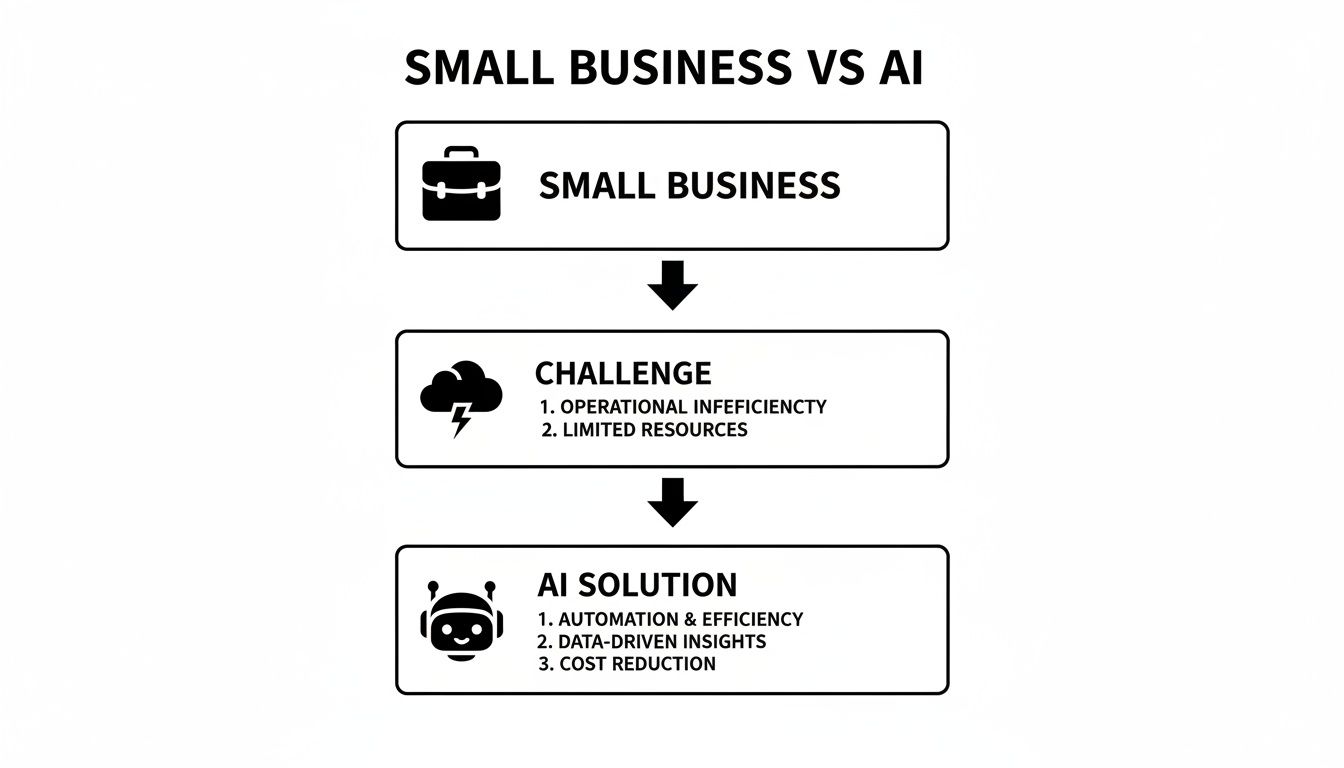
As you can see, a coordinated AI system doesn't just react to problems as they pop up. It gets ahead of them by proactively managing your workflows, turning what used to be a frantic scramble into a smooth, automated process.
From Individual Tools to a Unified System
Here’s the key difference between having a bunch of separate AI apps and having a real AI business team: **orchestration**. Using disconnected tools is like having a staff of brilliant people who never talk to each other. Your content writer might produce a fantastic blog post, but if the social media manager never hears about it, it just sits there. No promotion, no traffic, no results.
A coordinated AI platform like SynthAI solves this communication breakdown with a central "coordinator" that directs a team of specialized AI agents.
> Think of it like this: You don't just have a generic AI that writes emails. You have an email marketing specialist (like **Lumen**), an SEO expert (**Aura**), and a customer support pro (**Pax**). The coordinator AI, Nexus, is the project manager making sure they all work together on complex goals.
This changes everything. You stop just checking off isolated tasks and start automating entire business functions from start to finish.
An Example of Coordinated AI in Action
Let’s walk through a real-world scenario: launching a new product. Instead of you juggling a dozen steps across different software, the AI team handles it all.
1. **Goal Definition:** You give the coordinator a simple command: "Launch our new skincare line next month."
2. **Specialist Activation:** The coordinator immediately breaks down the goal and assigns tasks to the right AI specialists on its team.
3. **Cross-Functional Execution:**
* The landing page builder, **Basis**, creates a high-converting product page.
* The SEO specialist, **Aura**, optimizes all the page content and meta descriptions for search engines.
* The email marketing agent, **Lumen**, drafts and schedules a launch announcement campaign for your subscriber list.
* The social media assistant, **Echo**, generates a full content calendar with posts, images, and videos for your channels.
* The ads manager (also **Aura**) sets up targeted ad campaigns on Meta and Google.
And while all this is happening, a central analytics agent called **Vantage** is watching everything—tracking traffic, conversions, and ad spend in real-time. The team works in perfect harmony because the coordinator ensures information flows between them, just like a great human project manager would. This is the leap from simply using AI apps to deploying an intelligent, automated system that runs critical parts of your business for you.
What Can an AI Assistant *Actually* Do for Your Business?
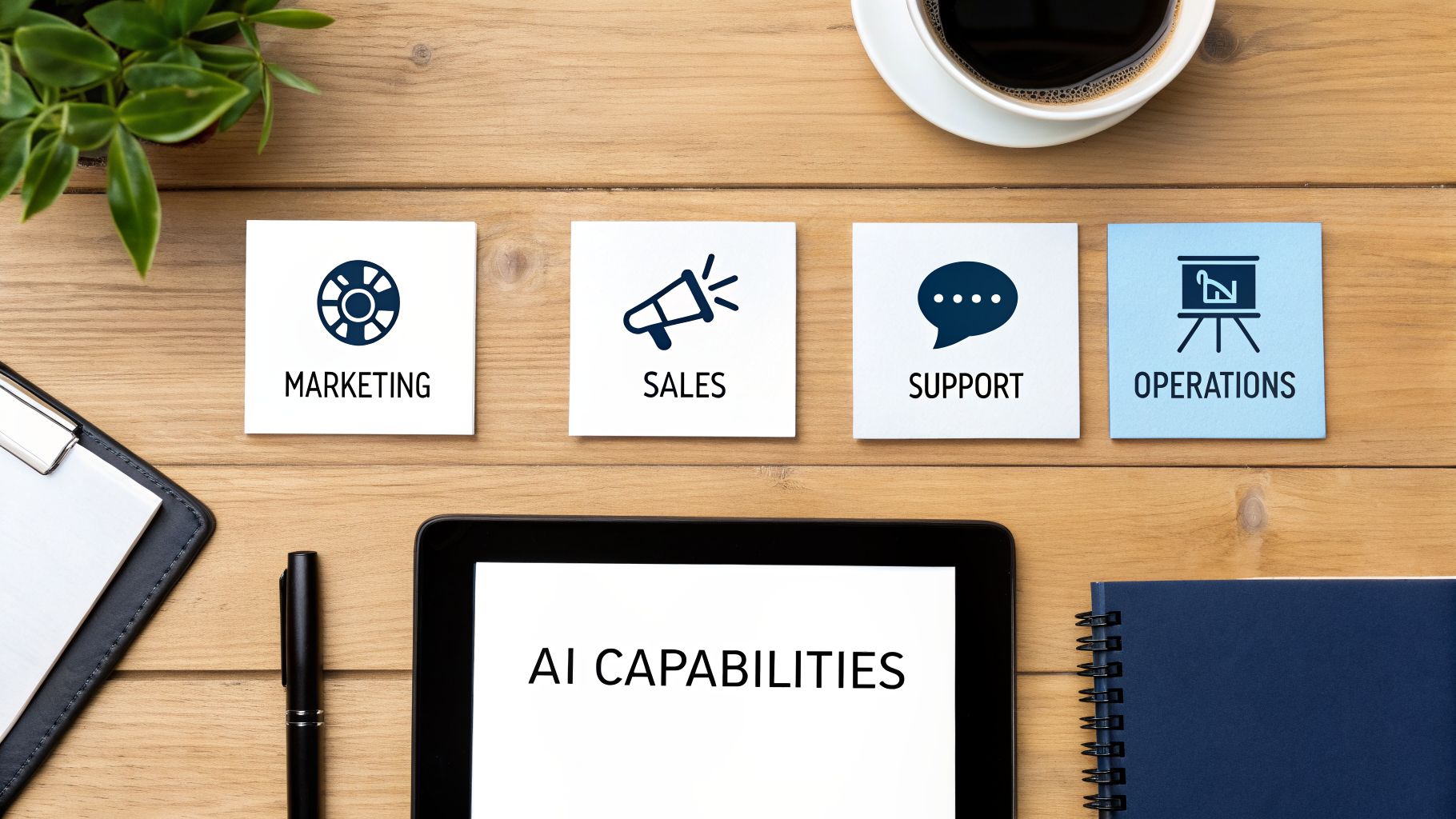
It’s one thing to talk about a team of AI assistants in theory. It’s another to see what they can *actually* do. An **AI assistant for small business** isn’t just a chatbot or a fancy search bar; it’s a hands-on executor designed to take real work off your plate.
The best way to grasp their impact is to see how they function across the four pillars of any small business: marketing, sales, customer support, and day-to-day operations. In each area, specialized AI assistants tackle the tedious, repetitive tasks that drain your time and energy, often working together to automate entire workflows.
Put Your Marketing on Autopilot
Marketing feels like a never-ending treadmill of creating content, running ads, and trying to get noticed. An AI assistant becomes your tireless marketing coordinator, handling the grunt work so you can finally step back and think about the big picture.
Forget staring at a blank screen trying to come up with your next blog post. An AI can draft articles, brainstorm social media content, and write ad copy that gets clicks. For most small teams, content creation is a huge bottleneck. This completely changes the game.
Here’s how a platform like SynthAI coordinates a full content campaign:
* **Aura**, the SEO specialist, spots a trending keyword in your industry.
* It then outlines an SEO-optimized blog post based on what's already ranking well.
* **Echo**, the social media assistant, takes that post and spins it into a week's worth of promotional content for all your channels.
* Finally, **Lumen** drafts a newsletter to share the new article with your email list.
Supercharge Your Sales Pipeline
The sales process is notoriously bogged down by admin work. All that time spent on data entry, lead management, and follow-ups is time you’re not spending actually talking to prospects and closing deals.
AI assistants are brilliant at this. They can monitor your inbox for new inquiries, add leads directly to your CRM (like HubSpot), and even schedule discovery calls for you. This kind of automation ensures every lead gets a prompt, professional response, which is absolutely critical for making a good first impression.
> A key insight from companies building these tools is that the real gold mine is automating "the work before the work"—all the prep and data entry that happens before you can even talk to a customer. This is where AI delivers immense time savings.
Imagine a new lead fills out a form on your website. Before you even open your inbox, an AI sales assistant like **Ascent** can:
1. Log the new contact in your CRM, complete with all their submitted details.
2. Instantly send them a personalized welcome email.
3. Create a follow-up task for a sales rep if the lead doesn’t reply within **48 hours**.
Deliver World-Class Support, 24/7
Great customer service builds loyal fans, but who has the staff to be available around the clock? An AI assistant can act as your first line of defense, giving customers instant answers to their questions, any time of day or night.
This isn’t just about basic chatbots, either. Today's support AI can tap into your knowledge base, look up order details in platforms like Shopify, and even help customers process their own returns or exchanges. Making help centers smarter with AI is a huge focus right now because it drastically improves self-service and frees up your human team for the truly complex issues.
Streamline Your Daily Operations
Beyond specific departments, an AI assistant can be the operational glue that holds your business together. It connects the dots between your different software systems—your marketing tools, your sales CRM, your financial software—to create a unified view of your business.
This is where you graduate from automating single tasks to automating entire business processes.
Your operational AI can pull data from all your tools to generate a weekly performance report, keep an eye on inventory levels, or even navigate tricky compliance rules. For example, some businesses use AI to create optimal employee shift schedules that account for complex local labor laws—a massive headache solved in minutes. It’s about making your entire operation run more smoothly, without you having to manually check in on everything.
Real-World Examples of an AI Team in Action
The theory behind an **ai assistant for small business** is great, but what does this actually look like day-to-day? Let's go beyond the feature list and step into a few real-world scenarios. You'll see how a coordinated AI team can take a simple goal and turn it into a fully executed project.
These examples show how specialized AI assistants, all directed by a central coordinator like SynthAI's Nexus, work in concert. It’s not about just one tool doing one thing; it’s about a whole system working together to get the job done.
Scenario 1: Launching a New Product for an E-commerce Brand
Imagine a small online shoe store on Shopify called "Sole Mate." They're getting ready to launch a new line of sustainable sneakers and need to make a big impression. Instead of the owner blocking off weeks to handle all the marketing tasks, they give their AI team a single instruction: "Launch the 'Earth Walker' sneaker collection on the first of next month."
From there, the AI coordinator, Nexus, springs into action and starts delegating:
1. **Landing Page Creation:** **Basis**, the page building assistant, gets to work creating a brand-new product page right inside Shopify. It pulls in all the product photos and details, writes fresh copy highlighting the sustainability angle, and makes sure the entire page looks perfect on mobile.
2. **SEO Optimization:** At the same time, **Aura**, the SEO specialist, gets the new page ready for Google. It finds the best keywords, like "eco-friendly sneakers" and "sustainable footwear," and crafts the perfect title tag, meta description, and image alt text to start climbing the search rankings.
3. **Content and Social Media:** The social media pro, **Echo**, maps out a two-week content calendar to build buzz. It generates engaging posts for Instagram and Facebook—complete with AI-created lifestyle images of the sneakers—and schedules them to post automatically when followers are most active.
4. **Email Campaign:** **Lumen**, the email marketing expert, builds a three-part email series for Sole Mate's subscribers. It sends a teaser to generate excitement, a launch day announcement, and a final follow-up, using personalized subject lines to get as many opens as possible.
5. **Ad Management:** Finally, **Aura** (wearing its ads hat) sets up targeted campaigns on Meta and Google. It creates the ad copy and visuals, aims them at audiences interested in sustainable fashion, and manages the budget to squeeze the most out of every dollar spent.
And while all this is happening, **Vantage**, the analytics assistant, is tracking everything. The store owner can glance at a dashboard and see traffic, conversion rates, and campaign performance in real-time, from the first ad click all the way to the final sale.
Scenario 2: Generating Qualified Leads for a SaaS Company
Let's switch gears to a B2B SaaS startup called "InnovateIQ." They have decent website traffic but are finding it hard to turn those visitors into actual leads. The small sales team is bogged down in manual outreach and data entry when they should be talking to potential customers. So, they give their AI assistant a new mission: "Automate our lead generation and qualification process."
This command activates an entirely different crew of AI specialists, all focused on the sales pipeline.
> The real value of AI in sales is often found in what experts call "the work before the work"—all the data entry, research, and follow-up that happens before a human ever joins the conversation. This is where AI assistants create the most significant time savings.
Here’s how the AI team gets it done:
* **Lead Capture and Enrichment:** When a visitor downloads an ebook, **Ascent**, the sales assistant, instantly grabs their info. It doesn't stop there; it automatically enriches that contact by finding their company size and job title from public data.
* **CRM Integration:** The newly enriched contact is immediately pushed into the company's HubSpot account, tagged with their interest based on the ebook they downloaded. No more manual copy-pasting for the sales team.
* **Automated Nurturing:** **Lumen** takes over and enrolls the new lead in a targeted email sequence. Over the next couple of weeks, it sends them helpful case studies and blog posts, building trust and showing them how InnovateIQ can solve their problems.
* **Intelligent Qualification:** The system watches how the lead interacts with the emails. If they click on several links or visit the pricing page, **Ascent** recognizes this buying signal, flags them as a "hot lead," and creates a task for a human sales rep to reach out personally.
This hands-free process means no lead ever slips through the cracks. More importantly, it frees up the sales team to invest their time where it counts: talking to prospects who are genuinely interested and ready to buy. The result is a faster, more efficient sales cycle and a much higher conversion rate.
As you can see, an AI assistant for a small business is more than just a chatbot; it's an operational multiplier that turns a simple command into a fully executed business initiative.
How to Measure the True ROI of Your AI Assistant
When you're looking at any new tool for your business, it all boils down to one question: What’s the return? With an **AI assistant for a small business**, the answer isn't just a simple dollar figure you can circle on a spreadsheet. The real return on investment (ROI) is a mix of hard financial gains and those invaluable, harder-to-measure benefits that give you a real edge.
To get the full picture, you have to look beyond the monthly subscription cost. Think of it as two sides of the same coin. On one side, you have the cold, hard data—the numbers you can actually track. On the other, you have the improvements in how your business feels and operates day-to-day, which are just as important.
Tracking the Hard Numbers
Let's start with the easy part: the measurable financial results. These are the metrics that draw a straight line from your AI assistant’s work to your bank account. A good platform like SynthAI will have a dashboard that serves up these numbers for you, so you're not digging for them.
You’ll want to keep a close eye on a few key performance indicators (KPIs):
* **Increased Revenue:** Are your AI-powered marketing campaigns actually bringing in more sales? You should be able to track revenue tied directly to specific promotions the AI is running.
* **Lower Customer Acquisition Cost (CAC):** An AI can often find new customers more efficiently by automating ad creation and refining targeting. This means you spend less to get each new buyer in the door.
* **Higher Lead Conversion Rates:** When an AI instantly follows up with a new lead or automatically nurtures them over time, you’ll see a bigger percentage of those prospects become paying customers.
The financial argument for AI is getting stronger every day. Projections show that companies often see revenue jump between **6% and 19%** after bringing AI into their workflow. On top of that, **64%** of business owners believe AI will make their teams more productive, and **42%** expect it to simplify their core processes. You can dig into more of this data on how businesses are using AI to grow over at Hostinger.com.
Valuing the Invaluable Benefits
Now for the other side of the coin. Some of the biggest returns don't show up on a balance sheet, but you’ll absolutely feel their impact on your growth and your own sanity.
> The real game-changer is getting your time and mental energy back. When you can hand off the tedious "work before the work"—like data entry, scheduling, and endless follow-ups—you free up your team for the strategic thinking that only people can do.
Think about what these gains really mean for your business:
1. **Reclaimed Hours:** Seriously, what's an hour of your time worth? If an AI saves you **10-15 hours a week** by handling social media posts or first-line support questions, that's a massive amount of your most valuable capital freed up to focus on growth.
2. **Faster Content Production:** We hear it all the time—businesses are creating content up to **four times faster** with AI's help. This isn't about cutting corners; it's about staying consistent, building your brand, and attracting customers without the creative burnout.
3. **A More Focused Team:** When your people aren't stuck in the weeds of repetitive admin work, they can use their brainpower for what matters: building customer relationships, innovating, and planning your next big move. This is the shift from just reacting to problems to proactively building your future.
At the end of the day, a great AI assistant doesn't just do tasks for you; it acts as a force multiplier for your entire team. When you combine the clear financial wins with these powerful operational improvements, the true ROI becomes impossible to ignore. It’s about building a business that's not just more profitable, but more efficient and resilient, too.
Your Simple AI Implementation Checklist
Jumping into an **ai assistant for a small business** might feel like a huge technical leap, but it’s not. Forget the idea that you need a computer science degree or weeks of training. The truth is, modern platforms are built for busy entrepreneurs, not coders. If you can write an email, you have all the skills you need.
Let’s walk through a simple, four-step process to get you from sign-up to your first automated win. The whole point is to get a tangible result, fast.
Step 1: Define Your First Goal
Before you click a single button, stop and ask yourself: what’s the one repetitive task that drains my time and energy? Be specific. A vague goal like "improve marketing" is too broad. We need something you can actually see happen.
Think about the "work before the work"—all the little manual steps that have to happen before you can actually do your job. Those are perfect candidates for your first AI task.
Here are a few solid starting points:
* **Automate lead follow-up:** Instantly email every new person who fills out your website's contact form.
* **Generate a social media calendar:** Create and schedule an entire week's worth of posts for Instagram and Facebook.
* **Answer common support questions:** Have an AI handle the top five most frequent questions your customers send in.
Pick just one. Nailing a single, clear objective makes everything else fall into place and gives you a quick, satisfying victory.
Step 2: Connect Your Existing Tools
An AI assistant really starts to shine when it can talk to the software you already depend on. Platforms like SynthAI have made this part incredibly easy with one-click integrations. You’ll just need to log in to your accounts to grant permission.
Start by linking up the core hubs of your business:
* Your e-commerce platform (like Shopify)
* Your marketing and sales CRM (like HubSpot)
* Your advertising accounts (Google Ads, Meta, etc.)
* Your team's communication tools (Gmail, Slack)
This step gives the AI the context it needs to understand your business—your products, your customers, and your workflows—so it can actually take meaningful action for you.
> Your business data is your most valuable asset. When connecting tools, ensure the AI platform is secure and compliant. Look for certifications like **SOC 2 compliance**, which confirms that your data is handled according to strict, audited security standards.
Step 3: Describe Your Task in Plain English
With your tools connected, it's time to delegate. There’s no special command language or code to learn here. Just describe the goal you set in Step 1 as if you were talking to a human assistant.
For instance, you might just type:
* "When a new lead comes through my HubSpot form, send them our welcome email template."
* "Create a seven-day social media plan promoting our latest blog post and schedule it."
* "Monitor my Shopify store for any new orders over $100 and send me a Slack notification."
The platform's coordinator AI will read your instruction, figure out which specialized assistants are needed (like the email or social media expert), and assemble the entire workflow automatically.
Step 4: Monitor and Refine
Your last step is simply to watch it work. A good AI platform will give you a central dashboard where you can see every task as it happens. For your first automation, double-check that the social posts were scheduled correctly or that a test lead actually received the welcome email.
This isn't about micromanaging; it's about building confidence. Once you see the AI handling these small tasks flawlessly, you'll naturally feel more comfortable handing off more complex, multi-step projects. That's when you really start to feel the weight lift off your shoulders.
Frequently Asked Questions About AI for Small Business
It's completely normal to have questions before bringing any new technology into your business. Let's walk through some of the most common concerns I hear from small business owners about adopting an **ai assistant for small business**. My goal here is to give you clear, honest answers so you can feel confident about your next steps.
We'll clear up any lingering doubts and give you the practical info you need to understand what to expect.
How Much Technical Skill Do I Really Need?
Honestly? Very little. Good AI platforms are built for business owners, not software developers. If you can write a simple email to an employee explaining what you need done, you have all the skill it takes to direct an AI assistant.
The whole system is built around plain English commands. You just type what you want to accomplish, and the AI figures out the complicated steps behind the scenes. Think of it as a conversation, not a coding session.
Is My Business Data Safe With an AI Platform?
This is a huge, and very important, question. The short answer is yes—as long as you partner with a reputable provider. Legitimate AI companies treat security as their absolute highest priority. They know your customer lists, sales figures, and internal documents are the lifeblood of your business.
To make sure your data is locked down, always look for these two non-negotiable security standards:
* **SOC 2 Compliance:** This is a serious, independent audit that proves a company has strong controls in place to keep customer data secure and private. Think of it as the gold standard for business software.
* **Data Encryption:** Make sure the platform encrypts your data both when it's being stored on their servers (at rest) and when it's moving back and forth (in transit).
Will AI Replace My Employees?
No, but it will absolutely make them more effective. An AI assistant is brilliant at handling the time-consuming, repetitive tasks that bog down your team and kill their momentum. This frees up your people to focus on the work only humans can do: building relationships, thinking strategically, and creatively solving customer problems.
> Think of it this way: AI does the grunt work—the tedious data entry, the scheduling back-and-forth, the initial follow-ups. This lets your team jump straight to the high-value activities that actually drive growth.
Your team doesn't become obsolete; they become supercharged. The goal isn't to replace people, but to multiply what they're able to achieve.
---
Ready to see what a coordinated AI team can do for you? **SynthAI** assembles a team of specialized assistants to automate your marketing, sales, and operations 24/7. Start your 7-day free trial and reclaim your time.
Ready to Transform Your Business with AI?
Build your AI team and start automating your marketing today.