Top 12 AI Marketing Automation Tools To Scale Your Business In 2026
SynthAI Team
Content Team
In 2026, the question isn’t *if* you should automate your marketing, but *how*. The right **AI marketing automation tools** can act as a force multiplier, running campaigns, nurturing leads, and optimizing funnels 24/7 while your team focuses on high-level strategy. This isn't about replacing marketers; it's about equipping them with a tireless, data-driven assistant that executes repetitive tasks with precision and scales personalization efforts far beyond human capacity.
The challenge is navigating a crowded market. Do you need an all-in-one platform like SynthAI to centralize your operations, or a best-of-breed tool like Klaviyo to supercharge a specific channel? Making the wrong choice leads to wasted budget, painful migrations, and a tech stack that creates more problems than it solves. This guide is built to prevent that.
We provide a direct, side-by-side analysis of the top 12 platforms designed for real-world business needs. For each tool, you will find:
* **Detailed feature breakdowns** and what they mean for your workflow.
* **Ideal use cases** for e-commerce, SaaS, agencies, and creators.
* **Honest limitations** to help you understand potential trade-offs.
* **Screenshots** and direct links to see the software in action.
Whether you're an e-commerce founder on Shopify, a SaaS growth marketer, or an agency leader, this resource provides the practical clarity needed to select the best AI marketing automation tools for your specific goals, avoid costly mistakes, and unlock tangible ROI from your investment.
1. SynthAI
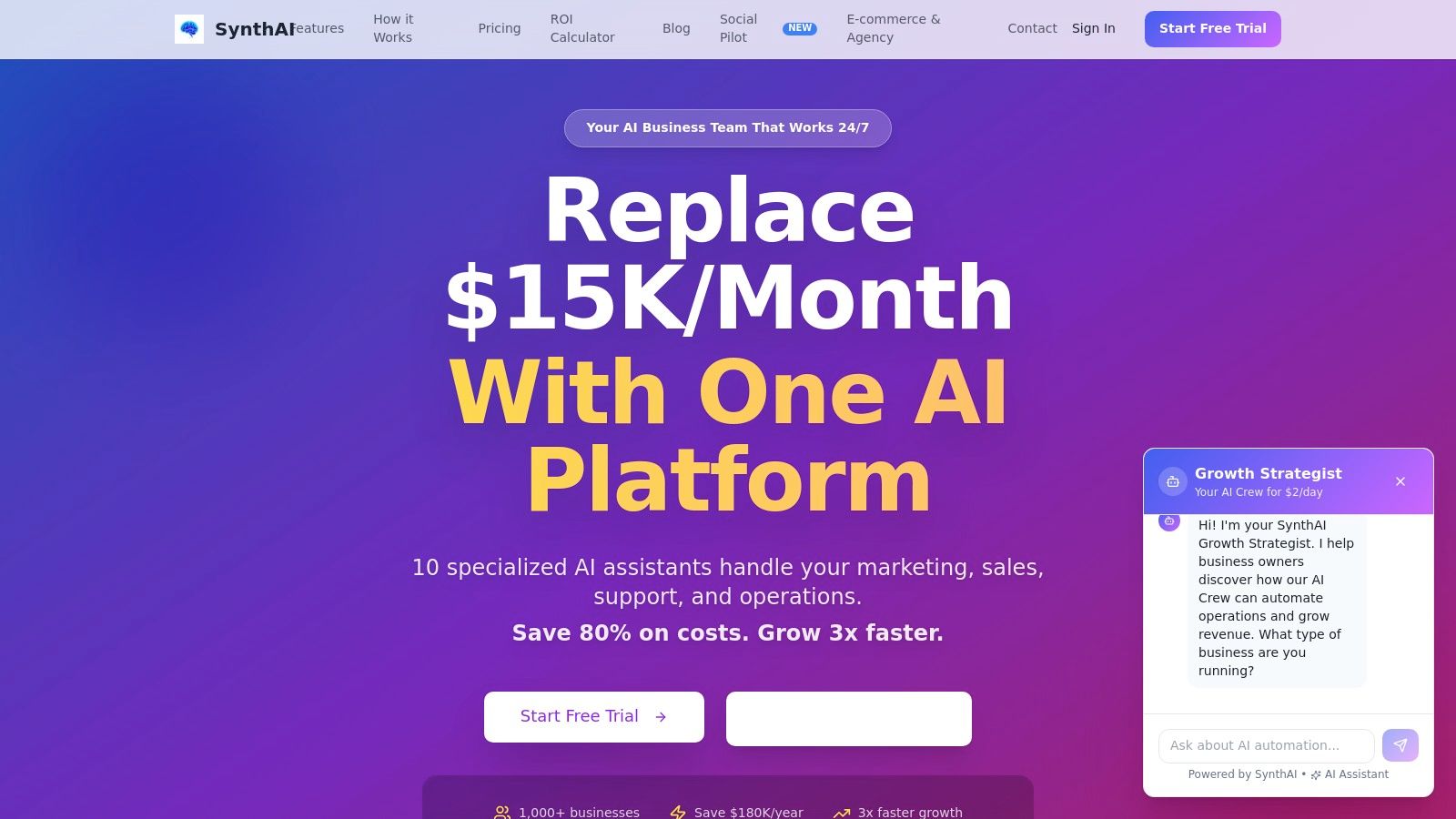
SynthAI presents a compelling vision for the future of business operations, positioning itself not merely as a tool but as a fully integrated, AI-driven team. It is an exceptional all-in-one platform for businesses seeking to consolidate their marketing, sales, content, and support functions into a single, automated system. Its core strength lies in its unique architecture, where a central coordinator AI, Nexus, orchestrates a team of ten specialized assistants, each designed for a specific business domain.
This model allows for a level of cross-functional automation that is difficult to achieve with a stack of disparate tools. For example, the sales assistant (Ascent) can trigger a new email sequence from the email assistant (Lumen) based on CRM updates, while the analytics assistant (Vantage) tracks the campaign's revenue impact in real-time. This cohesive approach makes it one of the most powerful **ai marketing automation tools** available for end-to-end campaign execution.
Key Features and Use Cases
* **Coordinated AI Team:** The standout feature is the Nexus coordinator directing specialized AIs like Aura (SEO/Ads), Echo (Social), and Pax (Support). This eliminates the need for complex, manual integrations between different marketing software, allowing for seamless, multi-channel campaigns managed from one dashboard.
* **Rapid Campaign Deployment:** Users can leverage pre-built workflows for everything from social media calendars to lead nurturing sequences. The "Social Pilot" feature is particularly effective, enabling the creation of a full month of platform-specific social posts from a single URL or image.
* **No-Code Automation & Integration:** With native connections to platforms like Shopify, HubSpot, and WordPress, plus access to over 5,000 apps via Zapier, non-technical users can automate complex processes. The Visual Debugger provides transparency, showing the AI's decision-making process and token usage.
* **AI-Powered Content Creation:** Beyond text, SynthAI incorporates Sora 2-powered video generation (Visio) to create short-form video content for social media, ads, and landing pages, a significant advantage for content-heavy strategies.
Pricing and Onboarding
SynthAI utilizes a credit-based system with tiered monthly subscriptions. Plans generally start around **$29 to $39/month** for basic access, with Pro tiers at **$69 to $97/month** and Ultimate plans ranging from **$97 to $149/month**, which unlock all AI assistants and offer higher throughput. It's important to note that pricing can vary based on active promotions, so check the site for the latest offers. Enterprise plans are available with custom pricing, SLAs, and SOC 2 compliance for larger teams.
Practical Assessment
| Strengths | Limitations |
| -------------------------------------------------------------------------------------------------------------- | -------------------------------------------------------------------------------------------------------- |
| **Unified Platform:** Replaces the need for multiple, expensive SaaS tools and freelancers for a single monthly fee. | **Human Oversight Still Recommended:** Best for executing defined strategies, not for high-level creative ideation. |
| **Measurable ROI:** Real-time analytics directly link campaign activities to revenue, MRR, and churn. | **Variable Costs:** Heavy usage, particularly for HD video generation, may require purchasing additional credits. |
| **Fast Implementation:** Connects to key business systems in minutes, allowing for immediate workflow deployment. | **Learning Curve:** While no-code, mastering the full suite of ten assistants requires initial exploration. |
**Best For:** E-commerce brands, digital agencies, and SaaS startups aiming to achieve significant operational efficiency and scale marketing efforts without a large in-house team.
2. HubSpot Marketing Hub
HubSpot Marketing Hub has evolved into a powerhouse among **ai marketing automation tools**, extending far beyond its inbound marketing roots. It's a comprehensive, all-in-one platform where marketing, sales, and service data converge within a native CRM. This integration is its core differentiator; it allows for incredibly sophisticated automation workflows based on a complete view of the customer journey, from first touchpoint to final sale and beyond. The platform excels at tying marketing efforts directly to revenue, providing clear ROI attribution that many point solutions struggle with.
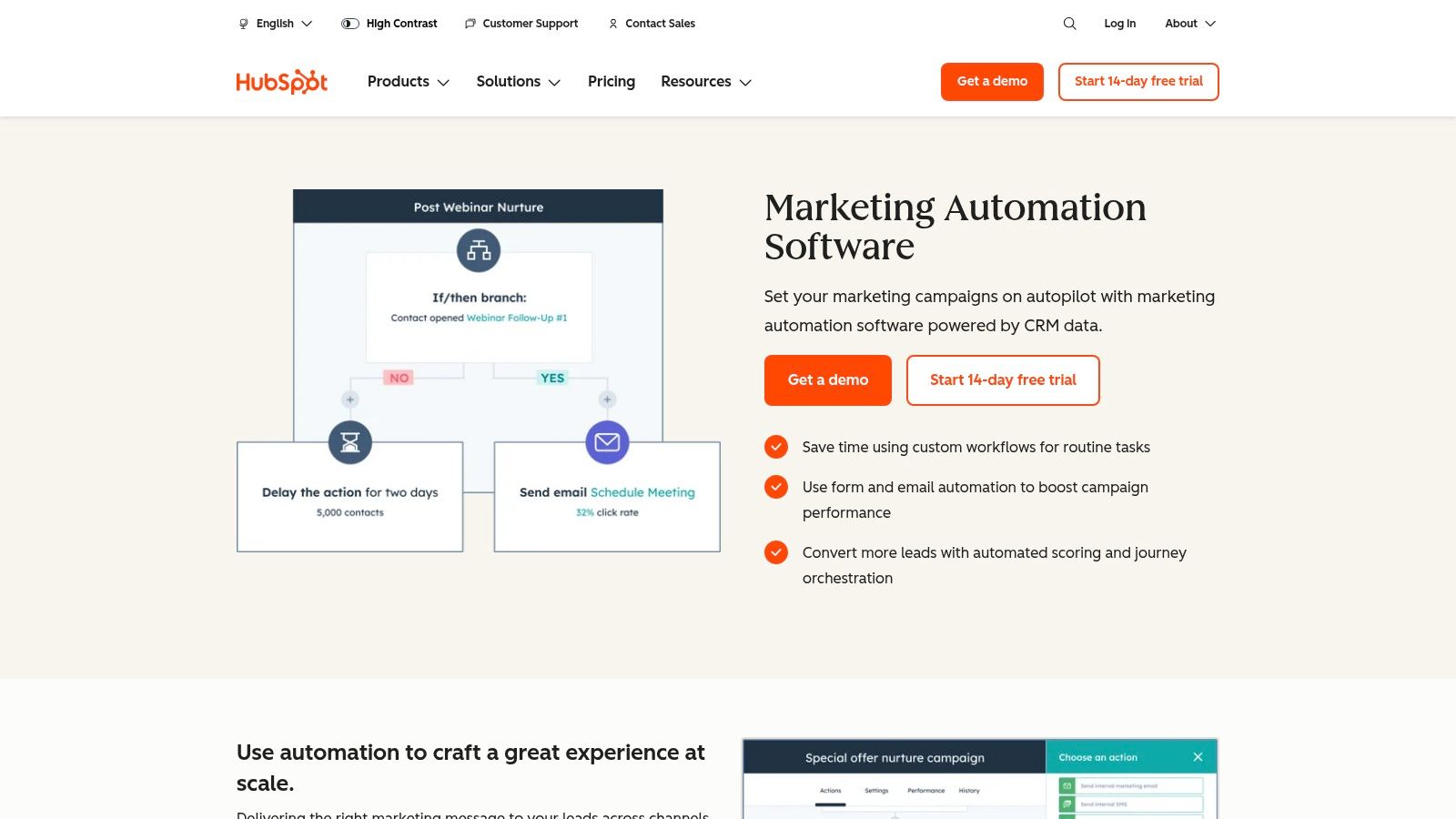
Its AI features, branded as "AI Assistants," are embedded throughout the platform. You can use AI to draft emails, generate social media copy, create blog post outlines, and even build entire campaigns. The platform’s predictive lead scoring also uses machine learning to identify your most qualified leads, allowing sales teams to prioritize their efforts effectively.
Key Features and Use Cases
* **AI-Enhanced Campaign Building:** Generate ad copy, email subject lines, and landing page content in seconds. Ideal for agencies and SaaS teams needing to scale content production quickly.
* **Deep CRM Integration:** Automate personalized follow-ups based on deal stages, contact properties, or website activity. A perfect fit for B2B companies with longer sales cycles.
* **Attribution Reporting:** Connect every marketing action to closed-won deals. This provides invaluable insight for marketing leaders needing to prove ROI to stakeholders.
* **Vast Ecosystem:** Access thousands of app integrations and leverage the extensive educational resources of HubSpot Academy, a significant benefit for teams upskilling in marketing operations.
Pricing and Limitations
HubSpot's pricing is its most significant consideration. While a free tier exists, powerful automation and AI features are locked behind the **Professional (starting at $800/mo)** and **Enterprise (starting at $3,600/mo)** tiers. Costs scale directly with the number of marketing contacts, which can become expensive for B2C or e-commerce businesses with large email lists. Additionally, higher tiers often require a paid onboarding process.
> **Our Takeaway:** HubSpot is the go-to choice for businesses that need a single source of truth for their customer data and can justify the premium for deep analytics and a tightly integrated ecosystem.
>
> **Website:** https://www.hubspot.com/products/marketing/marketing-automation
3. Salesforce Marketing Cloud Account Engagement (formerly Pardot)
Salesforce Marketing Cloud Account Engagement, the platform formerly known as Pardot, is an enterprise-grade solution built for B2B marketers who live inside the Salesforce ecosystem. Its core strength lies in its native integration with the world's leading CRM, enabling incredibly detailed, sales-aligned automation. This platform is one of the premier **ai marketing automation tools** for organizations needing to manage complex buyer journeys, score leads based on deep behavioral data, and provide sales teams with actionable intelligence directly within the CRM they already use.
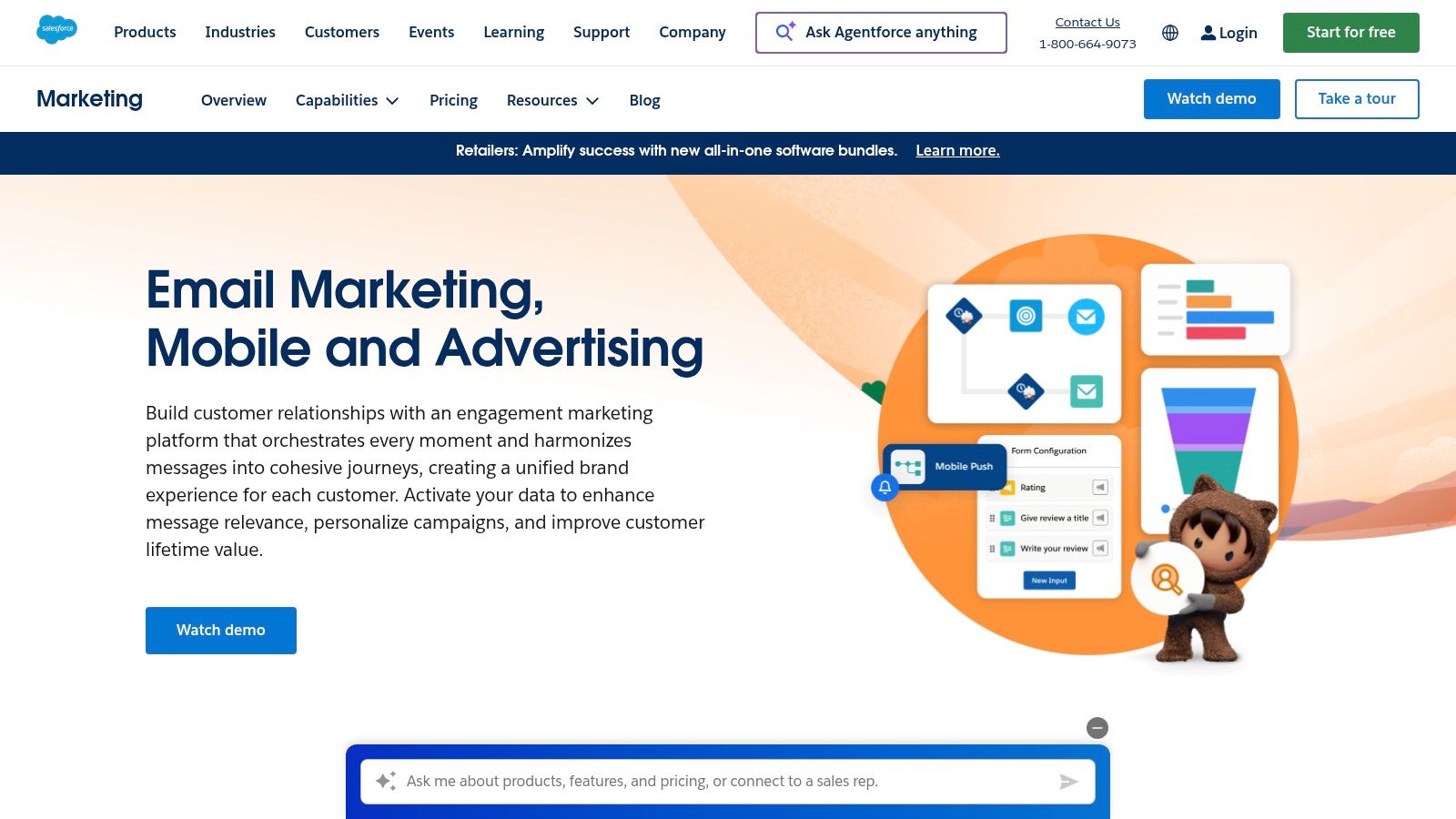
The platform leverages Salesforce's powerful Einstein AI to enhance its automation capabilities. Einstein analyzes engagement and firmographic data to predict which leads are most likely to convert, allowing for more intelligent lead scoring and routing. It also optimizes email send times and identifies key accounts that show buying intent, ensuring marketing and sales efforts are focused on the most promising opportunities.
Key Features and Use Cases
* **Einstein AI Behavior Scoring:** Automatically scores prospects based on their engagement patterns, moving beyond simple demographic data. This is ideal for sales-aligned teams that need to prioritize high-intent leads efficiently.
* **Multi-Touch Attribution & ROI Dashboards:** Connect marketing campaigns directly to sales pipeline and revenue within Salesforce. A critical feature for marketing leaders in enterprise settings who need to prove their department's financial impact.
* **Deep Salesforce CRM Integration:** Triggers complex automation workflows based on any standard or custom object in Salesforce. This is essential for companies with sophisticated sales processes and data governance requirements.
* **Advanced Lead Nurturing:** Build dynamic, personalized journeys that adapt to prospect behavior over long B2B sales cycles, ensuring timely and relevant communication.
Pricing and Limitations
Account Engagement is a premium product with a price tag to match. The **Growth plan starts at $1,250/mo**, with more advanced AI and analytics features in the **Plus ($2,500/mo)** and **Advanced ($4,000/mo)** tiers. The platform's true power and value are most apparent when deeply integrated with Salesforce Sales Cloud; for businesses not using Salesforce, it can be an overly complex and costly option.
> **Our Takeaway:** Account Engagement is the undisputed choice for enterprise B2B teams already committed to the Salesforce ecosystem who need robust governance, deep sales alignment, and powerful revenue attribution.
>
> **Website:** https://www.salesforce.com/products/marketing-cloud/account-engagement/
4. Adobe Marketo Engage
Adobe Marketo Engage is an enterprise-grade titan among **ai marketing automation tools**, designed for large organizations navigating complex B2B buyer journeys. Positioned within the Adobe Experience Cloud, its strength lies in orchestrating sophisticated, multi-touch attribution and account-based marketing (ABM) strategies at a massive scale. It offers unparalleled depth in lead management, scoring, and nurturing, making it a go-to for global enterprises that require deep configurability and strict governance over their marketing operations.
Marketo’s AI capabilities are focused on predictive audiences and personalization. It can analyze historical engagement data to identify the best-fit accounts for a campaign, predict content that will resonate most with a specific audience segment, and determine the optimal time to send communications. This moves beyond simple automation to intelligent orchestration, ensuring marketing efforts are precisely targeted for maximum impact.
Key Features and Use Cases
* **Advanced Lead Management:** Create intricate lead scoring and routing models that adapt to behavior in real-time. This is essential for companies with dedicated sales development teams and complex lead qualification criteria.
* **Account-Based Marketing (ABM):** Build and execute targeted campaigns aimed at specific high-value accounts, coordinating engagement across marketing and sales. A perfect fit for enterprise B2B sales cycles.
* **Deep CRM Integration:** Offers best-in-class, bi-directional sync with major CRMs like Salesforce and Microsoft Dynamics, ensuring data alignment between marketing and sales teams.
* **AI-Powered Personalization:** Use predictive content and audience segmentation to dynamically personalize website experiences, emails, and cross-channel journeys at scale.
Pricing and Limitations
Marketo’s pricing is entirely quote-based and tailored to enterprise needs, meaning it is not publicly listed and represents a significant investment. The platform is powerful but comes with a steep learning curve, often requiring dedicated administrators or specialized agency support to manage effectively. Its extensive feature set can be overkill for small to mid-sized businesses that don't need its level of complexity.
> **Our Takeaway:** Marketo Engage is the undisputed choice for large, mature B2B organizations that need a powerful, highly configurable marketing engine to manage complex sales funnels and prove marketing's contribution to revenue.
>
> **Website:** https://business.adobe.com/products/marketo/marketo-engage.html
5. Klaviyo
Klaviyo has cemented its position as the go-to platform for e-commerce brands looking to leverage powerful **ai marketing automation tools**. It is purpose-built for online stores, offering exceptionally deep integrations with platforms like Shopify, BigCommerce, and WooCommerce. Its primary differentiator is its focus on leveraging rich, real-time customer data, such as browsing history, cart contents, and purchase frequency, to power highly personalized email and SMS marketing campaigns that drive sales.
The platform incorporates AI to streamline campaign creation, offering AI-powered subject line suggestions and predictive analytics to forecast customer lifetime value and churn risk. This allows merchants to not only automate communication but also to make smarter, data-backed decisions about their marketing strategy. The focus is less on being an all-in-one CRM and more on being the absolute best-in-class tool for e-commerce communication.
Key Features and Use Cases
* **Event-Based Automation Flows:** Build sophisticated triggers for browse abandonment, cart abandonment, and post-purchase follow-ups. Essential for any online store aiming to recover lost revenue and increase customer loyalty.
* **Rich E-commerce Segmentation:** Create hyper-targeted audience segments based on specific purchase behavior, like "customers who bought product X but not product Y." This is perfect for cross-selling and upselling campaigns.
* **AI-Assisted Campaign Creation:** Quickly generate high-converting email subject lines and SMS copy. A huge time-saver for small e-commerce teams or solo entrepreneurs managing their own marketing.
* **Unified SMS and Email Marketing:** Manage and automate both channels from a single platform, creating a seamless customer communication experience.
Pricing and Limitations
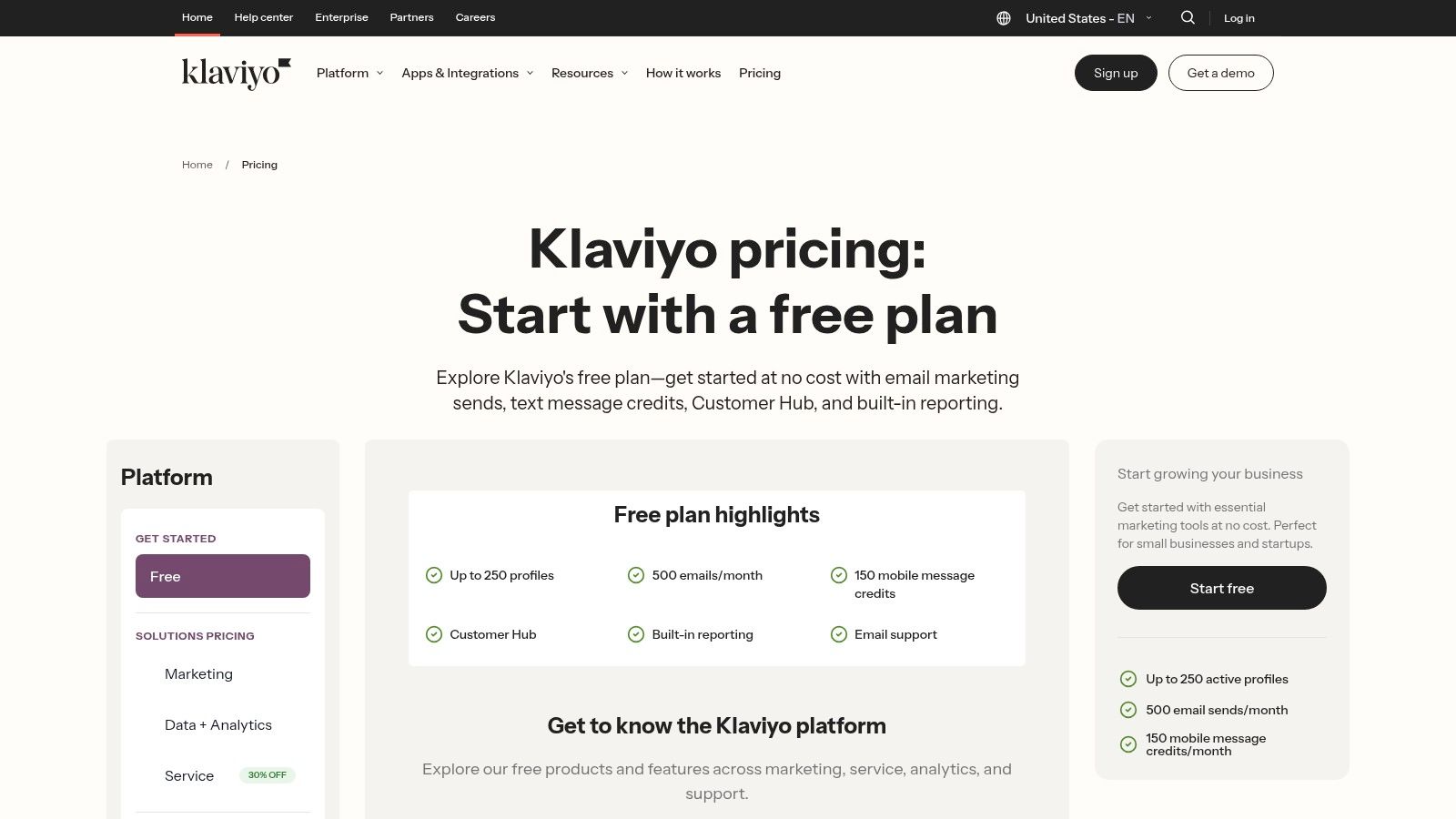
Klaviyo offers a flexible free tier for up to 250 contacts and 500 email sends, making it accessible for new stores. Paid plans are modular, with **Email plans starting at $45/mo** for 1,500 contacts and **SMS plans starting at $15/mo** for 1,250 credits. Costs scale directly with profile and message volume, which can become significant for rapidly growing stores. Advanced analytics, such as predictive modeling, are reserved for higher-tier plans.
> **Our Takeaway:** Klaviyo is the undisputed leader for direct-to-consumer and e-commerce businesses that need a powerful, data-driven engine for email and SMS marketing. It offers a fast time-to-value for store owners focused on revenue generation.
>
> **Website:** https://www.klaviyo.com/pricing/
6. ActiveCampaign
ActiveCampaign positions itself as a customer experience automation platform, blending powerful email marketing, CRM, and one of the most flexible **ai marketing automation tools** available for small to mid-sized businesses. Its core strength lies in its visual automation builder, which allows for intricate, logic-based workflows that can branch based on virtually any customer behavior or data point. This makes it a favorite for businesses that have outgrown simpler email tools and need more granular control over the customer journey without the enterprise-level price tag.
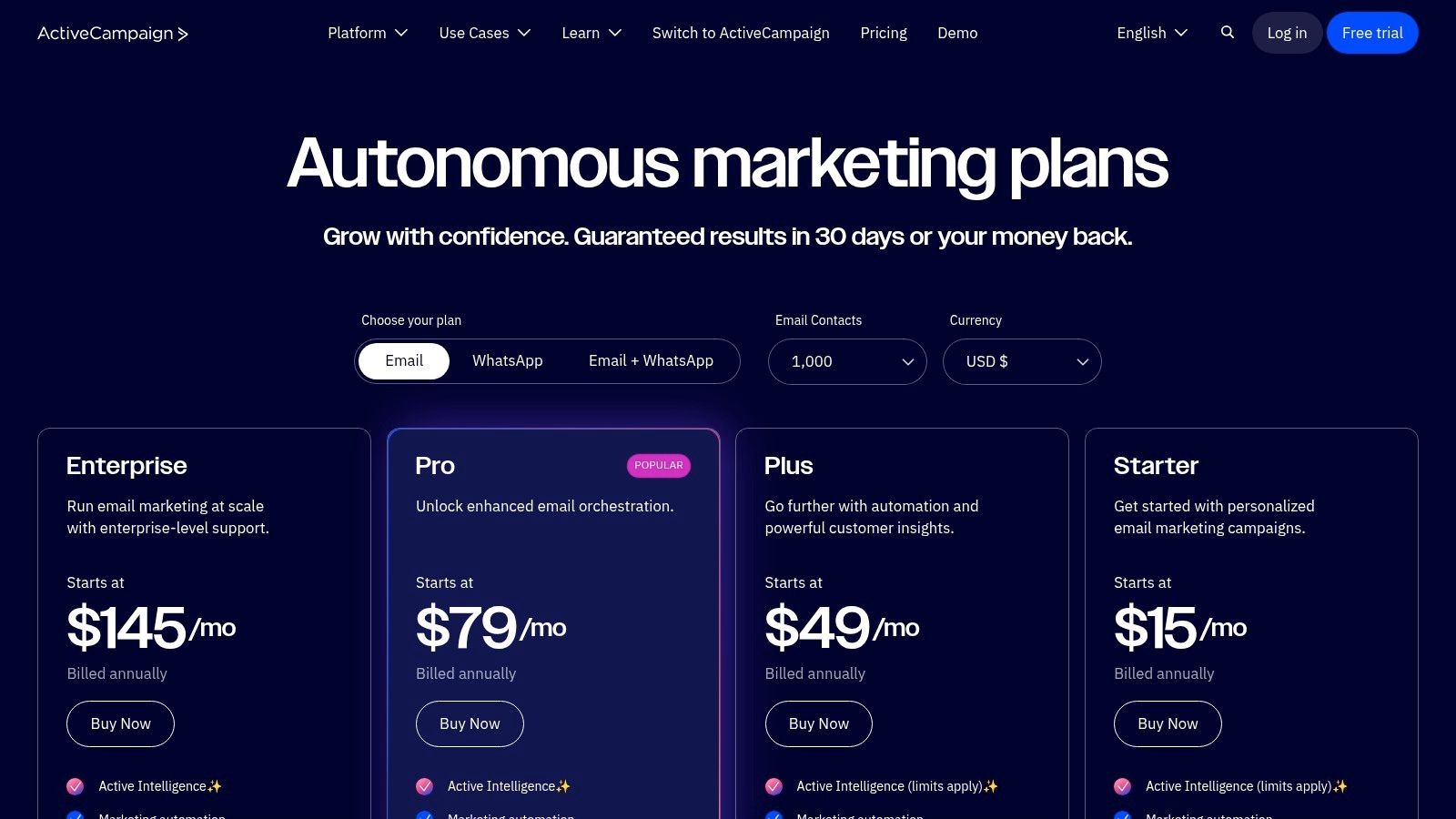
The platform's "Active Intelligence" AI features are woven throughout its tools. Predictive Sending optimizes email delivery times for each contact, while Predictive Content allows you to show different text blocks to different audience segments within a single email. Its AI also powers lead scoring and win probability models in the integrated CRM, helping sales teams focus on the deals most likely to close.
Key Features and Use Cases
* **Advanced Visual Automation:** Build complex if/then logic workflows to nurture leads, onboard customers, or re-engage dormant contacts. It's ideal for e-commerce stores needing to automate abandoned cart sequences with deep personalization.
* **Predictive AI Tools:** Leverage AI to determine the best send time for emails and predict which leads are most engaged. This is a game-changer for SaaS companies looking to improve trial-to-paid conversion rates.
* **Integrated CRM & Sales Automation:** Manage deals, tasks, and contact data within the same system as your marketing automation, creating a seamless handoff from marketing to sales.
* **Multi-Channel Messaging:** Combine email, SMS, site messages, and landing pages into a single cohesive automation, perfect for agencies creating comprehensive campaigns for clients.
Pricing and Limitations
ActiveCampaign offers a 14-day free trial and a range of plans. The **Marketing Lite plan starts at $29/mo**, but core AI and automation features require the **Plus (from $49/mo)** or **Professional (from $149/mo)** tiers. Pricing is contact-based and can become complex as you add different product bundles (Marketing, Sales, Service). While powerful, the sheer number of features can present a steep learning curve for teams completely new to marketing automation.
> **Our Takeaway:** ActiveCampaign hits the sweet spot for businesses that need deep, logic-based automation and integrated CRM capabilities without the budget for an all-in-one enterprise suite.
>
> **Website:** https://www.activecampaign.com/pricing
7. Mailchimp (Intuit Mailchimp)
Mailchimp has long been a gateway into email marketing, and it has evolved to incorporate a suite of accessible **ai marketing automation tools** tailored for small businesses and creators. Its strength lies in its user-friendly interface and rapid setup, making it an ideal starting point for teams who need to launch campaigns quickly without a steep learning curve. The platform centers around its familiar email builder but extends into multi-step customer journeys, landing pages, and social media ads, all manageable from one place.
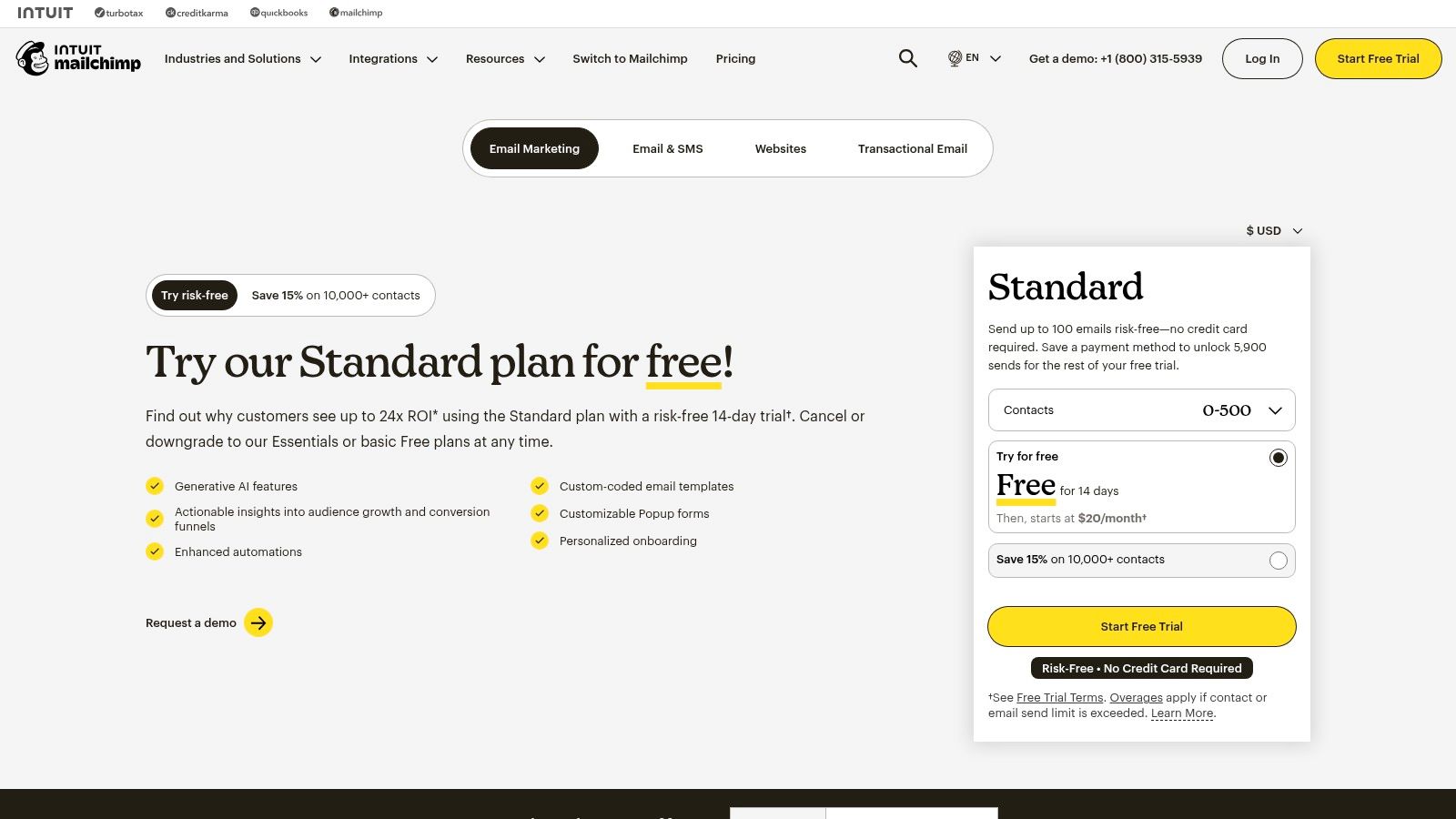
The platform's AI, branded as the "Creative Assistant," focuses on content generation and design. It can instantly create branded designs for emails or social posts based on your website's URL, and its content optimizer suggests improvements for subject lines and email copy. This makes it a practical tool for solopreneurs or small teams who lack dedicated design or copywriting resources, helping them maintain a professional look and feel with minimal effort.
Key Features and Use Cases
* **AI Creative Assistant:** Automatically generates on-brand designs and content suggestions. Perfect for e-commerce stores and creators needing to produce marketing assets fast.
* **Customer Journey Builder:** Visualize and automate multi-channel campaigns with pre-built templates for common scenarios like abandoned carts or welcome series.
* **Extensive Integration Library:** With over 300 integrations, it connects seamlessly with popular e-commerce platforms like Shopify and WooCommerce, as well as various CRMs.
* **Predictive Segmentation:** Uses purchase history and engagement data to group contacts, helping you send more targeted and effective campaigns.
Pricing and Limitations
Mailchimp offers a free plan, but its limits are restrictive and include mandatory branding. Paid plans, like **Standard (starting at $20/mo)** and **Premium (starting at $350/mo)**, unlock advanced automation and AI features. Pricing scales aggressively based on contact count and email sends, and add-on services like transactional emails or SMS credits can significantly increase the total cost, making it less economical for businesses with very large lists.
> **Our Takeaway:** Mailchimp is an excellent choice for small businesses, e-commerce stores, and creators who prioritize ease of use and speed to launch over deep, complex automation capabilities.
>
> **Website:** https://mailchimp.com/pricing/marketing/
8. Omnisend
Omnisend carves out its niche among **ai marketing automation tools** by focusing squarely on the needs of e-commerce businesses. Unlike generalist platforms, its entire feature set is engineered to convert store visitors into loyal customers through email, SMS, and push notifications. The platform's main strength lies in its deep integrations with e-commerce platforms like Shopify, BigCommerce, and WooCommerce, allowing for powerful automations based on real-time shopping behavior. It simplifies complex marketing funnels with a library of pre-built workflows designed for cart abandonment, browse abandonment, and customer win-back campaigns.
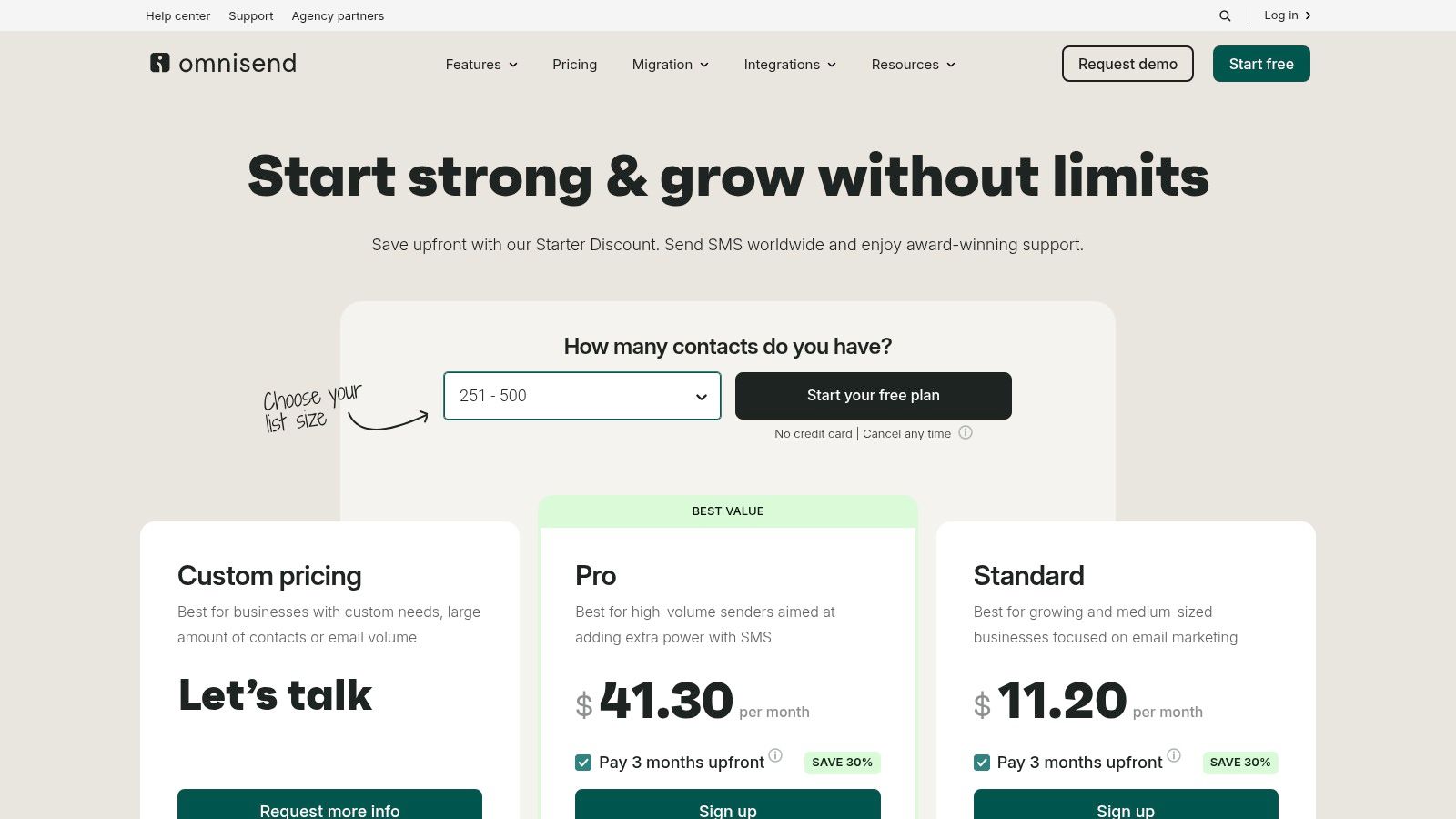
While not as AI-heavy as some all-in-one suites, Omnisend incorporates AI into practical features like its form and subject line generators, which help optimize lead capture and open rates. Its primary value is automating the e-commerce customer journey with precision, making it an accessible yet powerful tool for online stores looking to increase sales without a steep learning curve or excessive overhead.
Key Features and Use Cases
* **E-commerce-Centric Automations:** Deploy pre-built workflows for cart recovery, welcome series, and post-purchase follow-ups. Essential for Shopify and BigCommerce store owners aiming to maximize customer lifetime value.
* **Integrated SMS & Push Notifications:** Combine email, SMS, and push notifications within a single automation flow for omnichannel marketing. Ideal for flash sales and time-sensitive promotions.
* **Product Recommendations & Feeds:** Automatically pull product listings into emails, enabling personalized recommendations based on browsing history or past purchases.
* **Forms AI:** Use artificial intelligence to generate high-converting pop-ups and signup forms, reducing the guesswork in lead capture optimization.
Pricing and Limitations
Omnisend offers a compelling free plan for up to 250 contacts. The **Standard plan (starting at $16/mo)** offers core automation features, while the **Pro plan (starting at $59/mo)** adds unlimited emails, web push notifications, and included SMS credits. A key consideration is that pricing automatically adjusts as your billable contact list grows, which provides transparency but requires budget monitoring. While its e-commerce focus is a strength, it may lack the advanced CRM and sales pipeline features needed by B2B or SaaS companies.
> **Our Takeaway:** Omnisend is a top-tier choice for e-commerce businesses that need a powerful, multi-channel automation tool that integrates seamlessly with their store and provides clear, predictable value.
>
> **Website:** https://www.omnisend.com/pricing/
9. Brevo (formerly Sendinblue)
Brevo has carved out a unique space among **ai marketing automation tools** by offering a powerful multi-channel platform with a highly competitive pricing model. Formerly Sendinblue, it combines email, SMS, WhatsApp, and chat into a single hub built around a native CRM. Its key differentiator is its pricing structure, which is based on email volume rather than contact count. This makes it an incredibly scalable option for businesses with large audiences but variable sending needs, allowing them to grow their list without facing exponential cost increases.
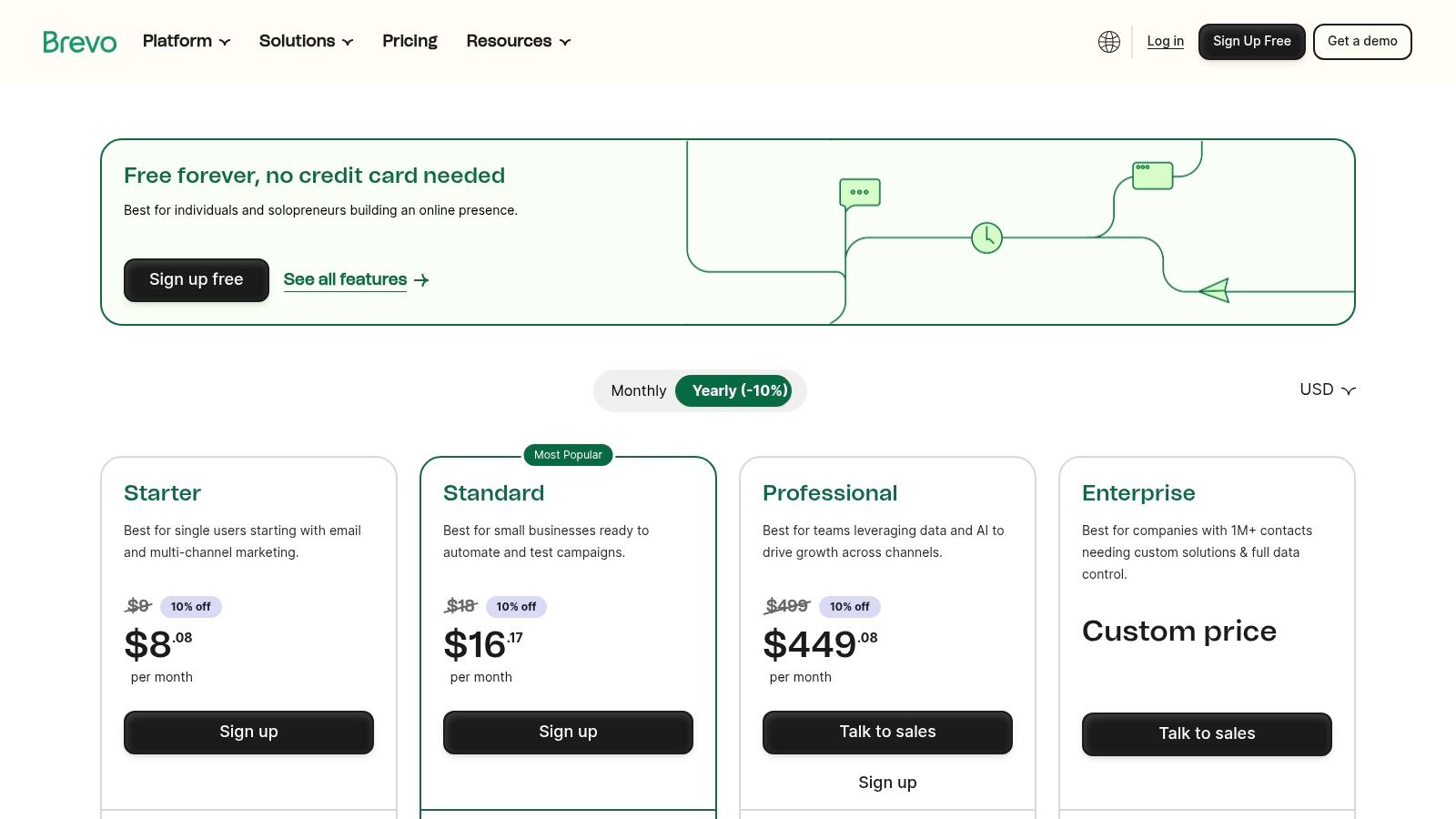
The platform incorporates AI to optimize campaign performance through features like send-time optimization, which analyzes user behavior to deliver messages when subscribers are most likely to engage. It also uses machine learning for A/B testing, helping marketers quickly identify the most effective content variations. This focus on practical, performance-driving AI makes it a strong contender for SMBs and e-commerce stores looking for an all-in-one solution.
Key Features and Use Cases
* **Multi-Channel Communication:** Seamlessly integrate email, SMS, and WhatsApp into unified automation workflows. Ideal for e-commerce brands wanting to run abandoned cart sequences across multiple channels.
* **Unlimited Contacts:** Store and manage an unlimited number of contacts without cost penalties. A massive benefit for B2C companies, content creators, and startups focused on rapid list growth.
* **AI Send-Time Optimization:** Automatically send emails at the optimal time for each individual contact, boosting open rates. This is perfect for marketers with global audiences across different time zones.
* **Built-in Sales Platform & CRM:** Manage leads and customer interactions directly within the platform, enabling automations based on deal stages and sales activity.
Pricing and Limitations
Brevo offers a generous free plan that includes up to 300 emails per day and marketing automation for up to 2,000 contacts. Paid plans are very accessible, with the **Starter plan beginning at $25/mo** for 20,000 emails and the **Business plan at $65/mo**, which unlocks A/B testing and advanced automation. While the core features are robust, some advanced AI capabilities and enterprise-level support are reserved for higher tiers. Additionally, web and mobile push notifications have campaign-based caps that require add-ons for higher volumes.
> **Our Takeaway:** Brevo is the best value-driven option for businesses that need a multi-channel marketing suite and want transparent, predictable pricing that doesn't punish them for growing their contact list.
>
> **Website:** https://www.brevo.com/pricing/
10. Zapier
While not a traditional marketing platform, Zapier is the essential glue connecting your tech stack, making it one of the most powerful **ai marketing automation tools** available. It's a no-code automation platform that allows you to link over 7,000 different applications, orchestrating workflows that would otherwise require dedicated engineering resources. Its core value lies in its ability to create "Zaps" - automated actions that trigger in one app based on an event in another - effectively creating a custom automation engine tailored to your specific toolset.
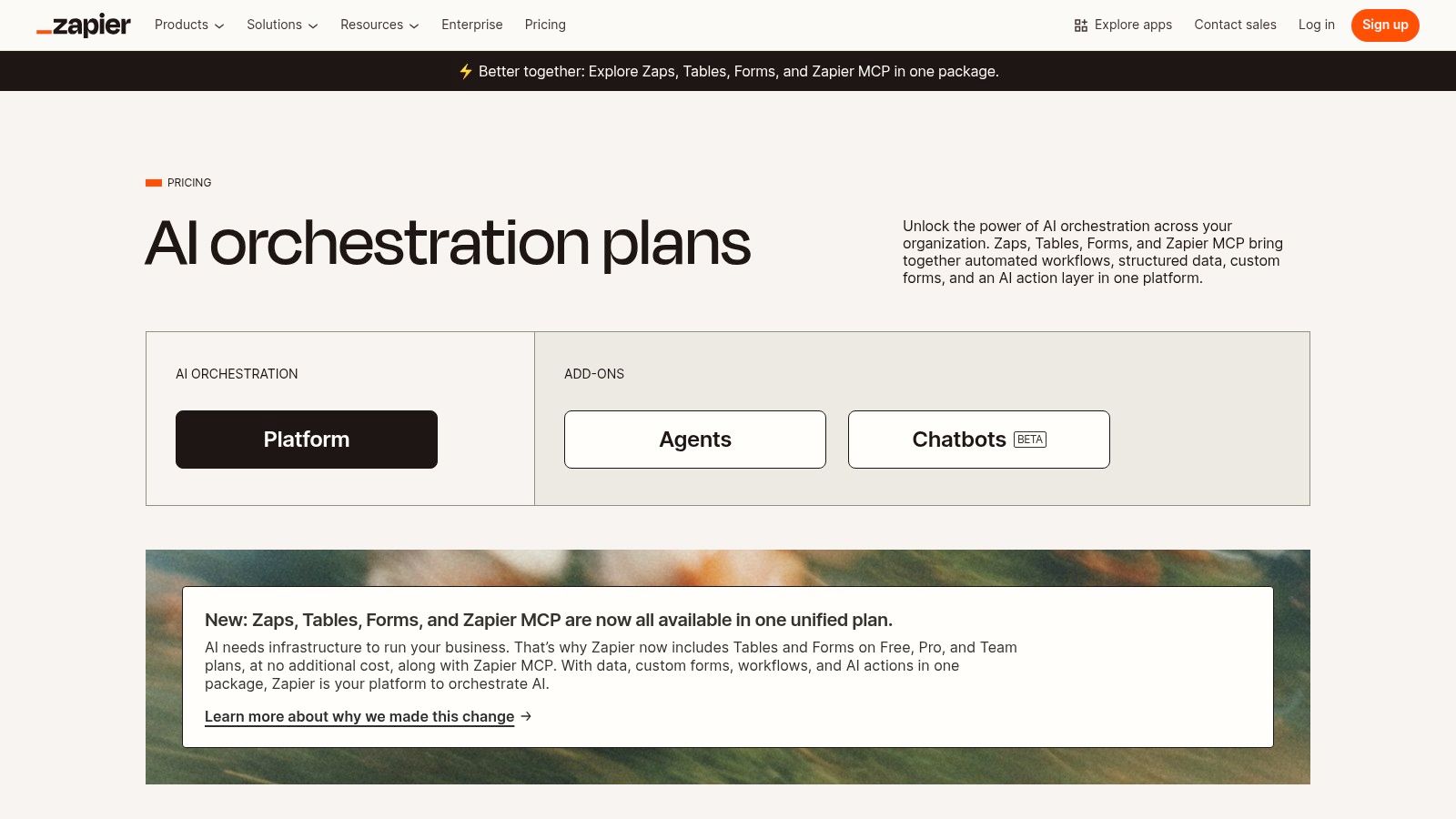
Zapier has integrated AI directly into its workflows, allowing you to connect to models like OpenAI's GPT or Google's Gemini. This enables marketers to automate tasks like summarizing customer feedback from a survey and posting it to Slack, generating personalized email drafts based on new CRM entries, or creating social media post variations whenever a new blog post is published. It excels at bridging gaps and automating processes across disparate systems.
Key Features and Use Cases
* **Vast App Ecosystem:** Connect virtually any marketing tool, from your CRM and email service provider to ad platforms and analytics software. Perfect for teams with a best-of-breed tech stack.
* **AI Actions & Integrations:** Embed AI directly into multi-step workflows to format text, summarize data, or generate content, connecting AI models to your existing apps.
* **No-Code Workflow Builder:** Empower non-technical marketers to build and manage complex automations without writing a single line of code, ideal for agile marketing teams.
* **Enterprise-Grade Governance:** Offers features like role-based access, shared app connections, and version control for Zaps, making it suitable for larger organizations needing security and oversight.
Pricing and Limitations
Zapier offers a free forever plan with limited tasks. Paid plans start with the **Starter tier at $19.99/mo** (billed annually) and scale up to **Company plans for enterprise needs**. The pricing model is task-based, meaning each action a Zap performs consumes a task. For high-volume operations, such as processing thousands of leads per day, these costs can accumulate quickly. Additionally, highly complex, multi-step Zaps can become difficult to troubleshoot and maintain without proper documentation.
> **Our Takeaway:** Zapier is an indispensable tool for any marketer looking to automate processes across a disconnected tech stack. It's the fastest way to build powerful, AI-enhanced integrations without developer intervention.
>
> **Website:** https://zapier.com/pricing
11. Shopify Marketing Automation
Shopify has transformed its native marketing tools into a compelling option among **ai marketing automation tools**, designed exclusively for its merchants. Its strength lies in its seamless integration; all marketing activities are tied directly to store data, from product catalogs to customer purchase history. This creates a zero-friction environment where e-commerce businesses can deploy sophisticated automations without complex third-party integrations, ensuring a single source of truth for sales and marketing performance.
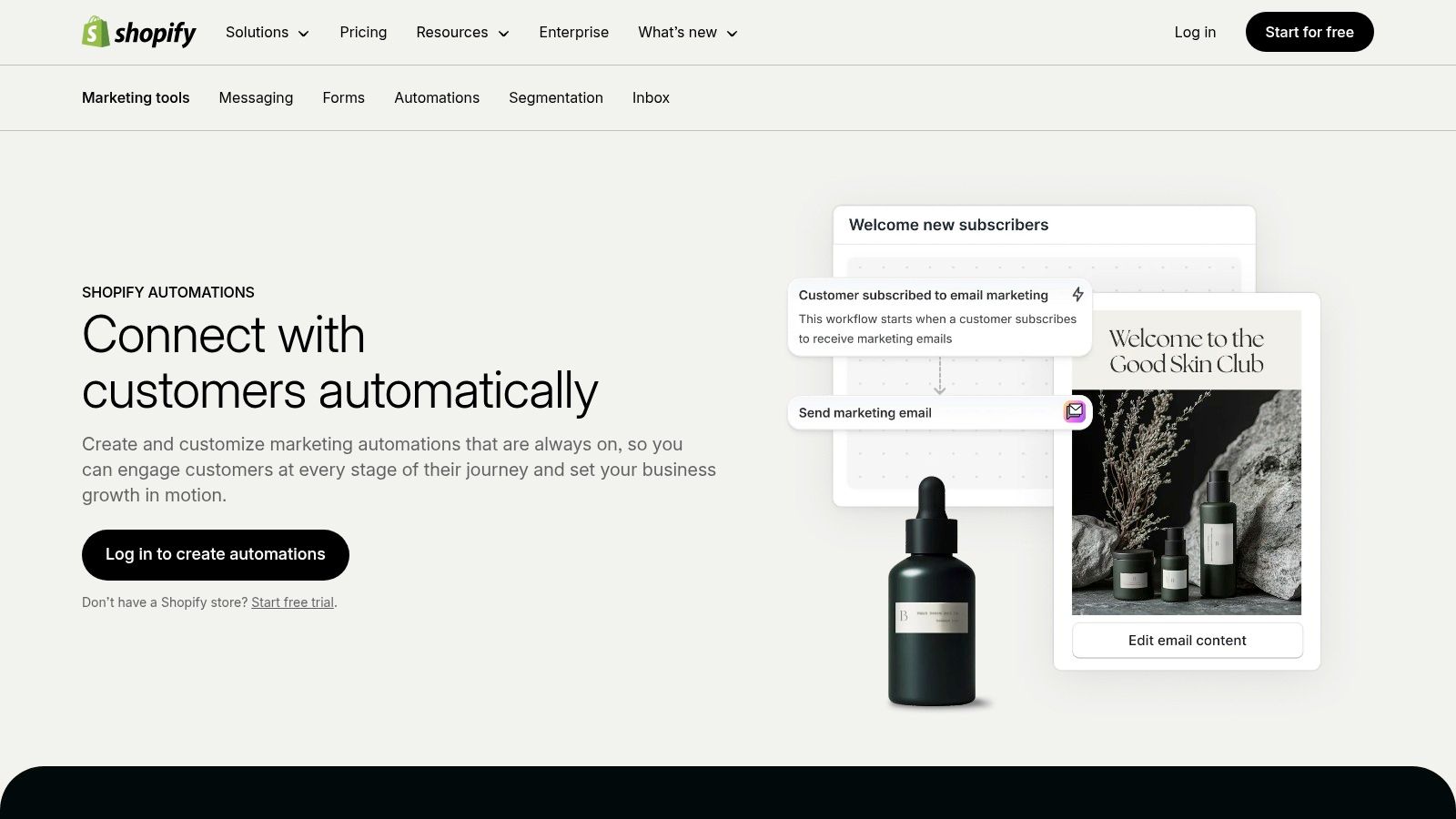
The platform’s AI assistant, Sidekick, is built to understand e-commerce contexts. It helps merchants generate on-brand campaign copy, suggest audience segments, and edit content, streamlining the creative process. This native AI support, combined with pre-built automation templates for crucial e-commerce funnels like abandoned carts and customer win-backs, makes it incredibly accessible for store owners who need efficiency.
Key Features and Use Cases
* **Native E-commerce Automations:** Deploy proven templates for welcome series, abandoned checkouts, first-purchase upsells, and win-back campaigns. Perfect for direct-to-consumer brands looking for quick, high-impact wins.
* **Sidekick AI Assistant:** Generate product descriptions, email subject lines, and campaign ideas directly within the Shopify admin. An invaluable tool for solo entrepreneurs or small teams managing all aspects of their store.
* **Unified Segmentation and Reporting:** Create customer segments based on real-time shopping behavior and view campaign performance right next to sales data. Ideal for data-driven merchants wanting to connect marketing spend directly to revenue.
* **Integrated Shopify Email & SMS:** Manage and automate both email and SMS marketing from a single platform, ensuring a cohesive communication strategy without needing extra tools.
Pricing and Limitations
Shopify’s automation tools are included in most Shopify plans, with pricing based on usage. **Shopify Email** offers 10,000 free emails per month, with additional emails costing $1 per 1,000. This usage-based model is highly cost-effective for growing stores. The primary limitation is its ecosystem-bound nature; it is designed to work best within Shopify. Businesses requiring complex, multi-channel orchestration beyond email, SMS, and social ads may still need to integrate partner apps from the Shopify App Store.
> **Our Takeaway:** For any business running on Shopify, its native marketing automation is the most logical and efficient starting point, offering unparalleled data integration and simplicity.
>
> **Website:** https://www.shopify.com/marketing-automation
12. G2 — Marketing Automation Software Category
G2 is not a tool itself but an essential research platform for evaluating the crowded market of **ai marketing automation tools**. It acts as a comprehensive, crowd-sourced directory where real users review and rate software. This peer-review model is its greatest strength, offering an unfiltered look into a tool's performance beyond polished marketing claims. It allows you to create shortlists based on business size, user satisfaction, feature sets, and market presence, dramatically accelerating the initial vendor screening process.
The platform’s iconic "Grid" reports visually segment vendors into Leaders, High Performers, Contenders, and Niche players. By filtering these grids and reading detailed reviews, teams can quickly identify solutions that fit their specific needs, whether for a small SaaS startup or a large enterprise. This approach helps de-risk the significant investment required for a marketing automation platform.
Key Features and Use Cases
* **Crowd-Sourced Reviews:** Access hundreds of detailed user reviews covering pros, cons, and implementation experiences. This is invaluable for marketing operations leaders vetting new technology.
* **Segment-Specific Filtering:** Filter tools by company size (SMB, Mid-Market, Enterprise) and user satisfaction scores. Ideal for finding solutions that are proven to work for businesses of a similar scale.
* **Side-by-Side Comparisons:** Directly compare features and user ratings for up to four different platforms simultaneously, simplifying the final selection process.
* **Vendor Vetting:** Use real-user feedback to validate vendor claims and prepare targeted questions for sales demos, a key benefit for agencies and consultants advising clients.
Pricing and Limitations
Access to G2's reviews and grids is free for users. The platform's primary limitation is its business model; vendors can pay for sponsored placements and enhanced profiles, which may influence visibility. The "Grid" report rankings can also change quarterly, so it's wise to look at trends over time rather than a single report. Finally, many vendors on the platform do not list public pricing, still requiring direct engagement with sales teams.
> **Our Takeaway:** G2 is an indispensable first step in the buying journey. Use it to build an educated shortlist and validate your choices with authentic user feedback before committing to demos or trials.
>
> **Website:** https://www.g2.com/categories/marketing-automation
Top 12 AI Marketing Automation Tools — Feature Comparison
| Product | Core capabilities | UX & quality ★ | Value & Pricing 💰 | Target audience 👥 | Unique differentiator ✨ |
|---|---:|:---:|:---:|:---:|---|
| **🏆 SynthAI** | AI "business team" of 10 assistants + Nexus coordinator; pre-built workflows; deep no-code integrations (Shopify, Ads, Meta, Gmail, HubSpot, WordPress, Zapier) | Real-time ROI & analytics; fast setup; reports 3–4x efficiency gains ★★★★☆ | Credit-based tiers; starter ~$29–$39, Pro ~$69–$97, Ultimate ~$97–$149; 7‑day trial; major freelancer cost savings 💰 | 👥 Solopreneurs → agencies → enterprises | ✨ Nexus orchestration; Visual Debugger; Social Pilot (URL→multi-post); Sora 2 HD video add-on |
| HubSpot Marketing Hub | All-in-one marketing + native CRM; automation, ads, landing pages, attribution | Deep analytics & education (Academy); polished UX ★★★★☆ | Tiered pricing; scales with contacts; higher tiers costly 💰 | 👥 Startups → enterprises needing CRM-linked marketing | ✨ Native CRM attribution & Hub ecosystem |
| Salesforce Marketing Cloud (Pardot) | B2B lead scoring, nurturing, multi-touch attribution; Einstein AI | Sales-aligned reporting; enterprise governance ★★★★ | Premium, sales-led pricing; best with Salesforce ecosystem 💰 | 👥 Enterprises and Salesforce customers | ✨ Tight Salesforce integration & Einstein predictions |
| Adobe Marketo Engage | ABM and multi-channel journey orchestration; AI personalization | Highly configurable for complex journeys ★★★★ | Sales-led premium pricing; enterprise contracts 💰 | 👥 Large B2B orgs needing deep configurability | ✨ Advanced ABM + Adobe Experience Cloud integration |
| Klaviyo | Ecommerce-focused email & SMS; product feeds; event-based flows | Fast time-to-value for stores; ecommerce analytics ★★★★ | Free tier; costs rise with profiles & SMS usage 💰 | 👥 Ecommerce merchants (Shopify, Amazon, WooCommerce) | ✨ Deep ecommerce triggers & product feed segmentation |
| ActiveCampaign | CRM + email/SMS, visual journey builder, AI tooling | Strong automation depth for price; visual builder ★★★★ | Competitive tiers; pricing by contacts/features; 14‑day trial 💰 | 👥 SMBs & mid-market teams | ✨ Visual automations + Active Intelligence |
| Mailchimp | Email/SMS, AI Creative Assistant, templates & integrations | Familiar UI; quick to launch for small teams ★★★ | Free tier limited; costs scale with contacts/add-ons 💰 | 👥 Small teams and beginners | ✨ Large template library & easy onboarding |
| Omnisend | Email, SMS, push; ecommerce automations and templates | Quick Shopify setup; ecommerce-focused UX ★★★★ | Transparent scaling; SMS credits on Pro; clear pricing 💰 | 👥 Ecommerce stores seeking omnichannel flows | ✨ Prebuilt ecommerce workflows and web push |
| Brevo (Sendinblue) | Email, SMS, WhatsApp, automation, CRM; email-volume pricing | Transparent billing; multi-channel support ★★★★ | Email-volume pricing; unlimited contacts option 💰 | 👥 Teams needing mixed channels + transparent pricing | ✨ Volume-based pricing with multi-channel SMS/WhatsApp |
| Zapier | No-code automation across 7,000+ apps; webhooks & AI actions | Fast cross-tool automations; reliable UX ★★★★ | Task-based pricing (can be expensive at scale) 💰 | 👥 Teams needing integrations without engineering | ✨ Massive app ecosystem; Tables/AI action protocols |
| Shopify Marketing Automation | Store-native automations, Sidekick AI, segmentation | Zero-friction for merchants; unified store data ★★★★ | Cost-effective for Shopify sends; tied to platform 💰 | 👥 Shopify merchants wanting native marketing | ✨ Native store data + Sidekick on‑brand AI |
| G2 — Marketing Automation Category | Crowd-sourced reviews, leader grids, filters by segment | Real-user feedback; useful for shortlisting ★★★★ | Free to use; vendor trials often require sales calls 💰 | 👥 Buyers researching vendors and budgets | ✨ Live reviews, rankings & market-segmentation filters |
Making Your Final Choice: A Practical Implementation Guide
Navigating the landscape of AI marketing automation tools can feel overwhelming. We've explored everything from all-in-one powerhouses like SynthAI and HubSpot to specialized e-commerce champions like Klaviyo and Omnisend. The key takeaway is clear: the "best" tool doesn't exist in a vacuum. The ideal platform is the one that aligns perfectly with your business model, technical capabilities, and strategic growth goals.
For a SaaS startup, the deep CRM integration and lead scoring of a platform like Salesforce Marketing Cloud or HubSpot might be non-negotiable. Conversely, an e-commerce brand on Shopify will likely find more immediate value in the granular segmentation and pre-built e-commerce workflows offered by Klaviyo or Omnisend. Your choice is a strategic one, defining not just your marketing efficiency but also your capacity to deliver personalized customer experiences at scale.
The true challenge, and the greatest opportunity, lies beyond the selection process. Successful implementation is what separates a costly software subscription from a transformative growth engine. The most powerful AI marketing automation tools are only as effective as the strategy guiding them.
Your 90-Day Implementation Blueprint
Before you sign a contract or begin migrating data, pause and create a deliberate plan. Rushing this stage is a common mistake that leads to underutilized features and disappointing results. Use the following framework to ensure a smooth transition and maximize your return on investment from day one.
1. **Map Your Core Customer Journeys:** Don't try to automate everything at once. Identify the 2-3 most critical customer journeys that have the highest impact on revenue or retention. This could be your new subscriber welcome sequence, your abandoned cart recovery flow, or your post-purchase feedback loop. Visually map each step, decision point, and communication touchpoint.
2. **Conduct a Tech Stack Audit:** List every tool your new platform must connect with. This includes your e-commerce platform (Shopify, BigCommerce), CRM, customer support desk (Zendesk, Gorgias), analytics tools, and social media schedulers. Cross-reference this list with the integration capabilities of your top contenders. A missing native integration could mean relying on a tool like Zapier, adding complexity and potential points of failure.
3. **Define Your Success Metrics (KPIs):** How will you measure success? Vague goals like "improve marketing" are not enough. Define specific, measurable KPIs for the first 90 days.
* **For E-commerce:** Target a 15% increase in revenue from automated email flows or a 10% reduction in cart abandonment rate.
* **For SaaS:** Aim for a 20% increase in marketing qualified leads (MQLs) or a 5% improvement in trial-to-paid conversion rate.
* **For Agencies:** Focus on reducing client campaign setup time by 30% or improving average client email open rates by 5%.
4. **Launch a Pilot Project:** The single most effective way to ensure long-term success is to start small. Choose one of the core journeys you mapped in step one and build it out as a pilot project. This focused approach allows your team to learn the platform's nuances, troubleshoot issues in a low-risk environment, and achieve an early win. This initial success builds crucial momentum and internal buy-in for wider adoption.
The era of manual, one-size-fits-all marketing is over. The AI marketing automation tools detailed in this guide offer the power to understand and engage customers on an individual level, at a scale previously unimaginable. By combining a thoughtful selection process with a disciplined implementation strategy, you can transform your marketing from a cost center into the primary driver of your company's growth.
---
Ready to see how an all-in-one AI platform can unify your marketing, sales, and support efforts without the complexity of managing multiple tools? **SynthAI** combines powerful automation with an intuitive interface, designed specifically to help businesses scale efficiently. Explore how SynthAI can become your central growth engine.
Ready to Transform Your Business with AI?
Build your AI team and start automating your marketing today.