The 12 Best AI Tools for Marketing to Scale Your Business in 2026
SynthAI Team
Content Team
In 2026, AI is no longer a futuristic concept-it's a critical component of any effective marketing stack. The real challenge isn't *whether* to adopt AI, but *how* to do it without stitching together a dozen expensive, disconnected tools. Marketers are drowning in manual tasks, from drafting social media calendars and running ad campaigns to analyzing performance data and personalizing customer journeys.
The promise of AI is to automate this work, freeing up teams to focus on strategy and creativity. But which platforms actually deliver on that promise? This guide cuts through the noise. We've curated and ranked the absolute **best AI tools for marketing**, evaluating them on real-world use cases, integration capabilities with systems like Shopify and HubSpot, and measurable ROI. We'll show you exactly how each tool solves specific marketing pains.
Inside, you will find a detailed breakdown of each platform, complete with screenshots, direct links, and clear pros and cons. Whether you need a comprehensive, all-in-one system to act as your automated marketing team or specialized tools for SEO, email, or social media, this list will help you build a more efficient, intelligent, and scalable marketing engine.
1. SynthAI
SynthAI stands out as one of the best AI tools for marketing by consolidating an entire AI-powered business team into a single, cohesive platform. Instead of stitching together multiple point solutions, it provides a coordinated system designed to automate marketing, sales, support, and operations from end to end. Its core differentiator is "Nexus," a context-aware coordinator that manages ten specialized AI assistants, each built for a specific function like SEO, social media, email, or analytics.
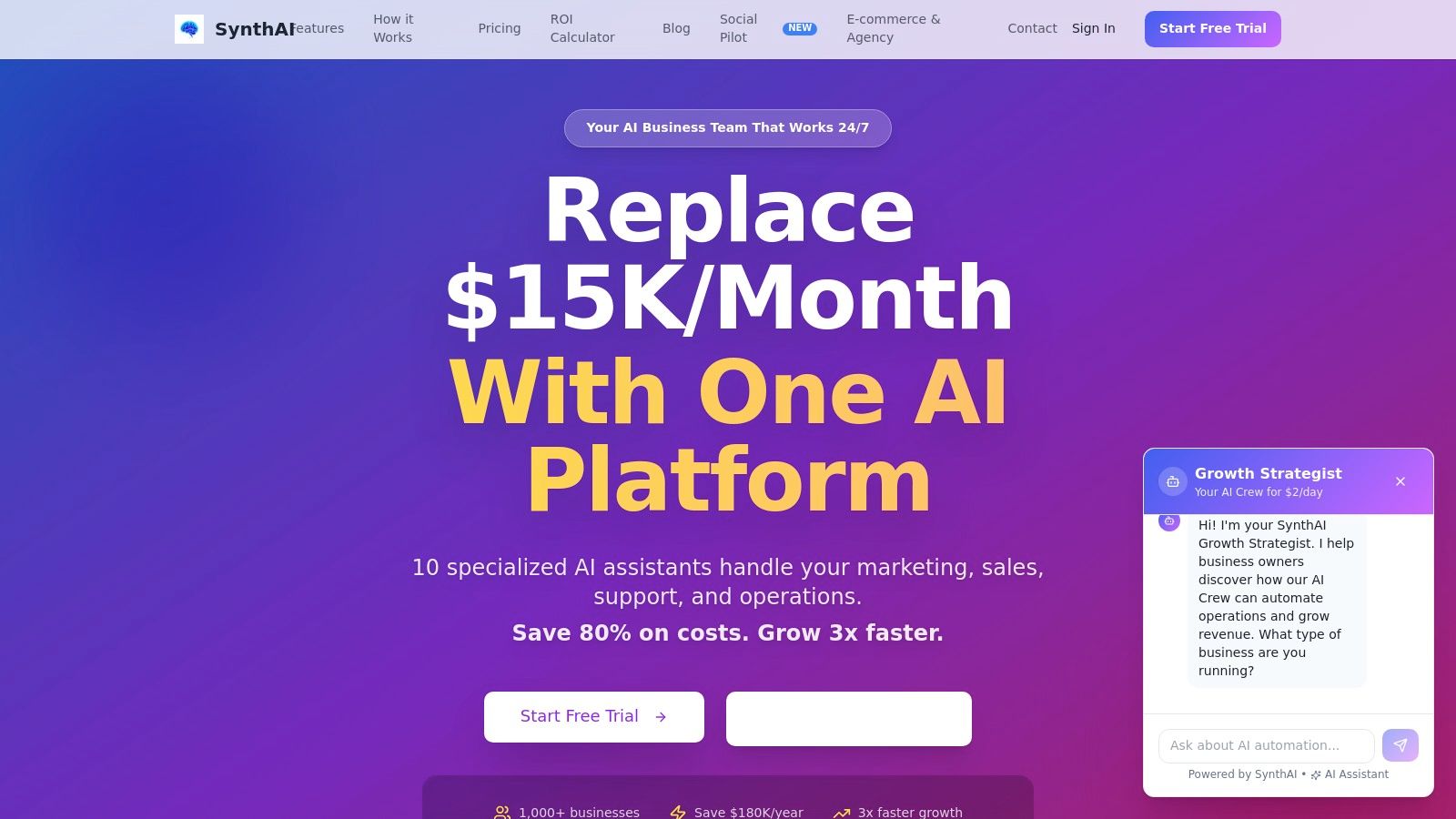
This structure allows businesses to define high-level goals, and Nexus automatically delegates tasks to the appropriate assistant. For example, a command to "launch a new product" can trigger Aura to create Google Ads, Echo to schedule social posts, Lumen to draft email campaigns, and Vantage to track the resulting ROI. The platform's deep integrations with Shopify, HubSpot, Meta, and Zapier ensure that this automation works with your existing tech stack, making it a powerful choice for e-commerce brands and agencies aiming to accelerate execution without hiring more staff or paying hefty agency retainers.
Key Strengths & Use Cases
* **All-in-One Execution:** The "AI team" model replaces the need for separate tools for content creation, ad management, and reporting. It's ideal for running multi-channel campaigns without the typical coordination overhead.
* **Rapid Implementation:** Setup is measured in minutes. By connecting your data sources, you can start assigning goals and see pre-built workflows generate assets almost immediately, with analytics linking every action to revenue impact.
* **Cost Consolidation:** SynthAI is positioned as a direct replacement for freelance and agency spending, with social proof pointing to significant cost savings and efficiency gains.
Pricing and Access
SynthAI uses a credit-based model with tiered monthly plans. A **Starter plan** is available for around **$39/month**, while the popular **Pro plan** is often cited at **$97/month**. Higher tiers and enterprise options are available for agencies and larger businesses needing more credits and features like SOC 2 security compliance. A free trial is available to test the platform's capabilities.
**Website:** https://www.getsynthai.com
2. HubSpot Marketing Hub
HubSpot Marketing Hub earns its spot as one of the best AI tools for marketing by integrating AI directly into a complete customer platform. It’s not a standalone gadget; it's a suite where AI assistants help draft emails, social posts, and landing pages, functioning as a built-in copywriter. The platform's real power comes from its native CRM, which AI uses for predictive lead scoring and creating smart audience lists, moving beyond simple automation.
This all-in-one approach consolidates your marketing stack, connecting your efforts directly to sales and service data. For instance, you can create a blog post with the AI writer, promote it via an AI-generated email campaign, and then use AI-powered analytics to track which leads engaged the most, all without leaving HubSpot. The complexity and pricing can be a hurdle for smaller operations, but for teams needing a unified system of record that scales, it’s a category leader.
***
**Website:** https://www.hubspot.com/products/marketing
| **Feature Summary** | **Pricing Tiers** | **Pros & Cons** |
| :--- | :--- | :--- |
| **AI Content Assistant:** Drafts for blogs, emails, social. | **Starter:** Begins at $15/mo (billed annually). | **Pro:** Mature all-in-one system. |
| **Predictive AI:** Lead scoring & list segmentation. | **Professional:** Starts at $800/mo (billed annually). | **Con:** Can get expensive with contact growth. |
| **Native CRM & Analytics:** Full customer journey tracking. | **Enterprise:** Starts at $3,600/mo (billed annually). | **Con:** May be overly complex for simple needs. |
3. Adobe Marketo Engage
Adobe Marketo Engage solidifies its position among the best AI tools for marketing by catering to the complex needs of enterprise B2B organizations. Rather than a simple content generator, its AI focuses on lead management and account-based marketing (ABM). The platform's intelligence excels at predictive audience segmentation and building dynamic, multi-channel nurturing journeys, making it ideal for managing long and intricate sales cycles. It’s built for teams that need deep, data-driven insights to guide prospects from initial contact to revenue.
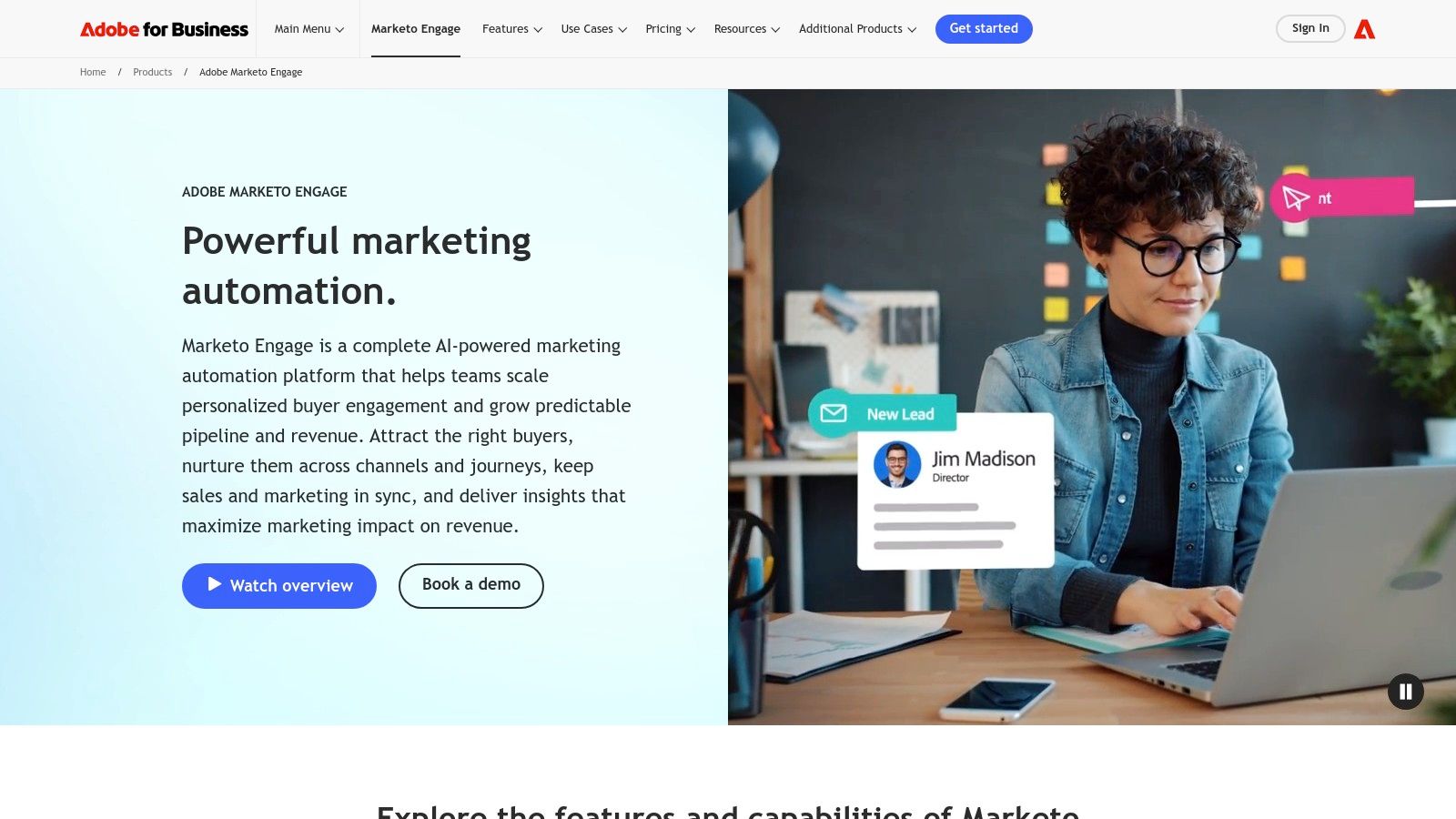
The platform’s strength lies in its governance and robust automation capabilities, especially its native integration with Salesforce, which provides clear revenue attribution models. For a large sales organization, you can use its AI to identify the most engaged accounts and automatically trigger personalized campaigns for key decision-makers within those targets. While the high learning curve and opaque enterprise pricing make it inaccessible for most small businesses, it's a top-tier choice for large teams requiring granular control and compliance over their marketing operations.
***
**Website:** https://business.adobe.com/products/marketo.html
| **Feature Summary** | **Pricing Tiers** | **Pros & Cons** |
| :-------------------------------------------------------- | :------------------------------------------------- | :----------------------------------------------------------------- |
| **Advanced Lead Scoring:** AI-driven lifecycle modeling. | **Enterprise Contracts:** Custom pricing, not public. | **Pro:** Powerful automation for large B2B teams. |
| **Orchestrated ABM Journeys:** Rich segmentation. | **Tiered Packages:** Growth, Select, Prime, Ultimate. | **Pro:** Robust governance, roles, and compliance features. |
| **Revenue & Reporting Models:** Strong Salesforce sync. | **Request a Quote:** Pricing based on database size. | **Con:** Steeper learning curve than SMB-focused tools. |
| | | **Con:** Pricing structure is not transparent and can be very high. |
4. Klaviyo
Klaviyo establishes itself as one of the best AI tools for marketing by focusing squarely on e-commerce. It uses AI not just for suggestions but to drive revenue through highly specific customer segmentation and campaign timing. Its AI-powered “Marketing Agent” helps plan and create campaigns, while its subject line assistant optimizes for open rates. The platform’s main strength is its deep integration with storefronts like Shopify, turning customer purchase history and browsing behavior into actionable data for personalized emails and SMS messages.
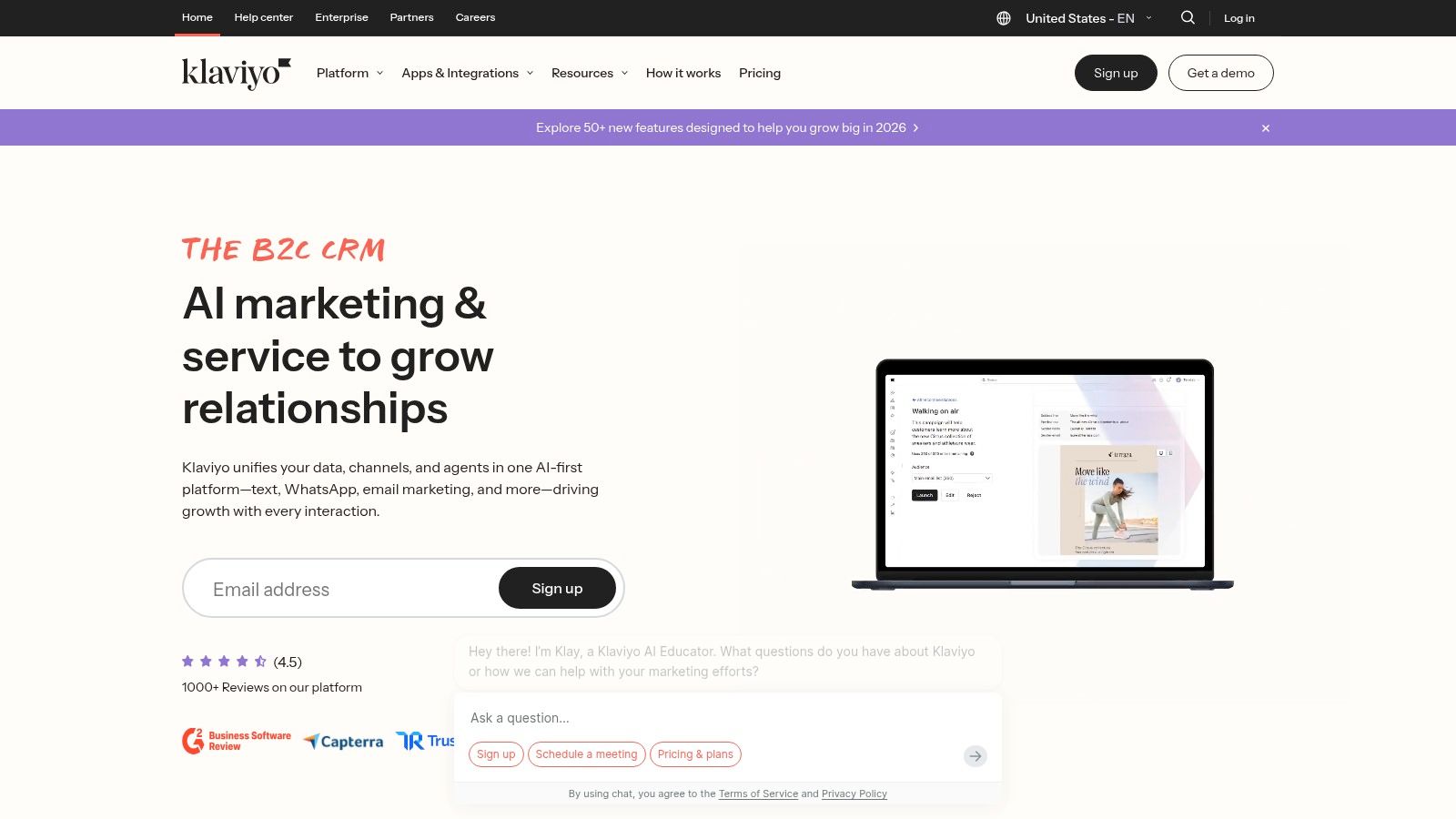
Unlike general email platforms, Klaviyo connects every campaign directly to sales figures, offering clear revenue attribution from specific flows. For example, a user can instantly set up a pre-built, AI-optimized abandoned cart series that automatically engages shoppers who left items behind. The pricing model scales with your contact list, which can become costly for rapidly growing brands, and the free plan's support is limited. However, for direct-to-consumer businesses that need to prove ROI from their marketing efforts, its e-commerce-centric intelligence is a significant advantage.
***
**Website:** https://www.klaviyo.com
| **Feature Summary** | **Pricing Tiers** | **Pros & Cons** |
| :--- | :--- | :--- |
| **AI Marketing Agent:** Helps plan and create campaigns. | **Free:** Up to 250 contacts and 500 email sends. | **Pro:** Best-in-class e-commerce segmentation. |
| **Deep E-commerce Integrations:** Shopify, BigCommerce, etc. | **Email Plan:** Starts at $20/mo (scales with contacts). | **Pro:** Large integration marketplace. |
| **Revenue Attribution:** Built-in dashboards showing order impact. | **Email & SMS Plan:** Starts at $35/mo (scales with contacts). | **Con:** Costs grow with list size. |
5. Mailchimp
Mailchimp has long been a go-to for email marketing, and its recent AI additions make it a strong contender among the best AI tools for marketing, especially for small businesses. The platform now includes generative AI tools that assist in writing subject lines, email copy, and even suggest design layouts, removing creative blocks for busy founders. Its core strength remains its user-friendly interface and extensive template library, which lower the barrier to launching professional campaigns quickly.
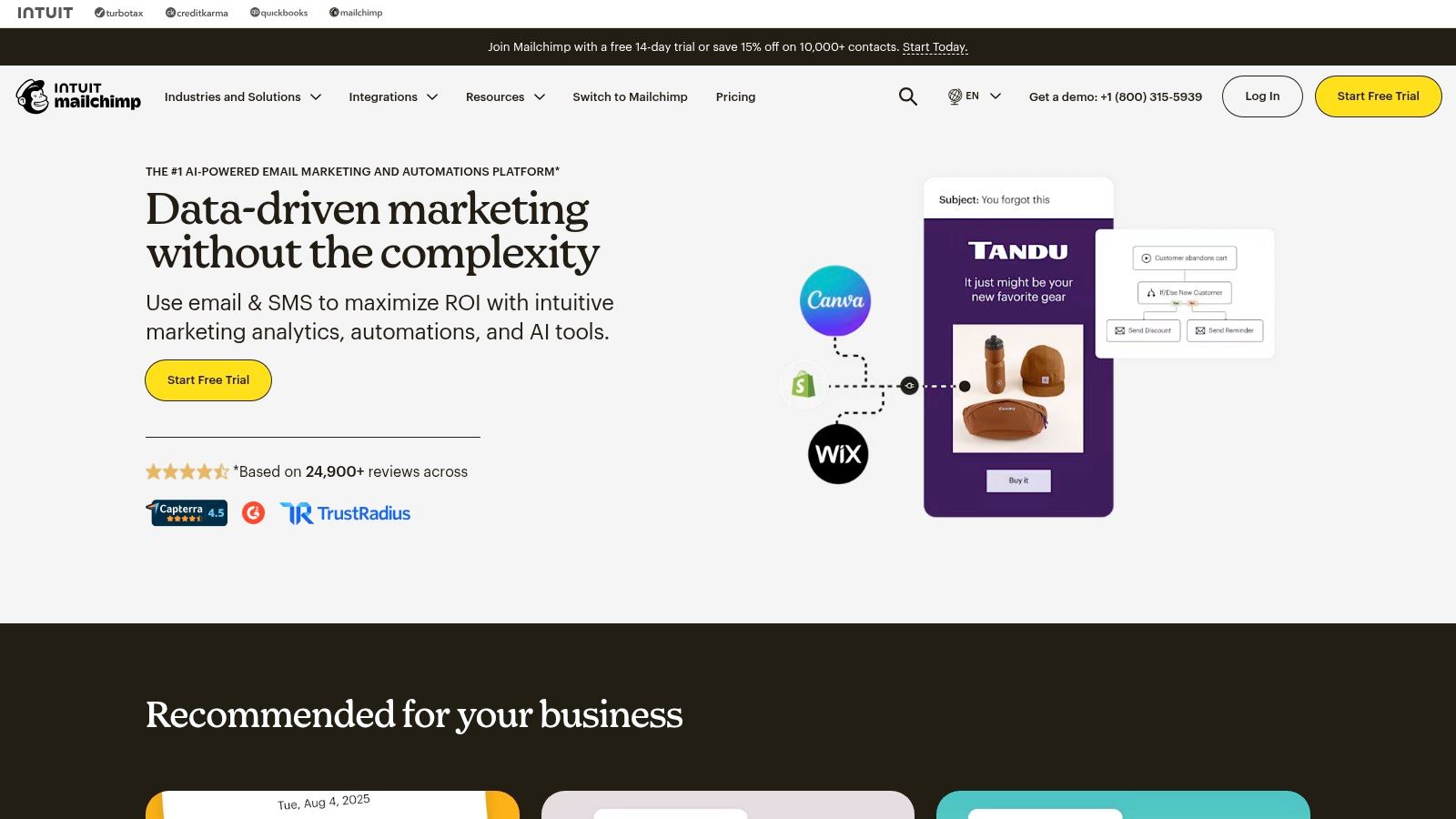
Unlike more complex systems, Mailchimp's AI is focused on immediate, practical tasks within its ecosystem of email, basic CRM, and landing pages. You can use its "Content Optimizer" to get AI-driven recommendations based on industry best practices before you hit send. While it may lack the deep predictive analytics of enterprise-level tools, its accessibility and direct application for creating and automating campaigns make it a valuable asset for teams that need to move fast without a steep learning curve or high initial investment.
***
**Website:** https://mailchimp.com
| **Feature Summary** | **Pricing Tiers** | **Pros & Cons** |
| :--- | :--- | :--- |
| **Generative AI Tools:** Assists with copy & creative. | **Free:** Limited to 500 contacts and 1,000 sends/mo. | **Pro:** Easy to start with extensive learning resources. |
| **Customer Journey Builder:** Visual automation workflows. | **Essentials:** Starts at $13/mo for 500 contacts. | **Pro:** Large ecosystem and integrations for SMBs. |
| **Content Optimizer:** AI-driven campaign suggestions. | **Standard:** Starts at $20/mo for 500 contacts. | **Con:** Free plan limits were recently reduced. |
| **Basic CRM & Landing Pages:** Simple lead capture tools. | **Premium:** Starts at $350/mo for 10,000 contacts. | **Con:** Costs scale significantly as your list grows. |
6. ActiveCampaign
ActiveCampaign distinguishes itself with powerful, AI-assisted marketing automation that remains accessible to small and mid-sized businesses. Its core strength lies in its visual automation builder, where AI helps map out complex customer journeys with conditional logic and predictive sending. This allows marketers to create highly personalized lifecycle campaigns, moving beyond simple email blasts to deliver dynamic content based on user behavior, engagement history, and site tracking.
The platform combines email marketing with a built-in CRM, enabling sales and marketing teams to work from a unified dataset. For example, its AI can predict which deals are most likely to close, allowing sales to prioritize their focus, while marketing can nurture colder leads automatically. This makes it one of the best AI tools for marketing for teams that need deep segmentation and automation without the enterprise-level price tag. The learning curve can be steep for its most advanced features, but the payoff is granular control over the customer experience.
***
**Website:** https://www.activecampaign.com
| **Feature Summary** | **Pricing Tiers** | **Pros & Cons** |
| :--- | :--- | :--- |
| **Visual Automations:** Conditional logic & site tracking. | **Marketing Lite:** Starts at $29/mo (billed annually). | **Pro:** Powerful automation without enterprise overhead. |
| **Built-in CRM & Lead Scoring:** Predictive win probability. | **Marketing Plus:** Starts at $49/mo (billed annually). | **Con:** Pricing scales with contacts and add-ons. |
| **Dynamic Content:** Multichannel messaging in one platform. | **Marketing Professional:** Starts at $149/mo (billed annually). | **Con:** Some advanced features require higher tiers. |
7. Jasper
Jasper establishes itself as a strong contender among the best AI tools for marketing by focusing squarely on the needs of content teams. It's a generative AI platform built to produce on-brand copy, ads, and blog posts at scale. Where it stands out is its emphasis on brand consistency; users can upload style guides and product catalogs to create a "Brand Voice" and "Knowledge Base," ensuring the AI's output aligns with company messaging instead of generating generic content.
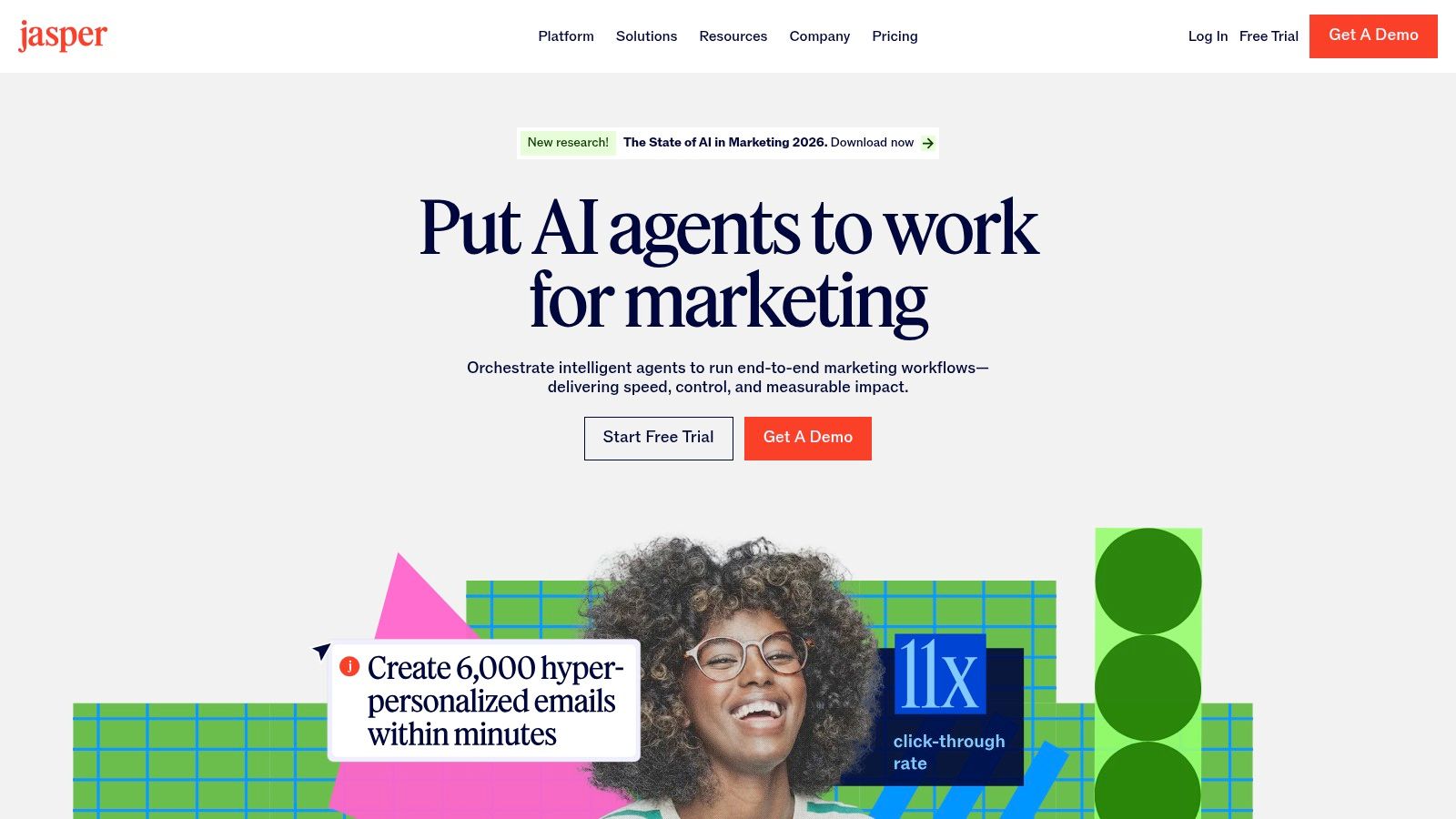
This focus makes it a practical tool for marketing departments needing to accelerate production without sacrificing quality control. A marketing manager can use a template to generate a dozen ad variations for A/B testing, all adhering to the brand's specific tone and product details. While its most powerful collaboration and governance features are reserved for higher-tier plans, Jasper provides a purpose-built environment for marketers that scales from individual creators to large, structured enterprise teams.
***
**Website:** https://www.jasper.ai
| **Feature Summary** | **Pricing Tiers** | **Pros & Cons** |
| :--- | :--- | :--- |
| **Brand Voice & Knowledge:** Ensures consistent, on-brand AI output. | **Creator:** Starts at $39/mo (billed annually). | **Pro:** Marketing-specific UX with strong brand controls. |
| **Content Templates & Recipes:** For ads, emails, and SEO articles. | **Pro:** Starts at $59/mo (billed annually). | **Con:** Pro plan is single-seat by default, limiting teams. |
| **Team Collaboration & API:** Governance and integration for scale. | **Business:** Custom pricing. | **Con:** Enterprise features and API access gated to Business plans. |
8. Copy.ai
Copy.ai positions itself not just as a content generator but as an AI go-to-market platform. It excels at automating repeatable marketing tasks through its Workflows and Copy Agents, making it one of the best AI tools for marketing teams looking to scale operations. Instead of one-off generations, you can build a process to, for example, turn a product update into a blog post, social media captions, and an email announcement, all while maintaining a consistent brand voice.
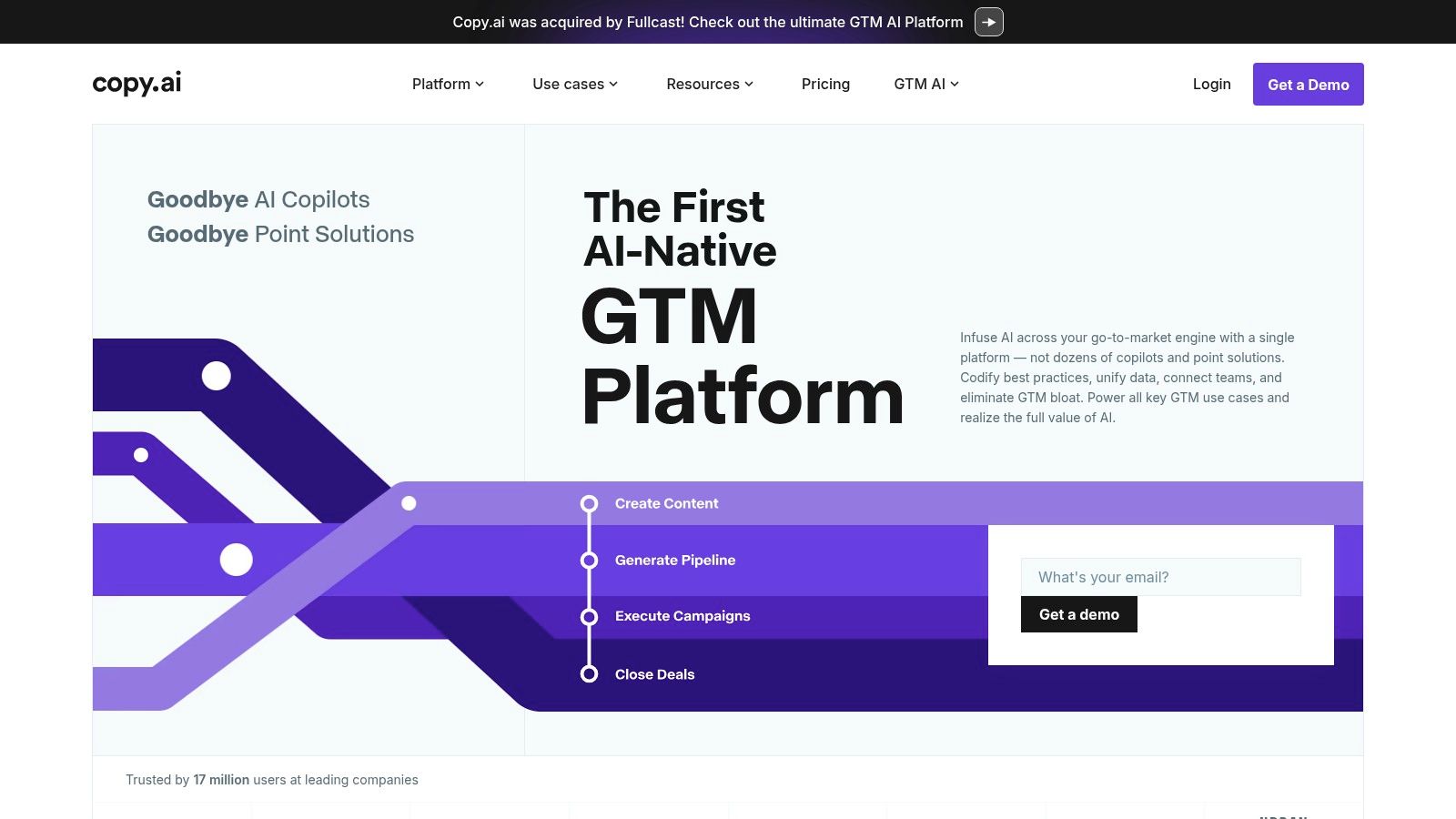
Its strength lies in structured, repeatable content creation for sales and marketing outreach, like personalizing account-based marketing (ABM) emails or translating content for different regions. While it offers straightforward self-serve pricing, users should note that complex workflows consume credits faster, so choosing the right plan is important. The platform is designed for team collaboration, with project organization and API access for deeper enterprise integration. For teams needing to systematize content production beyond simple copywriting, Copy.ai provides a powerful framework.
***
**Website:** https://www.copy.ai
| **Feature Summary** | **Pricing Tiers** | **Pros & Cons** |
| :--- | :--- | :--- |
| **Workflow Builder:** Automates repeatable GTM content tasks. | **Free:** Limited to 2,000 words. | **Pro:** Transparent self-serve pricing. |
| **Brand Voice Management:** Ensures content consistency. | **Pro:** Starts at $36/mo (billed annually). | **Pro:** Excellent for bulk tasks and ABM content. |
| **Team Seats & API Access:** Built for collaboration and integration. | **Enterprise:** Custom pricing for scale. | **Con:** Heavy automations can consume credits quickly. |
9. Semrush
Semrush solidifies its position as one of the best AI tools for marketing by embedding AI features directly into its industry-leading SEO and SEM suite. It moves beyond just data, using AI to power its ContentShake AI for creating optimized articles and its local marketing tools, which automate review responses and business listing updates. The platform is designed for marketers who need to connect competitive intelligence with content creation and execution in one place.
Its real strength lies in its massive dataset, which fuels AI recommendations for everything from keyword opportunities to backlink strategies and PPC campaigns. For example, you can identify a competitor's top-performing keywords, use the AI writer to draft a superior blog post targeting them, and then run it through the SEO Writing Assistant for real-time optimization suggestions. While the pricing structure can be complex with various add-ons, its ability to replace multiple niche tools makes it a powerhouse for agencies and in-house growth teams.
***
**Website:** https://www.semrush.com
| **Feature Summary** | **Pricing Tiers** | **Pros & Cons** |
| :--- | :--- | :--- |
| **Competitive Intelligence:** Keyword, backlink, & site audits. | **Pro:** Starts at $108.33/mo (billed annually). | **Pro:** Deep competitive datasets for SEO/PPC. |
| **AI Content Tools:** AI writing & content optimization. | **Guru:** Starts at $208.33/mo (billed annually). | **Pro:** Consolidates multiple marketing tools. |
| **Local Marketing AI:** Automated review replies & listings. | **Business:** Starts at $416.66/mo (billed annually). | **Con:** Can get pricey with add-ons and extra seats. |
10. Ahrefs
Ahrefs secures its place on our list of the best AI tools for marketing by layering AI onto its legendary SEO dataset. While renowned for its powerful backlink index and keyword research tools, Ahrefs integrates AI to solve marketing problems at scale. Instead of just finding keywords, you can use its data to understand competitive gaps and now, with features like Brand Radar AI, automatically monitor brand mentions across the web, turning a manual task into an automated intelligence feed.
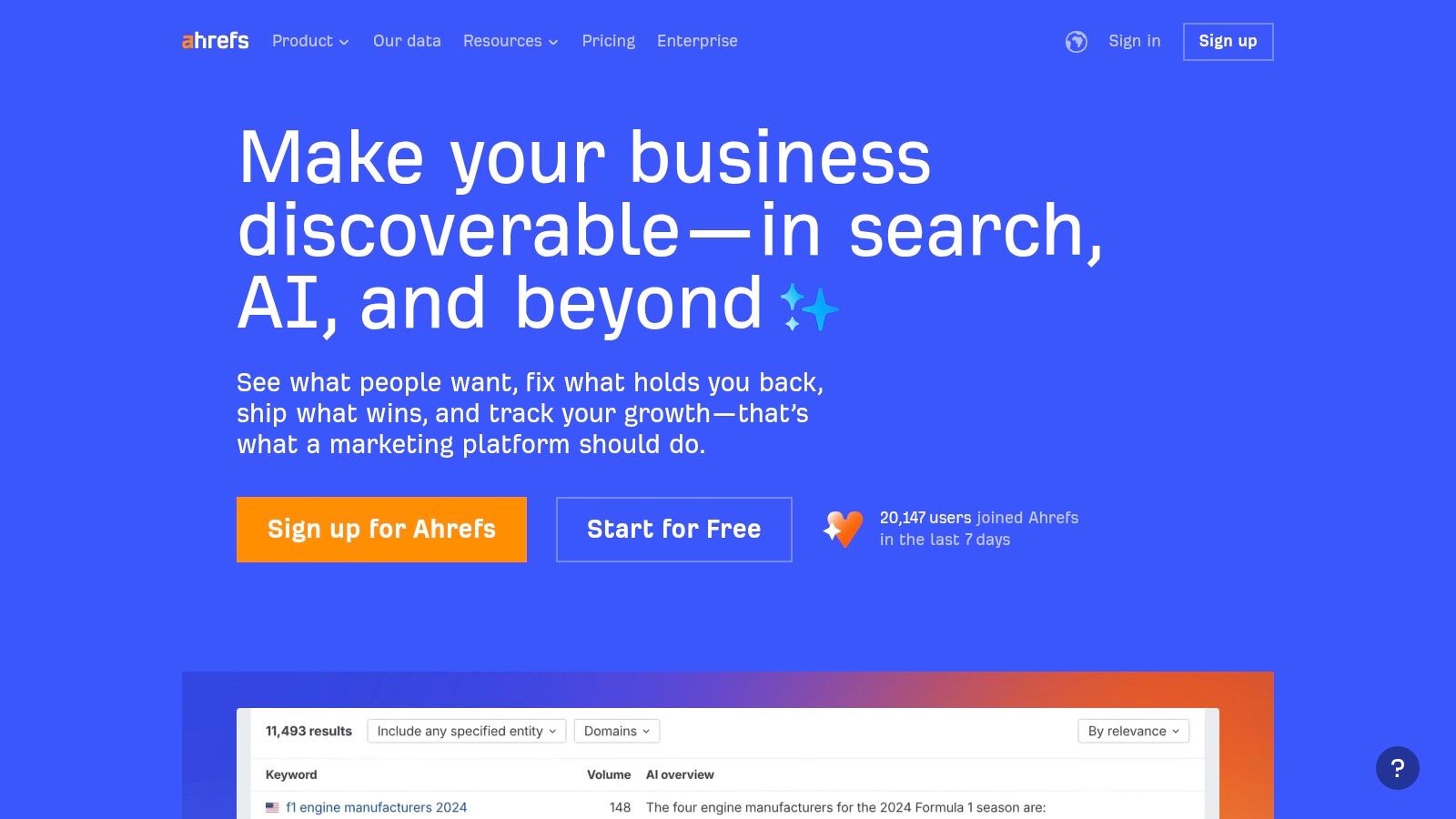
The platform’s strength is its depth of data, which gives its AI features a solid foundation. You can move from identifying a high-value keyword cluster to auditing your site's technical health and tracking rank changes all in one system. For example, a content team can identify underperforming pages with Site Audit, find new keyword opportunities with Keywords Explorer, and then validate their content strategy by analyzing the backlink profiles of top-ranking competitors in Site Explorer. The pricing can be a barrier for solo operators, but for any business serious about organic growth, its data is indispensable.
***
**Website:** https://ahrefs.com
| **Feature Summary** | **Pricing Tiers** | **Pros & Cons** |
| :--- | :--- | :--- |
| **Industry-Leading SEO Tools:** Site Explorer, Keywords Explorer. | **Lite:** Begins at $83/mo (billed annually). | **Pro:** Robust backlink and keyword datasets. |
| **Brand Radar AI:** Researches and tracks mentions at scale. | **Standard:** Begins at $166/mo (billed annually). | **Con:** Full platform can be pricey for beginners. |
| **Site Audit & Rank Tracker:** For site monitoring and performance. | **Advanced:** Begins at $333/mo (billed annually). | **Con:** AI add-ons may come at an additional cost. |
11. Sprout Social
Sprout Social stands out as a premium social media management platform designed for brands that require robust governance and deep analytics. While not a pure AI-play, it integrates AI to enhance established social workflows. For instance, its AI-powered Smart Inbox suggests replies and helps categorize incoming messages, allowing teams to manage high-volume engagement more effectively. The platform’s strength is in providing a controlled environment for enterprise-level social media operations, from publishing approvals to detailed reporting.
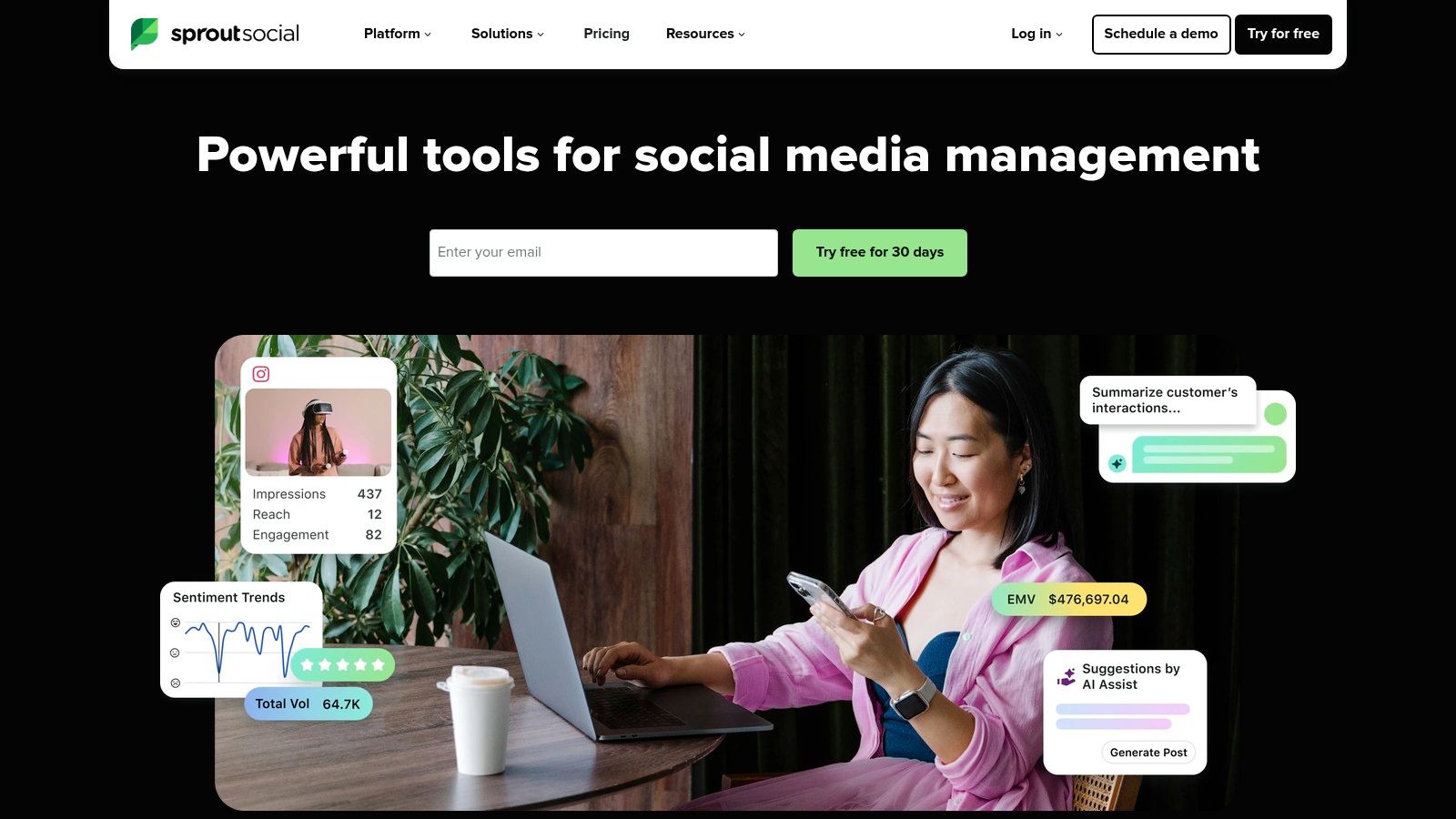
This tool is one of the best AI tools for marketing when your primary need is scaling and managing a large social presence with multiple stakeholders. Unlike tools focused solely on content creation, Sprout Social centralizes scheduling, listening, analytics, and employee advocacy into one cohesive system. The price point is higher and based per user, which can be a barrier for smaller teams. However, for organizations where brand safety, team collaboration, and comprehensive performance metrics are critical, the investment provides a necessary command center.
***
**Website:** https://sproutsocial.com
| **Feature Summary** | **Pricing Tiers** | **Pros & Cons** |
| :--- | :--- | :--- |
| **AI Smart Inbox:** Suggested replies & message categorization. | **Standard:** Starts at $249/mo (billed annually). | **Pro:** Enterprise-ready with strong governance. |
| **Unified Social Management:** Publishing, listening, analytics. | **Professional:** Starts at $399/mo (billed annually). | **Con:** Higher price per user than SMB tools. |
| **Advanced Analytics & Reporting:** Deep performance tracking. | **Advanced:** Starts at $499/mo (billed annually). | **Con:** Seat-based pricing can get costly. |
12. Mutiny
Mutiny secures its place as one of the best AI tools for marketing by focusing on website personalization without needing a developer. It's built for B2B marketers who want to convert visitor segments and target accounts with tailored web experiences. The platform's AI assists in identifying key audience segments from your existing traffic and then generates personalized copy and page variations to test against them, moving beyond generic A/B testing into dynamic content optimization.

The core strength is connecting website content directly to account-based marketing (ABM) goals. For instance, if a lead from a target account visits your site, Mutiny can dynamically change headlines, logos, and testimonials to match their industry or company, all powered by its AI engine and CRM integrations. While its enterprise focus and non-public pricing model make it inaccessible for smaller businesses, it provides a powerful, no-code solution for B2B teams aiming to boost late-funnel conversions.
***
**Website:** https://www.mutiny.com
| **Feature Summary** | **Pricing Tiers** | **Pros & Cons** |
| :--- | :--- | :--- |
| **AI Content & Design:** Generates personalized copy & pages. | **Not Publicly Listed:** Requires a demo for a custom quote. | **Pro:** Proven conversion uplift for B2B. |
| **Audience Segmentation:** AI discovers visitor segments. | **Enterprise-Focused:** Aimed at mid-market to large companies. | **Pro:** Excellent for ABM & late-funnel goals. |
| **CRM Integration:** Syncs with tools like HubSpot & Salesforce. | | **Con:** Pricing is high and not self-serve. |
Top 12 AI Marketing Tools: Feature Comparison
| Platform | Core features | UX & quality (★) | Pricing & value (💰) | Target audience (👥) | Standout (✨) |
|---|---|---:|---|---|---|
| 🏆 **SynthAI** | Nexus orchestration + 10 specialist assistants (SEO, ads, email, social, CRM, support, video, ops, analytics); deep integrations | ★★★★☆ — fast onboarding, 24/7 execution, real‑time analytics | 💰 Credit‑based tiers (Starter ~$39/mo; Pro ~$97/mo; Ultimate/Enterprise custom) + 7–14d trial; high ROI claims | 👥 E‑commerce founders, growth marketers, agencies, SMBs | ✨ Coordinated AI “business team” that plans & executes end‑to‑end; no‑code workflows; SOC2 |
| HubSpot Marketing Hub | CRM‑native automation: email, landing pages, ads, AI content & segmentation | ★★★★☆ — mature UX; unified system of record | 💰 Tiered by Hubs & contacts; scales costly at Enterprise | 👥 Startups → enterprises needing unified CRM + marketing | ✨ Single system across marketing, sales & service; large ecosystem |
| Adobe Marketo Engage | ABM, advanced lead scoring, journey orchestration, strong Salesforce integration | ★★★★☆ — enterprise governance & control | 💰 Enterprise contracts; higher TCO (custom pricing) | 👥 Large B2B teams, ABM and revenue ops | ✨ Robust ABM and lifecycle modeling for complex B2B sales |
| Klaviyo | Email + SMS, ecommerce flows, revenue attribution, Shopify native integrations | ★★★★☆ — commerce‑first UX and reliable flows | 💰 Scales with profiles; free/limited starter then paid tiers | 👥 DTC brands, Shopify/B2C merchants | ✨ Best‑in‑class ecommerce segmentation and prebuilt flows |
| Mailchimp | Email builder, templates, journeys, landing pages, basic CRM | ★★★☆☆ — easy start for SMBs | 💰 Free tier (limited) → paid tiers; costs grow with list size | 👥 Small businesses, solopreneurs | ✨ Ease‑of‑use + large template library and resources |
| ActiveCampaign | Visual automations, CRM, lead scoring, multichannel messaging | ★★★★☆ — powerful automations for SMBs | 💰 Tiers by contacts; good mid‑market value but scales with list | 👥 SMBs, agencies needing conditional flows | ✨ Advanced visual automation with site tracking & conditional logic |
| Jasper | Generative copy, templates, brand voice controls, team collaboration | ★★★★☆ — marketing‑focused writing UX | 💰 Seat‑based plans; Business tier for enterprise/API access | 👥 Marketers, content teams, agencies | ✨ Brand voice governance + templates for scale |
| Copy.ai | Workflows, Copy Agents, brand voice, team/project org & API | ★★★☆☆ — useful but credit/usage model | 💰 Transparent self‑serve pricing; enterprise plans available | 👥 GTM teams, content operations, localization | ✨ Repeatable workflow automation for bulk content tasks |
| Semrush | Keyword/backlink research, site audits, PPC tools, AI content modules | ★★★★☆ — deep datasets for SEO/PPC | 💰 Modular toolkits; add‑ons raise cost | 👥 SEO teams, agencies, growth marketers | ✨ Competitive intelligence + broad SEO/PPC toolkit |
| Ahrefs | Site Explorer, Keywords Explorer, backlink index, rank tracking | ★★★★☆ — trusted data accuracy | 💰 Clear plans; can be pricey for full access | 👥 SEO professionals, agencies | ✨ Industry‑leading backlink & keyword datasets |
| Sprout Social | Publishing, unified inbox, listening, analytics, approvals & governance | ★★★★☆ — enterprise social management | 💰 Premium per‑seat pricing; higher TCO for large teams | 👥 Social teams, enterprises | ✨ Deep social analytics, listening & approval workflows |
| Mutiny | No‑code personalization, 1:1 microsites, AI page generation & testing | ★★★★☆ — fast personalization with minimal dev | 💰 Enterprise pricing; demo/quote required | 👥 B2B, ABM teams, CRO specialists | ✨ 1:1 account personalization and tailored page experiences |
Building Your Ultimate AI Marketing Stack
As we've explored, the journey to finding the **best AI tools for marketing** isn't about adopting a single, all-powerful solution. Instead, it’s about strategically assembling an intelligent, interconnected stack that mirrors your specific business goals, budget, and team structure. The right combination of platforms can automate tedious work, uncover deep customer insights, and ultimately drive sustainable growth.
Your path forward depends heavily on your current operational maturity. For businesses feeling the strain of disjointed systems, high subscription costs, and slow campaign execution, a unified orchestration platform like SynthAI presents a compelling foundation. It replaces the need for multiple point solutions by providing a coordinated team of AI agents that manage campaigns from start to finish, consolidating costs and accelerating your entire marketing function.
Choosing Your Starting Point
For teams already invested in a core system like HubSpot or Klaviyo, the goal shifts to enhancement. The key is to identify your most significant bottleneck and select a specialized tool that integrates smoothly to solve that one problem.
* **Content Creation:** If your team struggles to produce high-quality content at scale, integrating a powerful AI writer like Jasper or Copy.ai into your workflow can provide an immediate boost in output.
* **SEO and Traffic:** For ecommerce brands needing to dominate search results, pairing an SEO powerhouse like Ahrefs or Semrush with your existing marketing automation tool creates a formidable combination for attracting and converting organic traffic.
* **Lead Conversion:** If your landing pages aren't converting, a dynamic personalization engine like Mutiny can work alongside your CRM to deliver tailored experiences that significantly lift conversion rates.
A Practical Framework for Implementation
The most common mistake is trying to implement too many new tools at once. This approach leads to confusion, poor adoption, and wasted resources. A more effective method is to start small and build incrementally.
First, **define a single, measurable objective**. For example, "increase blog traffic by 20% in Q3" or "reduce customer support response times by 50%." Select one primary tool from this list that directly addresses that goal. Focus all your initial energy on mastering its features, integrating it with your core platforms (like Shopify, Google Ads, or Meta), and proving its ROI. Once you have a clear win, you can then identify the next bottleneck and strategically layer in a complementary solution. By focusing on integration and tangible results, you can methodically build your marketing stack from a series of manual processes into a streamlined, automated growth engine.
---
Ready to stop juggling dozens of subscriptions and start orchestrating your entire marketing strategy from a single platform? **SynthAI** replaces fragmented tools with a unified team of AI agents that plan, create, and run campaigns for you. See how SynthAI can consolidate your stack and accelerate your growth today.
Ready to Transform Your Business with AI?
Build your AI team and start automating your marketing today.