Your Guide to AI Business Process Automation
SynthAI Team
Content Team
At its heart, **AI business process automation** is about using smart systems to run, manage, and even improve your business operations without constant human oversight. Think of it as giving your digital workforce a brain upgrade—moving from simple, rule-following bots to intelligent agents that can *think, decide, and act* on their own.
What Is AI Business Process Automation, Really?
Let’s break this down without the confusing tech-speak. Imagine your business is a busy restaurant kitchen. In a traditional setup, your team handles everything by hand—taking orders, prepping ingredients, cooking, and plating. It works, sure, but it's slow and mistakes are bound to happen, especially during the dinner rush.
Now, imagine an AI system as your new executive chef. This isn’t just about making things move faster. This AI chef intelligently directs specialized robotic arms—your AI assistants—to handle key tasks. One arm preps ingredients with perfect consistency. Another cooks every dish to the exact right temperature. A third can even tweak recipes on the fly based on customer feedback.
That's what AI business process automation feels like. It’s not just about speeding up one repetitive task. It’s about building a smart, self-managing system where AI handles the routine analysis, decision-making, and execution, **24/7**. This frees up your human team to focus on the things that matter most: creative problem-solving, connecting with customers, and big-picture strategy.
The Core Components of Intelligent Automation
So, how does this actually work? We need to look at the "brains" of the operation. AI automation is a team effort, powered by a few key technologies that work together to mimic how people think. But unlike people, these systems get smarter over time.
The main technologies driving this are:
* **Machine Learning (ML):** This is the engine for learning. Instead of being programmed with rigid rules, ML models learn from data. For instance, an ML model can sift through past sales figures to predict future demand and automatically adjust your inventory orders.
* **Natural Language Processing (NLP):** NLP is what gives AI the power to understand human language. It’s how a chatbot can actually understand what a customer is asking and give a genuinely helpful answer, not just a canned response.
* **Data Analysis:** AI can chew through massive amounts of data in seconds, spotting patterns and insights a human could never find. It can see that a marketing campaign is underperforming and suggest moving the budget to one that's actually working.
This simple diagram shows how these pieces fit together to analyze information, make a decision, and then take action.
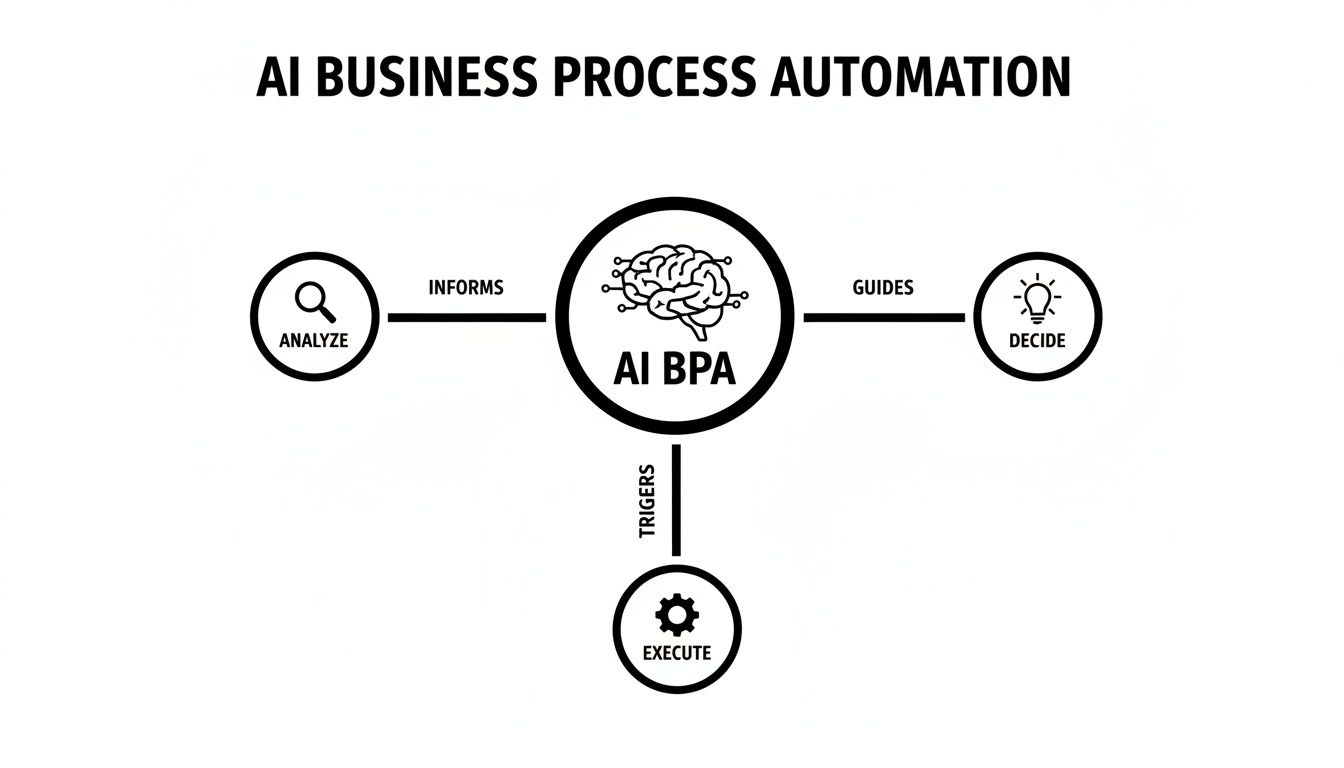
As you can see, it's a continuous loop. The system is always learning and improving itself, which is where the real power lies.
From Simple Rules to Smart Decisions
The biggest jump from traditional automation to **AI business process automation** is the ability to make decisions.
> Traditional automation is like a calculator: it follows pre-set instructions perfectly every time. AI automation is like a seasoned financial analyst: it doesn't just run the numbers, it interprets them, sees the bigger picture, and recommends what to do next.
To see the difference, think about customer follow-up. A basic automation tool can send a generic "thank you" email after someone makes a purchase. That’s it.
An AI-powered system like SynthAI, on the other hand, can analyze that customer’s entire history—what they’ve bought, what they’ve looked at, and how they’ve interacted with your brand before. It then sends a truly personal follow-up with product recommendations they’ll actually want, timed perfectly to encourage another purchase.
This move from rigid, "if-this-then-that" rules to dynamic, context-aware actions is what turns automation from a simple efficiency tool into a real competitive advantage.
To make this distinction even clearer, let's compare the old way with the new way side-by-side.
Comparing Manual vs AI-Automated Workflows
Here’s a look at how traditional business processes stack up against intelligent AI automation.
| Operational Aspect | The Traditional Manual Approach | The AI-Automated Approach |
| :--- | :--- | :--- |
| **Data Entry** | Employees manually copy-paste data between systems, prone to typos. | AI extracts data from emails, PDFs, and forms automatically with **99%** accuracy. |
| **Decision Making** | Based on fixed rules or requires human approval for any deviation. | AI makes dynamic decisions based on real-time data and learns from outcomes. |
| **Customer Support** | Agents answer common questions repeatedly, leading to long wait times. | AI chatbots handle **80%** of routine queries instantly, escalating only complex issues. |
| **Workflow Scope** | Limited to single, linear tasks ("if X happens, do Y"). | Manages complex, end-to-end processes that adapt to changing conditions. |
| **Scalability** | Scaling requires hiring and training more people, which is slow and costly. | Scales instantly to handle massive spikes in volume without any drop in performance. |
| **Improvement** | Process improvement relies on periodic reviews and manual adjustments. | The system continuously analyzes its own performance and self-optimizes over time. |
The contrast is stark. While manual and basic rule-based systems get the job done, they simply can't compete with the speed, intelligence, and adaptability of a process driven by AI.
Why AI Automation Is a Game Changer for Growth

It’s one thing to understand the nuts and bolts of **AI business process automation**, but seeing what it actually does for a business is where things get exciting. When you put intelligent automation to work, the results are about much more than just ticking tasks off a to-do list. It changes the very DNA of how your company operates and competes.
For any leader focused on growth, the benefits really stack up across three core areas.
The first, and most obvious, is a massive boost in efficiency. Think about it: every company has smart people bogged down by mind-numbing, repetitive work. They're stuck sorting support tickets, manually punching data into a CRM, or scheduling out a month's worth of social media posts. This isn't just a drag; it's a colossal waste of human potential.
AI automation acts as a force multiplier for your team. It takes over all that predictable grunt work, freeing up your people to focus on strategy, innovation, and creative problem-solving—the stuff that actually moves the needle. That’s where the real magic happens. Your team shifts from being task-doers to genuine strategic thinkers.
Achieve Seamless Operational Scalability
The second pillar is all about scaling without the usual growing pains. For a lot of businesses, growth is a double-edged sword. A sudden spike in orders or customer questions can completely swamp manual processes, leading to missed deadlines, shipping errors, and unhappy customers. The default solution—hiring more people—is slow and incredibly expensive.
This is where AI automation really proves its worth. Imagine your online store gets a shout-out in a major publication and website traffic jumps **10x** overnight. An AI-powered system doesn't break a sweat. It can instantly scale to handle thousands of customer chats at once, process every single order without a mistake, and keep your inventory updated in real-time.
> AI business process automation gives you an operational infrastructure that expands and contracts on demand. It allows you to capture every opportunity without being constrained by the physical limits of your human team.
This kind of elasticity means you can chase aggressive growth goals with total confidence, knowing your backend operations won't crumble under the pressure. The system is built for success.
The market numbers back this up. The business process automation market skyrocketed from **$8 billion** in 2020 and is on track to hit **$19.6 billion** by 2026. The real-world impact is just as impressive. One major insurance company, for example, slashed its claims processing time by **70%** by using AI to pull data automatically. For our own SynthAI users, assistants like Ascent for CRM and Axis for operations are delivering similar **4x** efficiency gains in as little as 90 days by automating entire workflows from Shopify to HubSpot. You can explore these BPA market trends and statistics to get the full picture.
Create a Truly Data-Driven Strategy
Finally, AI automation helps you build a proactive growth engine powered by data. Most companies are sitting on a goldmine of information they can’t actually use. By the time an analyst manually crunches the numbers from last month's sales campaign, the window to act on those insights has already closed.
AI completely flips this script. An intelligent automation platform analyzes your sales, marketing, and operational data around the clock, spotting emerging trends in minutes instead of weeks. This leads to much smarter, faster decisions.
For instance, an AI system can:
* **Pinpoint your best-performing ad campaigns** and automatically shift your budget away from the duds to maximize ROI.
* **Identify customers at risk of churning** based on their recent activity and trigger a personalized retention offer before they leave.
* **Forecast product demand** with stunning accuracy, helping you avoid stockouts during busy seasons and cut down on costly excess inventory.
This proactive approach means you stop reacting to what *happened* and start anticipating what *will happen*. It turns your strategy from educated guesswork into a precise, data-backed discipline, giving you a powerful edge in any market.
How AI Automation Works in the Real World
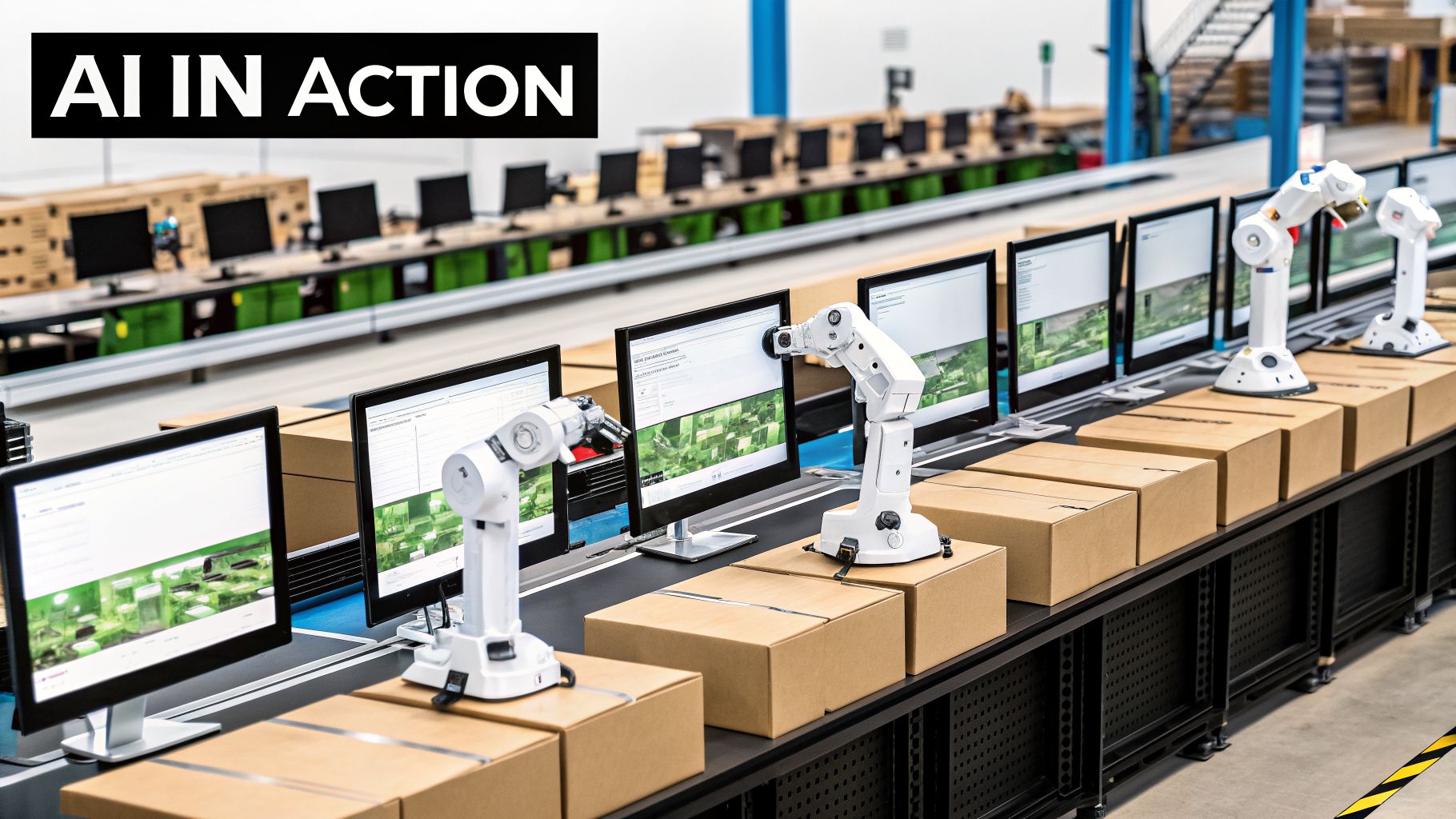
Theory is one thing, but seeing **AI business process automation** in action is where it all clicks. This is the point where abstract ideas like machine learning and data analysis stop being buzzwords and become concrete tools that get real work done.
The beauty of this technology is how it can bend and adapt to almost any business model. Whether you're selling products online, running client campaigns, or building a software empire, intelligent automation can be molded to fit your specific needs. Let's dig into a few practical examples to see what that actually looks like.
To make this even clearer, here's a quick look at how different departments can put AI automation to work.
AI Automation Use Cases by Business Function
| Business Function | Example AI-Automated Task | Primary Benefit |
| :--- | :--- | :--- |
| **Sales** | Automatically score and route new leads to the right salesperson based on firmographic data and initial website activity. | Faster response times to high-value prospects, increased conversion rates. |
| **Marketing** | Generate personalized email campaigns that adapt based on a user's behavior (e.g., pages visited, content downloaded). | Higher engagement and improved customer retention. |
| **Customer Support** | Deploy an AI chatbot to instantly answer common questions and handle basic requests, escalating to a human agent only when necessary. | **24/7** support availability and reduced operational costs. |
| **Finance** | Automate invoice processing by extracting data from PDFs and emails and entering it directly into accounting software. | Reduced manual errors and accelerated payment cycles. |
| **Operations** | Monitor inventory levels and automatically place new purchase orders when stock drops below a predefined threshold. | Prevention of stockouts and optimized supply chain management. |
As you can see, the applications are incredibly broad, touching nearly every corner of a business. Now let's dive deeper into some specific industries.
For E-commerce Brands
An e-commerce store is a machine with a thousand moving parts. AI automation acts like the central nervous system, connecting every stage of the customer journey, from the first click to the final delivery.
Think about the classic abandoned cart problem. On your Shopify store, a customer gets distracted and leaves. Without automation, you might send a generic reminder email 24 hours later, if you send one at all. With an intelligent system, a much smarter sequence kicks off the second they leave.
The system can:
* **Trigger a personalized email sequence:** The first message might nudge them with free shipping. A day later, another could show off five-star reviews for that exact product.
* **Launch dynamic ads:** At the same time, an AI assistant can fire up a retargeting ad on social media featuring the very item they left behind.
* **Optimize the product listing:** Behind the scenes, another AI could be analyzing search trends and tweaking the product description to boost its SEO value for the next visitor.
This isn't just one automated task; it's a coordinated, multi-channel play that runs on its own, turning a lost opportunity into a sale.
For Digital Marketing Agencies
Agencies are under constant pressure to deliver amazing results for clients. The problem? So much of their day is swallowed by repetitive administrative work and report-building, stealing time from the strategy and creative thinking clients actually pay for.
Just consider the monthly grind of client reporting. Manually yanking data from Google Analytics, Meta Ads, and your SEO tool can burn hours for every single client. An AI system, however, can tap into these platforms and generate beautiful, comprehensive reports on demand, complete with key takeaways.
> This simple shift lets an account manager spend their time figuring out what the data *means* and what to do next, instead of just copying and pasting it. They go from being a data-gatherer to a true strategic advisor.
It goes further, too. AI can help with content workflows. For instance, an agency using a platform like SynthAI could generate a whole month's social media calendar for a client, schedule everything, and even produce solid first drafts for blog posts from a simple outline. This frees up an incredible amount of time, letting the agency take on more clients without hiring more people.
For SaaS Operations
For a Software-as-a-Service company, a smooth onboarding process and quick support are everything. Get it wrong, and customers churn. As a SaaS business scales, trying to manually manage sign-ups, answer every ticket, and nurture new users just doesn't work. AI automation is the glue that holds it all together.
Imagine a new user signs up for a free trial. A well-oiled automated workflow can kick in to make sure their first experience is a great one.
1. **Instant CRM Logging:** The new user's details are instantly saved to your CRM, maybe HubSpot or Salesforce, and tagged as a "New Trial."
2. **Smart Onboarding:** They start receiving a sequence of emails that guide them through the most important features, potentially even customized based on the first few actions they take in the app.
3. **Proactive Support:** An AI-powered chatbot is there to answer their basic questions right away, leaving your human support team free to handle the really tricky problems.
This kind of connected system ensures no one falls through the cracks. By linking tools like Slack and Zapier, you can build powerful internal alerts. For example, when a user from a Fortune 500 company signs up, the sales team can get an instant Slack message with a full summary of that person's activity so far, ready for a warm outreach call.
Your Practical Implementation Roadmap
Jumping into **AI business process automation** can feel overwhelming, but it doesn't have to be a massive, all-at-once project. A clear, step-by-step plan makes everything manageable and lets you score early wins that build momentum for bigger things.
Think of it like building with LEGOs. You wouldn’t try to construct the entire castle from the get-go. You’d start with a single tower, figure out how the pieces click together, and then expand from there. This four-step roadmap follows that exact logic, giving you a low-risk path from a simple idea to full-scale execution.
Step 1 Identify Your Best Automation Opportunities
Before you even think about tools, you need to know where to aim them. The best place to start is by hunting down the biggest bottlenecks and the most mind-numbing, repetitive tasks in your business. These are your prime candidates for automation.
Look for work that is:
* **High-Volume:** Things that happen over and over, every single day, like processing new customer orders or handling basic support questions.
* **Rule-Based:** Processes that follow a clear, predictable playbook, such as data entry or pulling standard weekly reports.
* **Time-Consuming:** Activities that drain hours from your team's day but don't require deep strategic thought.
By picking off this low-hanging fruit first, you can show real value almost immediately and get your team genuinely excited about what’s next.
Step 2 Choose the Right Automation Platform
Once you have a shortlist of processes, it’s time to find the right technology partner. Not all AI automation platforms are built the same. The trick is to find one that solves your immediate problems but also has the muscle to grow with you.
> Your ideal platform should act as a central hub for your business operations, not just another disconnected tool. It needs to seamlessly integrate with the software you already use every day.
When you're comparing options, focus on these three things:
1. **Integration Capabilities:** Does it play nice with your core systems like Shopify, HubSpot, Google Ads, and Slack?
2. **Ease of Use:** Can your team build and manage automations with plain English, or does it require a developer?
3. **Scalability:** Will the platform keep up if your workload suddenly grows **10x**?
A platform like SynthAI is built around these principles. It lets you connect your entire tech stack in minutes and start building powerful workflows without writing a single line of code.
Step 3 Launch Your First Pilot Project
Alright, it’s time to make it real. Your first project should be small, contained, and have a crystal-clear definition of success. The goal isn’t to overhaul your company overnight; it’s to prove the concept and learn from the experience.
A perfect first project might be automating a single marketing campaign. For instance, you could set up a workflow that takes new blog content and automatically turns it into social media posts, a weekly newsletter, and even a script for a short video.
This gives you a quick, tangible win, helps you measure the immediate impact, and builds the confidence you’ll need to tackle the bigger stuff.
Step 4 Measure Optimize and Expand
Finally, with your pilot project up and running, you need to track how it’s doing. Keep an eye on key metrics like hours saved, the drop in error rates, or an increase in lead generation. This data is the proof you need to show that automation is delivering a real return on investment.
As AI adoption skyrockets—expected to hit **72%** in 2026 from 50% between 2020 and 2023—the results are becoming undeniable. In fact, a stunning **92.1%** of businesses that adopt AI report big improvements in productivity. This is directly tied to business process automation, where AI already handles **34%** of tasks—a number set to climb as tools like SynthAI coordinate entire teams of assistants to run campaigns from start to finish. You can dig into more stats about how AI is boosting business outcomes.
Use these early results to fine-tune your approach, then move on to the next process on your list. Before you know it, you’ll be expanding your AI-powered operations across the entire business.
Measuring Success and Finding the Right Partner
Putting **AI business process automation** into place is just the starting line. To make sure it’s actually helping you grow—and not just another expense—you have to measure its impact. Every automated task should tie directly back to a real business result.
So, how do you know if your shiny new AI system is really working? The proof is in the numbers. We're not talking about vanity metrics here, but hard data that shows your investment is paying off.
Key Performance Indicators for AI Automation
You can't track success if you don't define it first. Vague goals like "improving efficiency" won't cut it. You need specific, measurable metrics that draw a straight line from the automation to the health of your business.
Here are the four big ones to keep an eye on:
* **Reduced Cycle Time:** How long does it take to get something done from start to finish? For instance, track the time it takes from a new lead hitting your CRM to the first outreach email landing in their inbox. A **30% reduction** here means you’re connecting with potential customers that much faster.
* **Lower Error Rates:** Let's face it, humans make mistakes. Typos in data entry, sending an email to the wrong list—it happens. Track the percentage of errors in a process before and after you automate it. Getting to a near-zero error rate on tasks like invoice processing is a completely achievable goal.
* **Increased Throughput:** This is all about volume. How many more support tickets can your team close in an hour? How many more social media posts can you schedule each week? Pushing this number up means you can handle more business without burning out your team.
* **Return on Investment (ROI):** This is the ultimate bottom line. You need to calculate the total cost of your automation tool and weigh it against the value it creates. Think about the employee hours saved, new revenue from automated sales funnels, and lower operational costs.
> A successful AI automation project doesn't just make your team's life easier. It delivers a clear, measurable financial return. It should pay for itself by cutting costs or bringing in new revenue.
Choosing the Right AI Automation Partner
Your success with **AI business process automation** really comes down to the platform you choose. The right partner will feel like an extension of your team. The wrong one will cause more problems than it solves.
As you look at different vendors, here's a checklist to keep in mind. A solid partner must offer:
1. **Seamless Integration with Your Existing Tools:** Your business probably relies on a handful of core tools like Shopify, HubSpot, and Slack. Your automation platform needs to plug into these without a fuss, acting as the central hub, not another disconnected island.
2. **An Intuitive, User-Friendly Interface:** You shouldn't need a computer science degree to build a simple workflow. Look for platforms that let you create automations using plain English and simple visual builders. This empowers everyone on your team, not just the tech experts.
3. **The Ability to Scale with Your Growth:** What happens when you have a massive sales week? The platform needs to handle a sudden **10x** spike in work without breaking a sweat. A scalable system ensures your operations can keep up with your biggest ambitions.
4. **Robust Security and Compliance:** Your data is one of your most critical assets. Make sure any potential partner has top-notch security and meets compliance standards like SOC 2. This protects both your business and your customers.
For example, Gartner predicts that by 2026, **90%** of finance departments will be using at least one AI-powered solution. This shift makes it absolutely critical to find platforms that can securely handle sensitive tasks like journal entries and reconciliations.
We're already seeing companies achieve **70%** faster claims processing and **80%** fewer billing errors by working with trusted automation partners. It’s exactly why platforms like SynthAI not only connect with everything from Meta to Zapier but also provide specialized assistants like Vantage for secure finance and analytics reporting. You can dig deeper into AI's impact on business automation. Making the right choice here is an investment that will pay off for years to come.
Where Do We Go From Here?
As we've seen, **AI business process automation** isn't some far-off concept anymore. It's here, right now, and it's fundamentally changing how businesses compete and grow. We’ve walked through how it can build you an intelligent, 24/7 digital workforce—one that doesn’t just get tasks done, but actually helps your human team reach their full potential.
It’s easy to get the wrong idea about automation. The goal isn't to phase people out of the picture. Far from it. The real magic happens when you free your team from the mundane, repetitive work that quietly saps their energy and creativity. When you hand over those routine processes to a reliable AI system, you give your people the space to focus on what they do best.
From Doing Tasks to Making a Real Impact
Think about it. What if your best marketing mind spent less time buried in spreadsheets and more time dreaming up a campaign that truly connects with your audience? Or what if your top salesperson could focus entirely on building strong client relationships instead of manually logging every single call note? That’s the real-world result of smart automation.
It’s about shifting your team’s entire focus from low-value busywork to high-impact strategy:
* **Building Real Customer Relationships:** When AI handles the simple, common questions, your support team can spend their time solving the tough problems that turn customers into lifelong fans.
* **Sparking Creative Innovation:** By lifting the administrative weight, you give your team the mental bandwidth to brainstorm new products, refine services, and find new ways to grow.
* **Driving High-Level Strategy:** Automation delivers the data and clear insights, letting your leadership team step back, see the big picture, and steer the company with confidence.
> The ultimate goal is to build an operational engine that works *for* you, not one you have to constantly push. It’s about creating a system where human talent and artificial intelligence work hand-in-hand, each playing to its strengths.
It's time to move past the struggle of juggling disconnected tools and costly manual workflows. A unified, intelligent platform like SynthAI can bring your operations together, creating a single, automated engine to power your business forward. The future of work has arrived, and it runs on smart, accessible **AI business process automation**.
Frequently Asked Questions About AI Automation
Even with a solid plan, you're bound to have questions when you start thinking about intelligent automation. It's a big step. Let's walk through some of the most common ones I hear from business owners and team leaders.
Is AI Automation Only for Big Corporations?
That’s a myth left over from the early days of automation, when you needed massive budgets and a dedicated IT department to get anything done. Thankfully, things have changed completely. Today's AI platforms are built for everyone—from the solo founder to the growing startup and the established enterprise.
The big shift is in how these tools are delivered. Instead of a huge, one-time investment, modern platforms like SynthAI run on flexible, credit-based plans that scale with your business. This means a small e-commerce shop can tap into the same powerful technology as a Fortune 500 giant, but they only pay for what they actually use. It’s no longer a question of size; it’s about being smart.
Do I Need a Team of Developers to Get Started?
Absolutely not, and this is probably the most important change in the last few years. The industry has moved decisively toward no-code and low-code interfaces. You don't need to write a single line of code to build incredibly powerful workflows anymore. The whole point is to put the power in the hands of the people who actually know the processes inside and out.
Modern platforms make it easy for anyone to jump in:
* **Use Natural Language:** You can often just describe the workflow you need in plain English, and the AI will map it out for you.
* **Leverage Pre-Built Templates:** Why start from scratch? You can grab proven templates for common jobs like creating social media content or following up with new leads.
* **Drag-and-Drop Visual Builders:** If you can build a flowchart, you can build an automation. It’s as simple as connecting your apps and telling them what to do through a visual map.
This approach means marketing managers, operations leads, and founders can build what they need themselves, without getting stuck in a developer queue.
What Kind of ROI Can I Actually Expect to See?
This is where the rubber meets the road. Return on investment with AI automation isn't some fuzzy, abstract concept—it’s about real, measurable gains in efficiency and direct financial impact.
> A strong AI automation strategy doesn't just save time; it directly contributes to your bottom line. Businesses often report efficiency gains of up to **4x** within the first 90 days of implementation.
Let's break down what that ROI looks like in practical terms:
* **Lower Operational Costs:** Add up the hours your team gets back each week from repetitive tasks. Now, multiply that by their hourly rate. That’s real money you can re-invest elsewhere.
* **Increased Lead Conversion:** An automated marketing funnel works **24/7**, nurturing leads when you can't. This translates directly into more qualified sales opportunities and revenue.
* **Reduced Error-Related Expenses:** Every time you eliminate a manual data entry step, you prevent a potential mistake in billing, shipping, or customer records—all of which cost money to fix.
When you track these tangible metrics, it becomes incredibly clear how an investment in AI automation pays for itself over and over again.
---
Ready to build a smarter, more efficient business? With **SynthAI**, you can assemble a coordinated team of AI assistants to run your marketing, sales, and operations around the clock. Start your free trial and see the results for yourself. Get started with SynthAI today.
Ready to Transform Your Business with AI?
Build your AI team and start automating your marketing today.