Automated Marketing for Small Business: Boost Growth with Smart Workflows
SynthAI Team
Content Team
Picture this: a digital employee who works around the clock to find leads, connect with customers, and close sales, all without needing a single coffee break. That's the real power of **automated marketing**. For a small business, this isn't some far-off luxury—it's a game-changer that sets your most important marketing tasks on autopilot.
You'll never miss an opportunity again.
Why Automated Marketing Is Your Secret Weapon
If you're a small business owner, your day is a constant juggling act. You're the CEO, the marketer, the head of sales, and the customer support team, all rolled into one. It creates a constant tug-of-war between working *in* your business (packing orders, talking to clients) and working *on* your business (finding new customers, planning for the future).
This is the exact problem automated marketing was built to solve.
Think of it as hiring a team of digital assistants to handle the repetitive, yet absolutely critical, parts of your marketing. Instead of manually sending a "welcome" email every time someone signs up, an automated workflow does it instantly. Instead of trying to remember who to follow up with and when, your software sends a perfectly timed sequence of messages for you.
Suddenly, you get your most valuable resource back: your time.
The Great Equalizer For Small Teams
Automated marketing for small businesses truly levels the playing field. It gives you the tools to compete with bigger companies that have massive teams and budgets. It's how you deliver personalized, timely, and consistent communication at a scale that would be impossible to manage by hand.
This isn't just a trend; it's a fundamental shift. Recent data shows that **54% of small business owners** are already using AI marketing tools to get ahead. Of that group, **45%** use AI to analyze market trends and **44%** use it to create content.
The payoff? A huge boost in efficiency, with teams seeing an average productivity gain of **32%**. This frees them up to focus on the things that really matter—strategy, innovation, and building genuine relationships with customers. You can discover more insights about these AI marketing trends on newswire.ca.
Solving Core Small Business Challenges
Let's get practical. How does automation actually solve the biggest headaches small businesses face? By looking at the core benefits, you can start to see how a platform like SynthAI becomes more than just another tool—it becomes the engine for your growth.
The table below gives you a quick snapshot of how marketing automation can completely change the way you operate.
Core Benefits of Automation for Small Businesses
| Benefit | Impact on Your Business |
| :--- | :--- |
| **Time Savings** | Frees you from repetitive tasks like sending emails, posting on social media, and following up with leads. This allows you to focus on strategy, product development, and customer service. |
| **Increased Efficiency** | Handles tasks **24/7** without breaks, ensuring no lead is forgotten and every new customer receives a warm welcome, even while you sleep. |
| **Improved Lead Nurturing** | Automatically guides potential customers through the sales funnel with targeted messages, building trust and keeping your brand top-of-mind until they are ready to buy. |
| **Enhanced Personalization** | Sends the right message to the right person at the right time based on their behavior, such as abandoning a cart or downloading a resource. |
| **Scalable Growth** | Allows you to manage marketing for hundreds or thousands of customers with the same effort it would take for a few dozen, ensuring your operations can keep up with your success. |
Each of these benefits directly translates to a stronger, more resilient business that can grow without being limited by the number of hours in your day.
Your Automation Building Blocks: The Core Four
A killer marketing automation strategy isn't about finding one magical, do-it-all tool. It's about connecting a few key pieces that work in harmony. Think of it like a band—each instrument has its own role, but the real magic happens when they play together. For most small businesses, your "band" consists of four core players: email marketing, social media, customer support, and a CRM.
Before we dive into how they connect, let's get to know the role each one plays. Understanding what makes them powerful on their own is the first step to building a system that guides customers from their first visit to their tenth purchase, all on autopilot.
Email Marketing: Your Direct Line to Customers
In a world of ever-changing social media algorithms, email is the one channel you truly own. It’s a direct, reliable line to your audience, and the ROI is staggering. For every **$1** you put into it, you can expect an average return of **$36**. You can't argue with those numbers.
Automation is what turns your email list from a simple broadcast tool into a personalized conversation engine.
* **Welcome Series:** Someone new signs up. Instead of silence, they immediately get a sequence of emails introducing your brand, highlighting your best stuff, and maybe even offering a small discount. This all happens while you’re busy running your business.
* **Behavioral Triggers:** A customer clicks around on a product page but leaves without buying. A day later, an automated email can pop into their inbox with a gentle reminder, maybe showing off a few related items.
This isn’t about blasting people with generic promotions. It’s about sending the right message at the right time, making each customer feel like you’re paying attention.
Social Media: Your Automated Brand Voice
Trying to be "on" all the time across multiple social platforms is a recipe for burnout. Automation tools are your best friend here. They let you schedule your content weeks in advance, making sure your brand stays visible and consistent even when you're not actively posting.
> Marketing automation isn’t about replacing the human touch. It’s about handling the tedious, repetitive work so you have *more* time for genuine, human engagement. It posts the updates so you can reply to the comments.
But it goes beyond just scheduling. You can set up automations to listen for mentions of your brand or keywords related to your industry. Imagine getting an alert the second someone asks a question you can answer. This lets you jump into conversations and establish your business as the go-to expert.
Customer Support: Instant Answers, Happier People
For a small business, incredible service is how you win. Automation is your secret weapon for delivering fast, consistent support, especially after hours.
Simple chatbots can be set up to handle all the common, easy-to-answer questions like "What are your hours?" or "Where's my package?" In many cases, an automated system can handle up to **80%** of routine inquiries. This frees you and your team up to focus on the more complex issues where a real human conversation makes all the difference.
The CRM: Your Customer Data Hub
If email, social, and support are the instruments, your Customer Relationship Management (CRM) system is the conductor. It's the central brain where every piece of customer data lives—every email opened, every link clicked, every support ticket filed. It builds a complete picture of each person you interact with.
A good CRM is what makes truly intelligent automation possible, because it tracks behavior and triggers actions based on that data.
1. **Lead Scoring:** The CRM can automatically "score" leads based on their activity. Someone who visits your pricing page and opens every email gets a higher score than someone who just signed up for your newsletter. This tells you exactly who to focus your sales efforts on.
2. **Segmentation:** The system can automatically group customers based on their purchase history, location, or how engaged they are. This allows you to send incredibly relevant automated campaigns, like a special offer exclusively for your VIP customers in Chicago.
When you plug these building blocks together, everything clicks. An email interaction updates the CRM, a social media comment can trigger a support ticket, and a solved ticket can trigger a follow-up survey. It’s a smooth, smart, and seamless experience for your customers—and a massive time-saver for you.
High-Impact Automation Workflows You Can Launch Now
Alright, enough with the theory. Let's get our hands dirty and talk about the real-world automated workflows you can set up today to start seeing results. Think of these as proven recipes for growth, designed specifically for small businesses that need to make every marketing dollar count.
Each workflow is a mini-playbook. It has a trigger (what starts the process), a sequence of messages, and specific timing to hit a goal. We'll kick things off with the most profitable and easiest automations to implement—the ones that deliver the biggest bang for your buck right away.
The image below shows how the core pieces—Email, Social Media, and your CRM—fit together to make all this possible.
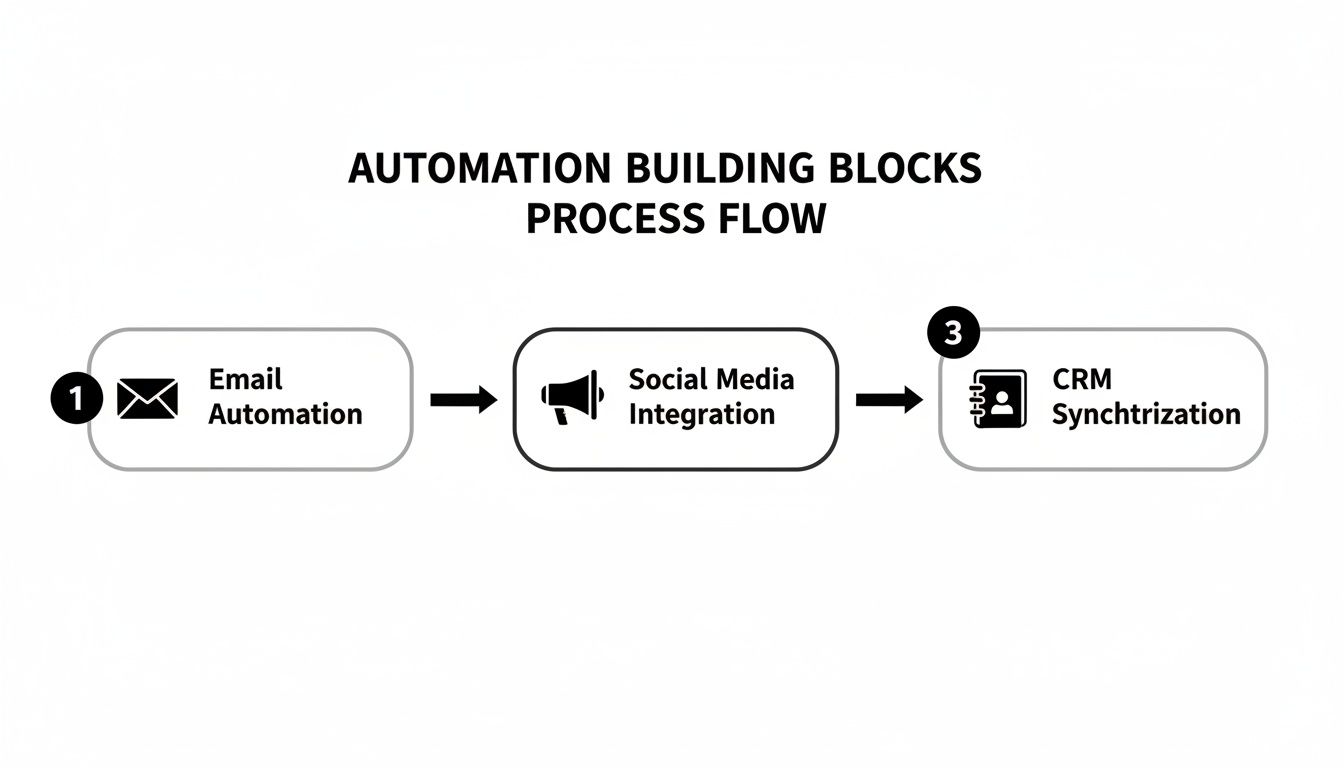
When you connect these systems, you create a powerful engine that personalizes the customer experience and drives growth while you focus on other things.
The Abandoned Cart Saver
For any ecommerce shop, the abandoned cart is the lowest-hanging fruit on the tree. Someone liked an item enough to add it to their cart, but for whatever reason, they didn't finish the checkout. This workflow is your digital safety net, designed to gently pull them back and recover that lost sale.
And it works. The data is pretty clear on this one: abandoned cart automations have an impressive **10.5% conversion rate**. That means you can win back roughly one out of every ten customers who were about to walk away. This single workflow can have an immediate, direct impact on your revenue.
Here’s the step-by-step playbook:
1. **The Trigger:** A shopper adds an item to their cart but leaves your site without buying.
2. **Wait (1 Hour):** Don't jump on them immediately. Give them a little space to come back on their own.
3. **Email #1 (The Gentle Nudge):** Send a simple, helpful email. A subject line like "Did you forget something?" or "Your items are waiting for you" works perfectly. The goal isn't a hard sell; it's a friendly reminder that you've saved their cart.
4. **Wait (23 Hours):** Let a day pass. Give them time to think it over.
5. **Email #2 (The Scarcity Angle):** Now, you can introduce a little urgency. Try a subject like "Your cart is about to expire" or "Don't miss out!" You could mention that popular items might sell out. This is often enough to get them to act.
6. **Wait (2 Days):** If they still haven't bought, it's time for one last effort.
7. **Email #3 (The Irresistible Offer):** This is where you pull out the incentive. Offer a small, time-sensitive discount like "**10% off your order, just for you!**" or free shipping. This final nudge is often what seals the deal for shoppers on the fence.
This sequence is effective because it matches the customer's mindset, offering timely and increasingly persuasive reasons to complete their purchase without being pushy.
The New Customer Welcome Journey
The moments right after someone makes their first purchase are golden. They just put their trust (and their money) in your hands. This is your chance to turn that one-time transaction into a long-term relationship. A welcome journey uses automation to bring new customers into the fold, build loyalty, and pave the way for future sales.
> This workflow is about so much more than a simple "thank you." It’s your opportunity to prove they made the right choice, squash any buyer's remorse, and show them how to get the most out of what they just bought.
This journey is absolutely essential. Automated workflows like a post-purchase series can generate up to **30 times more revenue** per recipient than a standard promotional email. Why? Because they deliver super relevant content when a customer is most engaged with your brand. You can read the full research about marketing automation's revenue impact on martal.ca.
Here’s how to build your welcome journey:
* **The Trigger:** A customer completes their very first purchase.
* **Message #1 (Instant):** Send an immediate order confirmation that feels more personal than a standard receipt. Thank them warmly and set clear expectations for when their order will ship.
* **Wait (3 Days):** Give them a little breathing room.
* **Message #2 (Value Add):** Send something that helps them enjoy their purchase even more. If they bought a coffee machine, maybe send a guide to brewing the perfect espresso. If it was software, share a quick "pro tip" video.
* **Wait (7 Days):** By now, they've likely received their item.
* **Message #3 (The Social Proof Request):** Gently ask for a review. Don't just ask for a favor; frame it as a way to help other customers make smart decisions. Make it dead simple by including a direct link to the product page.
* **Wait (14 Days):** Give them a couple of weeks to really experience your product and brand.
* **Message #4 (The Next Step):** Now is a great time to introduce them to related products or invite them to join your loyalty program or social media community. This is how you transition them from a one-time buyer to a true member of your brand's world.
Each step in this journey reinforces their decision to buy from you and deepens their connection with your business—all running on autopilot once you set it up. Platforms like SynthAI are fantastic for this, offering pre-built templates that make building and managing these workflows quick and painless.
Choosing Your Small Business Automation Toolkit
Picking the right marketing automation tools can feel like a major fork in the road. One path leads to a single, do-it-all solution, while the other involves mixing and matching specialized tools for each job. This isn't a small decision—the right toolkit should feel like a natural extension of your team, while the wrong one will just create headaches and slow you down.
There are really two main philosophies when it comes to building your **automated marketing for small business** tech stack. Let's walk through both so you can confidently pick the approach that fits your goals, budget, and how comfortable you are with technology.
The All-in-One Platform Approach
Think of this as the Swiss Army Knife of marketing. An all-in-one platform bundles everything you need—email marketing, a CRM, social media scheduling, analytics—into one tidy package. The whole idea is built around simplicity.
For most small businesses dipping their toes into automation, this is a huge draw. You get one login, one monthly bill, and one consistent interface to learn. The biggest win is that everything just *works* together right out of the box, so you don't have to play tech support trying to connect a bunch of different apps.
Of course, there's usually a trade-off. While these platforms are good at a lot of things, they might not be the absolute best at every single one. A dedicated, top-tier email tool, for example, might have more advanced A/B testing features than the email module inside an all-in-one suite.
The Best-of-Breed Approach
Now, picture a master carpenter's workshop. Instead of one multi-tool, you have the perfect instrument for every task: the best hammer, the best saw, the best drill. This is the "best-of-breed" strategy, where you hand-pick individual, specialized apps and stitch them together.
You might choose one tool for its amazing email deliverability, another for its deep social media analytics, and a third for its incredibly powerful CRM. This gives you ultimate control and flexibility, letting you build a custom stack that’s perfectly suited to your specific needs.
The main hurdle here is getting everything to talk to each other. You'll need to make sure all these separate tools can share data, often by using a third-party connector like Zapier. This can add a layer of complexity (and cost), making it a better fit for more tech-savvy teams or businesses with very particular demands.
> **The Key Takeaway:** The question isn't which approach is "better"—it's which is **better for you**. An all-in-one platform is about ease of use and unity. A best-of-breed stack is about peak performance and total customization.
Comparing Your Options Head-to-Head
To help you see the differences more clearly, let's put these two approaches side-by-side. This should help you weigh the pros and cons based on what really matters for your business right now.
Automation Stack Comparison: All-in-One vs. Best-of-Breed
Here’s a head-to-head comparison to help you decide which tool strategy is the right fit.
| Factor | All-in-One Platform (e.g., SynthAI) | Best-of-Breed (Multiple Tools) |
| :--- | :--- | :--- |
| **Ease of Use** | **High.** A single interface and pre-built integrations make it beginner-friendly. | **Moderate to Low.** Requires managing multiple platforms and setting up connections. |
| **Setup Time** | **Fast.** You can often get up and running in a single afternoon. | **Slow.** Involves researching, subscribing to, and integrating several different tools. |
| **Cost** | **Predictable.** Usually a single monthly or annual subscription fee. | **Variable.** Costs can add up with multiple subscriptions and connector fees. |
| **Functionality** | **Broad.** Covers a wide range of marketing needs well. | **Deep.** Offers best-in-class features for each specific function. |
| **Scalability** | **Good.** Platforms like SynthAI are built to grow with you from startup to enterprise. | **Excellent.** You can swap out tools as your needs evolve without changing your entire system. |
| **Support** | **Centralized.** One support team to contact for any issues. | **Fragmented.** You'll need to deal with multiple support teams for different tools. |
When it comes down to it, most small businesses find that an all-in-one platform strikes the perfect balance of power, simplicity, and cost. It removes the technical roadblocks, letting you focus your energy on your marketing strategy and growing the business from day one.
How to Measure Your Automation Success
Getting your first automated workflow live is a fantastic milestone, but it’s really just the starting line. The real power of **automated marketing for small business** isn't about 'set it and forget it.' It's about 'set it, measure it, and make it better.' To know if your efforts are actually working, you have to look beyond the obvious numbers and zero in on the metrics that directly affect your bottom line.
This means you’ve got to stop obsessing over vanity metrics like email open rates or the number of likes on a social post. Sure, they might signal some level of engagement, but they don't tell you if your automation is putting money in the bank. The goal is to draw a straight line from your marketing activities to actual business growth.
Key Metrics That Truly Matter
To get a real sense of how you're doing, you need to track metrics that show changes in customer behavior and your bank account. These numbers tell the story of how your automation is guiding people through their entire journey with you, from that very first click to becoming a loyal fan.
Here are the three areas where you should focus your attention:
* **Conversion Rate:** This is your MVP metric. It’s simply the percentage of people who do what you want them to do after seeing your automated campaign—whether that’s buying a product, booking a demo, or downloading a guide. When this number goes up, you know your message is hitting the mark.
* **Customer Lifetime Value (CLV):** This number predicts how much a single customer is worth to your business over time. Smart automation, like a killer welcome series or a thoughtful follow-up email, builds relationships and keeps people coming back. This directly bumps up your CLV.
* **Marketing-Attributed Revenue:** This is the ultimate proof. It answers the question, "How much money did this specific automation campaign make?" For example, you can see exactly how many sales came directly from your abandoned cart email sequence.
We’re seeing a massive shift toward AI-powered operations across the board. In fact, **79% of marketers** are now automating some part of their customer journey. For small teams, this is a game-changer, since an estimated **85% of marketing tasks** can now be handled by AI. The payoff is huge: **60%** of marketers see higher engagement and **58%** report better customer loyalty, which means more frequent purchases and a higher CLV. You can discover more insights about marketing automation's impact on emailvendorselection.com.
Calculating Your Automation ROI
Beyond tracking individual metrics, you need the big picture: your return on investment (ROI). Calculating ROI helps you justify the expense of tools like SynthAI and make smarter decisions about where to put your budget.
> The formula is simple: (Revenue Gained from Automation - Cost of Automation) / Cost of Automation. Multiply that result by 100 to get your ROI as a percentage.
Let's say your automated workflows brought in **$5,000** in sales last month, and your software cost you **$500**. Your ROI would be a whopping **900%**.
Watching these numbers closely lets you double down on what’s working, ditch what isn’t, and constantly sharpen your strategy. This data-driven habit is what turns your automation from a handy tool into a predictable engine for growth.
Your Quick-Start Automation Checklist
Feeling ready to dive in? Good. Let's channel that energy into action. This isn't just theory; this is a practical roadmap to get your first automation up and running. Think of this as your launch guide to start getting real results for your business.

Phase 1: Define Your Foundation
Before you even think about software, you need a clear strategy. A solid foundation is what separates a focused, effective automation from a confusing mess.
1. **Pinpoint Your Primary Goal:** What's the **#1** thing you need to fix or improve? "More sales" is too vague. Get specific. Are you trying to win back abandoned carts, turn new leads into paying customers, or get existing clients to buy again? Pick one.
2. **Sketch Your Customer Journey:** Grab a whiteboard or even just a piece of paper and map out how a customer interacts with you. Trace their steps from their first website visit to their purchase and beyond. This simple visual map will instantly show you the best places to automate.
3. **Choose Your First Workflow:** Please, don't try to automate everything at once. You'll burn out. Start with one high-impact workflow that offers a clear, immediate return. The "Abandoned Cart Saver" or a "New Customer Welcome Journey" are fantastic starting points.
> The most successful automation strategies start small. Pick one pain point, solve it brilliantly with a simple workflow, measure the results, and then expand.
Phase 2: Select and Implement Your Tools
Okay, with a solid plan, it's time to pick your tools and plug everything in. Simplicity is key here.
* **Select Your Platform:** For most small businesses, an all-in-one platform like SynthAI is the quickest path forward. It bundles your email, CRM, and workflow builders into one system, which means you avoid the major headache of trying to sync a bunch of different tools.
* **Connect Your Data Sources:** This is where you integrate the tools you already use. Typically, this means connecting your e-commerce store (like Shopify), your email marketing service, and your social media accounts. This is what allows the platform to "see" what customers are doing and trigger your automations.
Phase 3: Launch and Measure
This is the fun part—flipping the switch and watching it work.
1. **Build Your Workflow:** Hop into your platform's visual builder and create the sequence you mapped out earlier. Write your emails, set the timing delays between them, and define what action will kick things off.
2. **Activate and Monitor:** Go live! For the first couple of days, just keep an eye on your dashboard. Are emails going out? Are people clicking the links? Make sure the plumbing is working correctly.
3. **Review Key Metrics:** After about a week, dig into the numbers. What's your conversion rate? How much actual revenue did this workflow bring in? Use that data to make small tweaks and keep making it better over time.
Got Questions About Automation? Let's Clear Things Up.
Thinking about bringing automation into your business? It's smart to have questions. Most small business owners wonder about the same things before they jump in. Let's tackle the big ones head-on so you can feel confident about your next steps.
These are the real-world concerns we hear all the time, and the answers are probably more straightforward than you think.
Isn't Marketing Automation Crazy Expensive?
This is probably the biggest myth out there. Ten years ago, maybe. But today? Not at all. While giant corporations use systems that cost a fortune, the market is now full of powerful tools designed specifically for small businesses. You'll find that many all-in-one platforms have entry-level plans that cost less than patching together a few separate tools.
The best way to look at it is as an investment, not an expense.
> A simple abandoned cart automation can recover an average of **10.5%** of sales you would have otherwise lost completely. When you see numbers like that, the right software starts paying for itself almost immediately. The goal is always a positive return, and modern tools make that very achievable.
How Long Does This Actually Take to Set Up?
Getting your first automation up and running is faster than you might imagine. Modern platforms like SynthAI are built with busy entrepreneurs in mind, offering pre-built templates and drag-and-drop editors. You absolutely do not need to be a developer to make this work.
Most of the initial setup, like connecting your Shopify store or your email list, is a matter of a few clicks. Honestly, you could launch a high-impact workflow—like a welcome series for new subscribers—in a single afternoon. The trick is to start simple and focus on one goal first.
Will This Make My Brand Feel Like a Robot?
It’s a fair question, but here’s the twist: good automation does the exact opposite. It allows you to create *more* personal, timely experiences at a scale that would be impossible for any human to manage alone. It's not about blasting everyone with the same generic message. It’s about using what you know about a customer to send the right thing at the right time.
For example, you could automatically:
* Send a unique birthday discount to a loyal customer.
* Recommend a product based on what they just viewed on your site.
* Follow up a week after a purchase with a helpful "how-to" guide.
These aren't robotic interactions; they make customers feel recognized and valued. Automation simply handles the "when" and "who," freeing you up to focus on crafting the great content that builds real relationships. It doesn't replace the human touch—it scales it.
---
Ready to stop manually managing every task and start growing your business? The **SynthAI** platform gives you a team of AI assistants to run your marketing, sales, and support, 24/7. Start your free 7-day trial and launch your first workflow in minutes.
Ready to Transform Your Business with AI?
Build your AI team and start automating your marketing today.