10 Actionable Best Practices for Email Marketing Campaigns in 2026
SynthAI Team
Content Team
Email marketing remains one of the highest ROI channels for e-commerce and growth-focused teams, but the playbook for success has fundamentally shifted. Generic blasts and one-size-fits-all tactics no longer resonate in a landscape of crowded inboxes and sophisticated customer expectations. Achieving meaningful engagement and driving revenue in 2026 requires a more strategic, data-driven approach that weaves personalization, automation, and relentless optimization into every campaign.
This roundup goes beyond the foundational advice to deliver a prioritized list of the most impactful best practices for email marketing campaigns. We will provide actionable frameworks, detailed checklists, and specific implementation notes you can use immediately to refine your strategy. This guide is designed for teams looking to move from basic sending to building a powerful, conversion-focused email program.
You will learn how to master advanced segmentation, design compelling automation flows, ensure top-tier deliverability, and measure what truly matters. We will also explore how to integrate these practices into your existing workflows, including how AI assistants like SynthAI's Lumen can streamline execution and amplify your team's efficiency. Consider this your definitive checklist for building an email marketing engine that not only converts but also fosters lasting customer loyalty and drives sustainable growth. We will cover everything from mobile-first design principles to data synchronization across your entire tech stack, giving you the tools to compete and win.
1. Segmentation and Personalization
Among the most effective best practices for email marketing campaigns is the shift from generic, one-size-fits-all broadcasts to highly targeted, personalized communication. Segmentation is the process of dividing your email list into smaller, more manageable groups based on specific criteria. Personalization then involves tailoring your email content, from subject lines to product recommendations, to resonate with the unique characteristics and needs of each segment. This strategic approach ensures your messages are not just seen, but are genuinely relevant and valuable to the recipient.
The impact is significant: segmented and personalized campaigns consistently outperform generic ones, driving higher open rates, click-through rates, and ultimately, more revenue. By speaking directly to a customer's known interests, purchase history, or stage in their journey, you transform your emails from simple advertisements into helpful, timely conversations. This builds brand loyalty and increases customer lifetime value.
Actionable Implementation Steps
To effectively integrate segmentation and personalization, start with a focused approach and expand over time. Over-complicating from the outset can lead to analysis paralysis.
- Start with Foundational Segments: Don't try to create dozens of segments at once. Begin with 3-5 high-impact groups. For an e-commerce store, this could be:
- New Subscribers: Haven't made a purchase yet.
- First-Time Buyers: Made one purchase.
- Repeat Customers: Made two or more purchases.
- Lapsed Customers: Haven't purchased in the last 90 days.
- Leverage Behavioral Triggers: Set up dynamic segments that automatically update based on user actions. A classic example is an abandoned cart segment, which targets users who added items to their cart but didn't complete the purchase. Other powerful triggers include browsing specific product categories or viewing a particular page multiple times.
- Utilize RFM Analysis: Implement Recency, Frequency, and Monetary (RFM) analysis to identify your most valuable customers. This model scores customers based on how recently they purchased, how often they purchase, and how much they spend. You can then create a "VIP" segment for your highest-scoring customers and send them exclusive offers, early access to new products, or loyalty rewards.
- Personalize Content at Scale: Use merge tags to insert dynamic content like the recipient's first name. Go deeper by personalizing product recommendations based on past purchases or browsing history, a tactic perfected by industry leaders like Amazon.
> Pro Tip: For teams looking to scale these efforts, SynthAI's Lumen assistant can streamline the process. It uses AI to automatically analyze customer data, identify optimal segments, and generate personalized copy and product recommendations, saving your team valuable time while maximizing campaign effectiveness.
2. Mobile-Optimized Email Design
With over half of all emails now being opened on mobile devices, a mobile-first approach is no longer optional; it's a fundamental component of the best practices for email marketing campaigns. Mobile-optimized email design ensures your templates are not just viewable but are fully functional and engaging on smaller screens. This involves using responsive layouts that automatically adapt, implementing large touch-friendly buttons, selecting readable fonts, and compressing images so they load quickly on cellular networks.
Failing to optimize for mobile can be catastrophic for engagement. A pinched, unreadable, or slow-loading email is an email that gets deleted instantly, damaging sender reputation and wasting marketing spend. Conversely, a seamless mobile experience, like those provided by Shopify or Airbnb, builds user confidence and dramatically increases the likelihood of a click-through or conversion. It respects the user's context and makes it easy for them to act, whether they are on a commute or waiting in line.
Actionable Implementation Steps
To ensure your emails perform flawlessly on every device, integrate mobile-first principles directly into your design and testing workflow. Start with a solid foundation and consistently test your output.
- Build on a Responsive Foundation: Design your emails with a single-column layout, ideally at a maximum width of 600px. This structure scales down cleanly on mobile devices without breaking or forcing horizontal scrolling. Ensure font sizes are at least 16px for body copy to guarantee readability without zooming.
- Prioritize Above-the-Fold Content: Place your most critical information, including the primary call-to-action (CTA), within the first 300-400 pixels of vertical space. This ensures the core message is visible immediately when a user opens the email on their phone, capturing their attention before they decide to scroll or delete.
- Make CTAs Touch-Friendly: Design buttons to be a minimum of 44x44 pixels. This size accommodates fingertip taps, preventing user frustration and accidental clicks on nearby links. Use ample white space around your buttons to make them stand out and easy to press.
- Test Relentlessly Before Sending: Never assume your email will render correctly. Use services like Litmus or Email on Acid to preview your campaign across dozens of different email clients and devices (including iPhones and Androids in both light and dark mode). Always include descriptive alt text for images, as many mobile clients block them by default.
> Pro Tip: For teams needing to guarantee mobile-readiness without the manual overhead, SynthAI's Lumen assistant can be invaluable. It automatically generates email templates that are built mobile-first from the ground up, ensuring a perfect rendering experience for every subscriber, on every device.
3. Compelling Subject Lines and Preview Text
In a crowded inbox, the subject line and preview text are your first and often only chance to make an impression. Mastering this element is one of the most critical best practices for email marketing campaigns because it directly determines whether your email gets opened or ignored. A compelling subject line creates curiosity or communicates a clear value proposition, while the preview text acts as a secondary hook to provide more context and entice the reader to click.
This powerful combination serves as the gateway to your entire message. No matter how valuable your offer or well-crafted your email body is, it's irrelevant if the subscriber never opens it. Brands that excel at this, like Grammarly with its hyper-personalized data ("You had 847 writing errors this year") or Everlane with its direct value ("We're dropping prices by 40%"), see dramatically higher engagement and conversion rates.
Actionable Implementation Steps
To craft subject lines and preview text that consistently drive opens, focus on clarity, relevance, and a touch of creativity. It's a blend of art and science that can be systematically improved.
- Prioritize Clarity and Brevity: Keep subject lines under 50 characters to ensure they are fully visible on mobile devices, where most emails are opened. Front-load the most important words and clearly state the email's value or purpose. Avoid vague phrases that leave the reader guessing.
- Use Preview Text Strategically: The preview text should extend the subject line, not repeat it. Use this space to add a secondary benefit, create urgency, or ask a compelling question. If you don't set it, email clients will pull the first line of text, which often looks unprofessional (e.g., "View this email in your browser").
- Test Emotional and Psychological Triggers: Experiment with different angles to see what resonates with your audience. Test subject lines that evoke:
- Curiosity: "This is not another marketing email."
- Urgency/FOMO: "[Action Required] Your first order is ready to ship."
- Social Proof: "See what thousands of customers are buying."
- Personalization: "We found 2,847 places in Bali matching your preferences."
- Avoid Spam Filter Traps: Be cautious with spam trigger words like "free," "act now," or "limited time," especially when used with excessive punctuation or capitalization. These can hurt your deliverability. Use them only when the offer is genuine and contextually appropriate.
> Pro Tip: Manually brainstorming and A/B testing dozens of subject line variations is time-consuming. SynthAI's Lumen assistant automates this process by generating multiple high-potential subject lines based on your email's content and audience data, then helps you set up tests to identify the top performers, boosting your open rates with minimal effort.
4. Send-Time Optimization and Continuous Testing
Beyond what you send, when you send it is a critical factor that can make or break your campaign’s success. One of the most impactful best practices for email marketing campaigns involves combining Send-Time Optimization (STO) with a rigorous, continuous testing framework. STO uses data to determine the ideal day and time to send emails for maximum engagement, while A/B testing provides empirical evidence on what resonates most with your audience, from subject lines to calls-to-action.
This two-pronged strategy moves your email marketing from guesswork to a data-driven science. By systematically testing variables and timing your sends based on recipient behavior, you ensure your messages land in the inbox at the moment they are most likely to be opened and acted upon. This leads directly to higher open rates, increased click-throughs, and improved conversion metrics, validating every campaign change with statistical confidence.
Actionable Implementation Steps
To implement a powerful optimization and testing engine, begin with broad hypotheses and narrow your focus as you gather data. Consistency and clear documentation are key to long-term improvement.
- Establish Baseline and Test Major Variables First: Before testing, document your current baseline metrics (open rate, CTR, conversion rate). Start by testing high-impact elements like the subject line, as even small wins here can significantly lift performance. For example, test a question-based subject line ("Ready for a better night's sleep?") against a benefit-driven one ("Our new sheets guarantee better sleep.").
- Systematically Test Send Times: Begin with broad day and time tests. For a B2B audience, you might test Tuesday at 10 AM vs. Thursday at 2 PM. For e-commerce, test a weekend morning against a weekday evening. Use your email platform’s time-zone sending feature to ensure your message arrives at the same local time for all recipients.
- Run Statistically Significant Tests: To ensure your results are reliable, test only one variable at a time (e.g., subject line A vs. subject line B, not two different subject lines and two different send times). Send each variation to a randomized sample size large enough to yield a statistically significant result, typically with a 95% confidence level.
- Create a Testing Hypothesis and Library: For every test, formulate a clear hypothesis: "I believe that using a benefit-focused subject line will increase the open rate by 15% because it more clearly communicates value to the user." Document all results, including wins, losses, and inconclusive outcomes, in a shared testing library to inform future campaigns and build institutional knowledge.
> Pro Tip: Manually tracking all this data can be overwhelming. SynthAI's Vantage analytics platform automates the process by tracking email metrics, analyzing send-time performance across segments, and providing clear recommendations for optimization, allowing your team to focus on strategy rather than data wrangling.
5. Clear Call-to-Action (CTA) Strategy
One of the most critical best practices for email marketing campaigns involves crafting a clear and compelling call-to-action (CTA). Your CTA is the navigational beacon of your email, guiding subscribers from passive reading to active engagement. It's the button or link that tells the recipient exactly what to do next, whether that’s making a purchase, downloading a resource, or signing up for a webinar. A weak or ambiguous CTA can render an otherwise brilliant email completely ineffective.
An effective CTA strategy eliminates friction and decision fatigue. By presenting a single, focused action with persuasive copy and standout design, you make it easy for subscribers to convert. This directness increases click-through rates and drives users to the desired destination, turning email opens into tangible business outcomes. From Amazon's "Buy Now" to Slack's "Get Started Free," the most successful campaigns use CTAs that are impossible to misunderstand and easy to act upon.
Actionable Implementation Steps
To build a high-converting CTA strategy, focus on clarity, visibility, and value. The goal is to make the desired action the most obvious and appealing option in the email.
- Design for Visibility and Contrast: Your primary CTA should be a button, not just hyperlinked text. Use a color that contrasts sharply with your email's background to make it pop. Action-oriented colors like orange, green, and red often perform well, as they naturally draw the eye.
- Use Action-Oriented Verb-First Copy: Start your CTA text with a strong command verb that tells the user exactly what they will do. Instead of "Learn More," try "Get Your Free Guide." Examples include:
- E-commerce: "Shop the Collection," "Claim Your 30% Off," "Complete Your Purchase"
- SaaS/Lead Gen: "Start Your Free Trial," "Download Now," "Join the Webinar"
- Maintain a Single Primary Goal: While you can include secondary, text-based CTAs, your email should have one clear, primary objective represented by the main button. Offering too many choices can lead to paralysis and lower overall clicks. Place this primary CTA strategically, often above the fold and again near the end of longer emails.
- Test and Optimize Relentlessly: Don't assume you know what works best. Continuously run A/B tests on your CTAs. Experiment with different button colors, copy (e.g., "Get My Discount" vs. "Shop Sale"), sizes, and placements to identify what resonates most with your audience and drives the highest engagement.
> Pro Tip: A powerful email CTA is only half the battle. SynthAI's Basis assistant helps ensure a cohesive conversion funnel by optimizing your landing pages to perfectly match the promise and design of your email CTAs, reducing user friction and maximizing conversion rates post-click.
6. Automated Email Sequences and Workflows
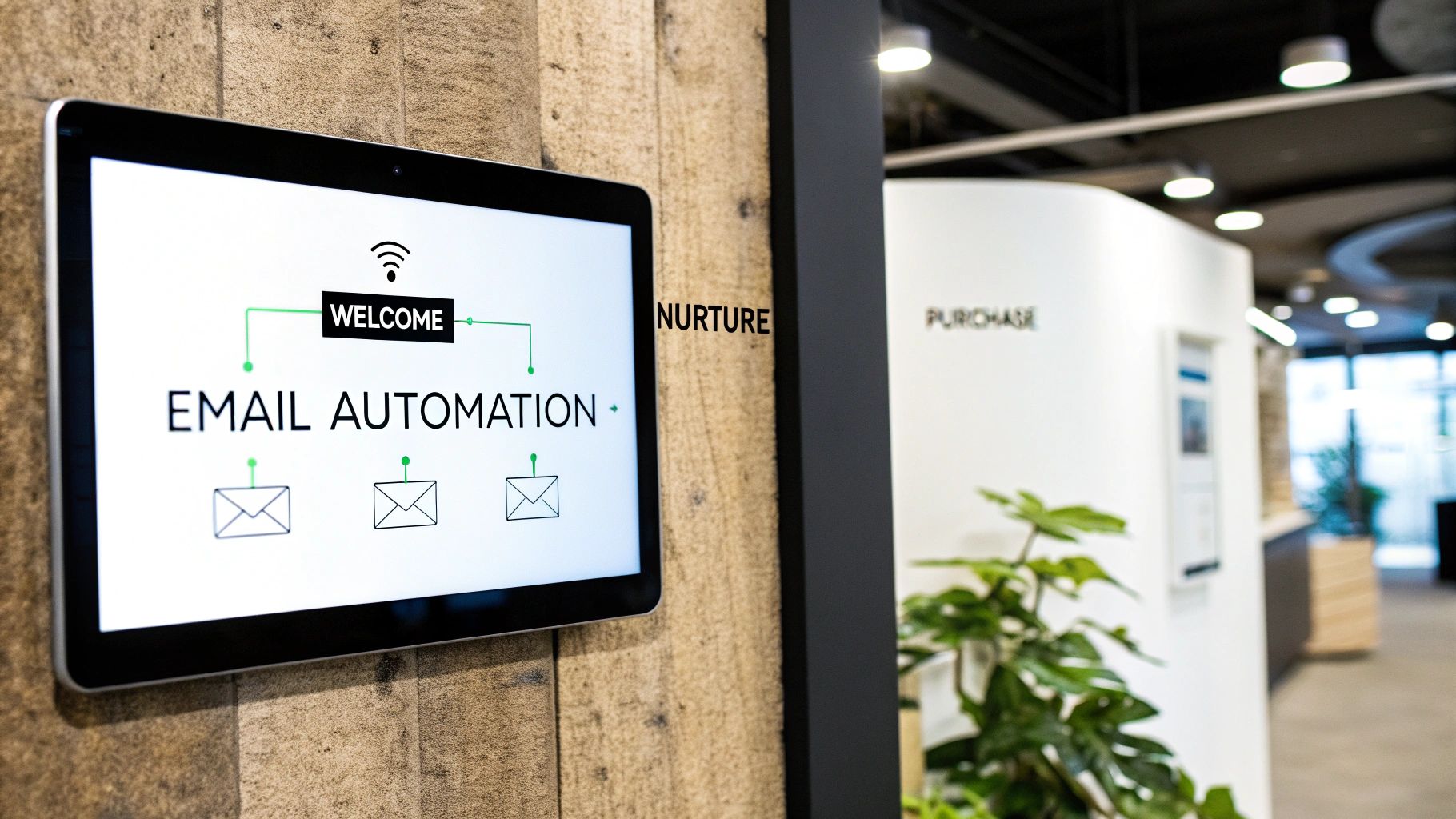
One of the most powerful best practices for email marketing campaigns is implementing automated sequences. Automation involves creating a pre-planned series of emails that are automatically sent to subscribers based on specific triggers, timelines, or behaviors. This strategy moves beyond single-email blasts to create ongoing, timely conversations that nurture leads, onboard new customers, and recover lost sales without constant manual effort. By delivering the right message at the right moment, you build a scalable system for engagement and conversion.
The key benefit is delivering hyper-relevant content at crucial points in the customer journey. A welcome series can introduce your brand to a new subscriber, an abandoned cart sequence can recapture potential revenue, and a post-purchase workflow can build loyalty and encourage repeat business. This level of responsiveness is impossible to manage manually at scale, making automation essential for modern growth teams.
Actionable Implementation Steps
To build effective automated workflows, map out key customer journey touchpoints and build sequences that address the specific needs of subscribers at each stage.
- Implement Foundational E-commerce Flows: Start with the highest-impact sequences for an online store:
- Welcome Series: Triggered by a new subscription. A common flow is Email 1: Welcome and discount offer, Email 2: Brand story, Email 3: Social proof and bestsellers.
- Abandoned Cart Series: Triggered when a user adds to cart but doesn't buy. A typical cadence is 1 hour later (reminder), 24 hours later (address objections), and 48 hours later (final offer).
- Post-Purchase Series: Triggered by an order. This includes transactional emails (confirmation, shipping) followed by a request for a review and then cross-sells of related products.
- Use Conditional Logic: Make your automations smarter by adding conditional splits. For example, in a welcome series, if a subscriber clicks on a specific product category, you can send them a follow-up email with more content related to that category. If they don't click, send a different angle to re-engage them.
- Monitor Sequence-Specific Metrics: Pay close attention to the performance of each automated flow. High unsubscribe rates within a specific sequence often signal that the messaging is misaligned with subscriber expectations at that stage. Test and optimize each email in the sequence individually to improve overall performance.
- Build a Re-Engagement Campaign: Create a workflow to automatically identify and win back inactive subscribers. A simple sequence could be Email 1: "We miss you" with a poll, Email 2: A compelling special offer, and Email 3: A final chance to stay subscribed before being removed from the active list.
> Pro Tip: Building complex workflows can be time-consuming. SynthAI's Lumen assistant accelerates this by allowing you to describe a desired sequence in natural language. It then automatically generates the complete multi-step email flow, including personalized copy for each stage, turning a days-long project into a matter of minutes.
7. Compliance, Permissions, and Deliverability
Often overlooked in the rush to design beautiful campaigns, a rigorous focus on compliance and deliverability forms the foundation of all successful email programs. These are non-negotiable best practices for email marketing campaigns that protect your brand legally and ensure your meticulously crafted messages actually reach their intended audience. This involves adhering to regulations like GDPR and CAN-SPAM, respecting user permissions, and implementing the technical standards required for strong inbox placement.
Getting this right prevents costly legal fines, protects your sender reputation, and directly impacts your campaign performance. An email that lands in the spam folder is an email that was never sent. By prioritizing a clean, permission-based list and proper authentication, you signal to inbox providers like Gmail and Yahoo that you are a legitimate, trustworthy sender, maximizing your chances of reaching the primary inbox.
Actionable Implementation Steps
To build a compliant and high-performing email program, integrate these technical and procedural checks into your core workflow. A proactive approach is always better than a reactive one.
- Adhere to Legal Requirements: Your emails must follow the law in your recipients' locations.
- CAN-SPAM (U.S.): Always include your physical business address and a clear, functional unsubscribe link in every promotional email.
- GDPR (EU): Obtain explicit, provable consent before emailing contacts in the European Union. Never use pre-checked boxes for consent.
- CASL (Canada): Secure implied or express consent and clearly identify yourself in all commercial electronic messages.
- Implement Domain Authentication: This is a critical technical step to prove your emails are legitimate. Configure these three DNS records for your sending domain:
- SPF (Sender Policy Framework): Lists authorized servers allowed to send email on your behalf.
- DKIM (DomainKeys Identified Mail): Adds a digital signature to your emails, verifying they weren't altered in transit.
- DMARC (Domain-based Message Authentication, Reporting & Conformance): Tells receiving servers what to do with emails that fail SPF or DKIM checks.
- Practice Proactive List Hygiene: A clean list is an engaged list. Regularly remove unengaged subscribers, as low engagement rates hurt your sender reputation. Implement a quarterly re-engagement campaign to win back inactive users, and remove those who don't respond.
- Monitor Key Deliverability Metrics: Keep a close eye on your bounce rates. Remove hard bounces (invalid email addresses) immediately after a campaign. Use tools like Google Postmaster Tools to monitor your domain reputation, spam rates, and authentication status.
> Pro Tip: Managing the technical complexities of authentication and compliance can be a major hurdle. SynthAI's platform simplifies this by handling the setup of SPF, DKIM, and DMARC automatically. Furthermore, our system is built with SOC 2 compliance, ensuring your customer data is managed with the highest security standards.
8. Value-First Content and Avoiding Over-Promotion
One of the most crucial best practices for email marketing campaigns is prioritizing the delivery of genuine value over constant sales pitches. This value-first approach involves balancing promotional emails with content that educates, entertains, or solves a problem for your audience. Instead of treating your email list as a sales channel, you cultivate it as a community by providing helpful resources, building trust, and establishing your brand as an authority in your niche.
This strategy fundamentally changes the subscriber relationship. When subscribers know your emails offer tangible benefits beyond discounts, they are more likely to open them, engage with them, and stay subscribed. Brands like Morning Brew have built empires on this model, where the primary offering is valuable content (business news), with monetization woven in subtly. This approach leads to higher engagement rates, lower unsubscribe rates, and a more loyal customer base that is more receptive when you do present an offer.
Actionable Implementation Steps
Shifting to a value-first model requires a content-centric mindset. It's about giving more than you ask for, with the understanding that this generosity builds a stronger long-term asset.
- Implement the 80/20 Rule: Plan your content calendar so that approximately 80% of your emails provide pure value and only 20% are directly promotional. For every four value-driven emails (how-to guides, industry insights, customer stories), you earn the right to send one sales-focused email.
- Teach and Inform: Create content that teaches your subscribers a skill or provides actionable tips related to your products or industry. A skincare brand, for example, could send a guide on building a morning routine, while a SaaS company could share productivity hacks.
- Leverage User-Generated Content and Case Studies: Share customer stories, testimonials, and detailed case studies. This provides immense value by offering social proof and real-world examples, while also subtly highlighting the benefits of your product without a hard sell.
- Survey Your Audience: Don't guess what your subscribers find valuable. Ask them directly. Run a simple survey asking about their biggest challenges, what topics they want to learn more about, and their preferred content formats. Use this data to fuel your content calendar.
> Pro Tip: Generating a consistent stream of high-value content can be demanding. SynthAI's Echo assistant can analyze top-performing social media trends and discussions in your niche to generate fresh blog topics and educational content ideas. This ensures your value-driven emails are always relevant and engaging.
9. List Building and Organic Growth Strategies
A core component of any list of best practices for email marketing campaigns is the focus on systematic, organic list growth. Rather than purchasing lists or using aggressive, non-consensual tactics, this strategy prioritizes attracting genuinely interested subscribers through value-driven incentives. A smaller, highly engaged list built organically will consistently outperform a massive, unengaged one in terms of deliverability, open rates, revenue, and sender reputation.
The principle is simple: provide tangible value in exchange for an email address. This ensures that new subscribers have a clear interest in your brand, content, or products from the very beginning. Whether it's a discount, a valuable piece of content, or exclusive access, this ethical approach builds a foundation of trust and results in a subscriber base that is more likely to convert and remain loyal over time.
Actionable Implementation Steps
To build a high-quality email list, focus on creating compelling offers and making the signup process as seamless as possible. Combine strategic placement with clear value propositions.
- Create High-Value Lead Magnets: Offer something specific and valuable that your target audience truly wants. Instead of a generic "sign up for our newsletter," provide a tangible asset.
- E-commerce: A 10-15% discount on the first purchase.
- SaaS: A free trial, a helpful checklist, or a "first to know" list for new features.
- Publishers: An exclusive guide, a free template, or early access to articles.
- Optimize Signup Form Placement: Make it easy for visitors to subscribe without being intrusive. Place highly visible signup forms in key locations like the website footer, within relevant blog posts, and on the order confirmation page to capture post-purchase subscribers.
- Use Intelligent Pop-Ups: Implement exit-intent pop-ups to present a final, compelling offer to visitors who are about to leave your site. This is a last-chance opportunity to convert a visitor into a subscriber.
- Implement a Double Opt-In: Require subscribers to confirm their email address after signing up. This practice verifies genuine interest, improves list hygiene by filtering out invalid addresses, and strengthens your sender reputation with email service providers.
> Pro Tip: Accelerate your list growth by using SynthAI's Basis to create high-converting landing pages for your lead magnets and Aura to run targeted ad campaigns that drive qualified traffic directly to these signup pages. This integrated approach streamlines the entire lead generation funnel, from initial ad click to new subscriber confirmation.
10. Integration and Data Synchronization with Sales and Operations
One of the most powerful yet often overlooked best practices for email marketing campaigns is creating a connected ecosystem where data flows seamlessly between your email platform and other core business systems. Integration and data synchronization eliminate information silos, ensuring that your marketing efforts are based on a complete and up-to-date view of the customer. This involves connecting your email marketing tool with your CRM, e-commerce platform, and operational software to create a unified data foundation.
This strategy transforms your email marketing from a standalone channel into an integrated part of the entire customer lifecycle. When your Shopify store data automatically syncs with your email platform, an abandoned cart email can be triggered in real-time with pinpoint accuracy. Similarly, when sales activities in your CRM are visible to the marketing team, you can suppress promotional emails to leads actively engaged in a sales conversation. This coordination prevents disjointed customer experiences and maximizes the impact of every touchpoint.
Actionable Implementation Steps
To build a robust and synchronized data environment, start with your most critical systems and expand methodically. A well-planned integration strategy prevents data conflicts and ensures reliability.
- Establish a Core Connection: Begin by integrating your email marketing platform with your primary system of record, which is typically your CRM (like HubSpot or Salesforce) or your e-commerce platform (like Shopify or BigCommerce). This initial link provides the most critical data for segmentation, such as purchase history and customer contact information.
- Implement Bi-Directional Syncing: Whenever possible, set up a two-way sync to ensure data remains fresh across all platforms. For example, if a customer updates their contact information through an email preference center, that change should automatically reflect in your CRM, and vice-versa. This prevents targeting customers with outdated or incorrect information.
- Utilize Real-Time Triggers: Leverage webhooks and native integrations to act on customer behavior instantly. Instead of relying on nightly batch syncs, a webhook can trigger an onboarding sequence the moment a new user signs up for a SaaS trial or send a "thank you" email immediately after a purchase is completed on your website.
- Schedule Regular Data Audits: Data synchronization can fail. Schedule monthly or quarterly audits to identify and resolve any sync errors, duplicates, or data corruption issues. Document your integration setup and create a clear protocol for troubleshooting common problems to ensure long-term data integrity.
> Pro Tip: Managing multiple integrations can become complex. SynthAI's Axis specializes in this operational orchestration, connecting over 50 platforms like Shopify, HubSpot, Stripe, and Google Ads. It can automate the flow of data, ensuring your marketing campaigns are always powered by real-time, accurate customer insights without manual intervention.
Top 10 Email Marketing Best-Practices Comparison
| Practice | Implementation complexity 🔄 | Resource requirements 💡 | Expected outcomes ⭐📊 | Ideal use cases | Key advantages ⚡ |
|---|---|---|---|---|---|
| Segmentation and Personalization | High — complex segment logic & maintenance 🔄 | High — CRM, analytics, automation, data ops 💡 | ⭐⭐⭐ — higher open/click/conversion; measurable revenue uplift 📊 | E‑commerce, SaaS, high‑volume lists needing personalization | Tailored relevance → higher AOV & lower unsubscribes ⚡ |
| Mobile-Optimized Email Design | Medium — responsive templates + client testing 🔄 | Medium — design/dev, testing tools, device QA 💡 | ⭐⭐ — fewer deletes, ↑ CTR (15–30%) on mobile 📊 | Consumer brands, app-driven products, mobile-first audiences | Better UX on mobile → higher engagement and retention ⚡ |
| Compelling Subject Lines & Preview Text | Low–Medium — copy testing & iteration 🔄 | Low — copywriters, A/B testing tools 💡 | ⭐⭐ — significant open rate gains (26–50% with testing) 📊 | All campaign types where open rate matters (newsletters, promos) | Fast, low‑cost lift in opens; immediate measurable impact ⚡ |
| Send-Time Optimization & Continuous Testing | High — ML, statistical testing, multi-cycle analysis 🔄 | High — historical data, analytics platform, large send volume 💡 | ⭐⭐ — +10–20% opens; improved conversions over time 📊 | High‑volume & global senders, B2B/B2C with varied timezones | Data‑driven timing → incremental compounding gains ⚡ |
| Clear Call-to-Action (CTA) Strategy | Low — design + copy alignment 🔄 | Low — designer, copy, landing page alignment 💡 | ⭐⭐ — large CTR improvements (single CTA +371%) 📊 | Conversion‑focused campaigns, e‑commerce, lead gen | Removes friction → higher click→conversion rates ⚡ |
| Automated Email Sequences & Workflows | Medium–High — triggers, conditional logic, sequencing 🔄 | Medium — automation platform, content, integration 💡 | ⭐⭐⭐ — steady revenue (welcome/abandon/cart); time savings 📊 | Onboarding, cart recovery, lifecycle nurturing | Scales personalized journeys and drives repeat revenue ⚡ |
| Compliance, Permissions & Deliverability | Medium — legal + technical enforcement 🔄 | Medium–High — compliance, auth (SPF/DKIM/DMARC), list hygiene 💡 | ⭐⭐ — improved inbox placement; reduces legal risk 📊 | All senders, essential for EU audiences and large volumes | Protects deliverability and legal standing; maintains reputation ⚡ |
| Value‑First Content & Avoiding Over‑Promotion | Medium — content strategy & production cadence 🔄 | Medium — writers, editorial calendar, repurposing tools 💡 | ⭐⭐ — lower unsubscribes, stronger long‑term engagement 📊 | Brand building, newsletters, audience retention strategies | Builds trust and long‑term LTV; sustainable engagement ⚡ |
| List Building & Organic Growth Strategies | Medium — landing pages, incentives, optimization 🔄 | Medium — landing pages, lead magnets, ads/tools 💡 | ⭐⭐ — higher quality subscribers; better LTV than purchased lists 📊 | New brands, organic growth plans, publishers | Sustainable, high‑engagement list growth (better deliverability) ⚡ |
| Integration & Data Synchronization with Sales & Ops | High — APIs, mapping, ongoing maintenance 🔄 | High — devs, integration platform, governance, security 💡 | ⭐⭐ — accurate targeting, attribution, operational efficiency 📊 | Enterprises, multi‑system businesses, omnichannel teams | Real‑time data sync → coordinated experiences & better attribution ⚡ |
From Best Practices to Automated Excellence
You now have a comprehensive blueprint for transforming your email program from a simple broadcast tool into a powerful engine for growth and customer loyalty. We’ve explored the essential pillars, from the foundational importance of hyper-specific segmentation and mobile-first design to the strategic nuances of automated workflows and value-driven content. Mastering these elements is no longer a competitive advantage; it’s a baseline requirement for standing out in a crowded inbox.
The true challenge, however, isn't understanding these concepts. It's executing them consistently and at scale. The difference between a good and an exceptional email marketing program lies in the relentless dedication to optimization, testing, and personalization. This is where many teams, especially in fast-growing e-commerce and SaaS environments, hit a resource ceiling.
The Key Takeaways: From Checklist to Culture
To truly integrate these best practices for email marketing campaigns into your operations, shift your thinking from a one-time checklist to a continuous improvement cycle. Here are the most critical principles to internalize:
- Audience First, Always: Every tactic discussed, from segmentation to content, is rooted in a deep understanding of your audience. Your subscribers are not just entries in a database; they are individuals with unique needs and preferences. Your primary goal is to serve them with relevance and respect.
- Automation is Your Scalpel, Not a Sledgehammer: Effective automation isn't about blasting messages indiscriminately. It's about delivering the right message to the right person at the precise moment of intent. Use automated welcome series, cart abandonment flows, and re-engagement campaigns to build relationships, not just to sell products.
- Testing is Non-Negotiable: Assumptions are the enemy of growth. A/B testing isn't an occasional task; it should be an ingrained habit. Continuously test your subject lines, CTAs, send times, and content formats to gather data that replaces guesswork with proven results. This iterative process is the engine of sustainable improvement.
- Deliverability is Earned, Not Given: Your sender reputation is one of your most valuable marketing assets. Adhering to compliance standards like GDPR and CAN-SPAM, maintaining a clean list, and monitoring engagement metrics are crucial for ensuring your carefully crafted messages actually reach the inbox.
Your Actionable Path Forward
Translating this knowledge into action is the final, most important step. Don't try to implement everything at once. Instead, adopt a phased approach that builds momentum and delivers measurable wins.
1. Conduct a Comprehensive Audit: Use the practices outlined in this article as a scorecard. Where are your biggest gaps? Are you neglecting mobile optimization? Is your segmentation too broad? Identify the top three areas with the most significant potential for improvement.
2. Prioritize One Automation Flow: If you're new to automation, start with a high-impact workflow. For e-commerce, this is typically the abandoned cart sequence. For SaaS, it might be a user onboarding series. Perfecting one flow will provide valuable learnings you can apply to others.
3. Commit to a Testing Cadence: Schedule your first A/B test for next week. It could be as simple as testing two different subject lines for your weekly newsletter. The goal is to build the habit and operationalize the process of testing, learning, and iterating.
Mastering these best practices for email marketing campaigns is the foundation, but the future lies in leveraging technology to execute these strategies flawlessly and without manual friction. The next evolution isn't just about knowing what to do; it’s about empowering your team with tools that can automate the execution, turning your strategic checklist into a continuously optimized system.
Ready to move from manual execution to automated excellence? The AI assistants at SynthAI can implement these best practices for you, from building dynamic segments and writing personalized copy to managing A/B tests and optimizing automation flows 24/7. See how you can build a world-class email program without scaling your team by visiting SynthAI.
Ready to Transform Your Business with AI?
Build your AI team and start automating your marketing today.